Engagement and
Service
Criterion
5
Engagement and Service
As called for by its mission, the organization identifies its
constituencies and serves them in ways both value. |
Community engagement and service have become central to Calvin’s
mission, and appropriate and effective structures and programs exist
to maintain the college’s engagement with its various partners.
In keeping with its mission, the college has active partnerships with
agencies of its parent church and other religious groups, with institutions
in the Grand Rapids urban area, and with numerous national and international
organizations. While the Expanded Statement of the Mission of Calvin
College (ESM) focuses on the relationship between the college and
its sponsoring denomination, the Christian Reformed Church, Calvin has
dramatically expanded its partnerships outside the church and has become
more proactive in serving additional constituencies. Through a variety
of programs, the college identifies and creates platforms for collaborating
effectively with its partners.
Identifying Communities of Engagement: Partners in Learning
5a The organization learns from the constituencies it serves and
analyzes its capacity to serve their needs and expectations. |
Calvin College has in place an impressive variety of programs responding
to the needs of the constituencies it serves locally, nationally, and
internationally. Until recently, most of these programs were developed
in reaction to expressed needs or perceived opportunities, without much
centralized coordination or planning growing out of the college’s
institutional priorities. Initiatives were often begun through the personal
relationships of faculty or staff members with church members or professional
colleagues. In the decade since its last accreditation review, the college
has recognized that if the relationships and programs it has developed
are to be sustained, it needs to become more intentional about analyzing
its ongoing capacities and planning for engagement in a continuing and
systematic way.
Partners with Local, National, and International Networks
of Higher Education
Calvin participates in a variety of local, national, and international
networks of higher education, in accordance with its mission. These
relationships provide Calvin faculty and staff with opportunities to
serve and to lead, and they enable the college to take part in some
important higher education–initiated community service programs
as well.
Local Networks of Higher Education:
Calvin’s leadership in local networks of higher education can
be seen in several recent ventures.
In May 2004 the Calvin campus hosted a panel discussion on affirmative
action in higher education. It was organized and sponsored jointly by
President Byker and the presidents of Aquinas College, Cornerstone University,
Davenport University, Grand Rapids Community College, Grand Valley State
University, Reformed Bible College, Hope College, Ferris State University,
Western Michigan University, and Cooley Law School. Representatives
of a group that has proposed banning affirmative action in Michigan
through an amendment to the state constitution participated in a panel
discussion together with representatives from two groups opposed to
it to provide a balanced look at an issue that is critical for Michigan
colleges and universities.1
Another example: Calvin is a member of the Michigan Intercollegiate
Athletic Association, the nation’s oldest organized athletic conference.
Calvin’s president has been very active in the MIAA college presidents’
policy-making discussions. Calvin is especially vigilant in protecting
the “student” side of the student-athlete model that is
under constant pressure for athletic specialization and professionalization.
In national NCAA Division III programs, Calvin representatives have
played active roles as well. The NCAA recently awarded Calvin one of
its three-year Choices grants to implement and evaluate an effective
alcohol education program.2
On another front: since 1991 Calvin has been a part of the national
Campus Compact movement, a coalition of colleges and universities committed
to the civic purpose of higher education. Calvin’s participation
in this movement has resulted in three major ventures:
- A Campus Compact international partnership program in 1999 linked
eight American colleges and universities with partners in South Africa
for mutual learning about community service.3 Calvin, the
only Christian college among the eight, was linked with the University
of Transkei, a troubled institution created in a so-called homeland
during apartheid.
- Calvin also received a grant from MCI/WorldCom via Campus Compact
that supported faculty involvement in two Grand Rapids elementary
schools.4
- A third consequence of the college’s engagement with Campus
Compact is the forum it has provided at national meetings for Calvin
faculty to talk about faith perspectives in service-learning.5
Michigan Campus Compact, a loosely organized state chapter of the
national Campus Compact movement in which Calvin participates, encourages
colleges and universities to make servicelearning more salient in their
priorities and to establish “compacts” or partnerships for
learning and development with neighborhood organizations. This group
awarded Calvin business professor Steve VanderVeen one of its 2003 Faculty/Staff
Community Service-Learning Awards. VanderVeen’s work targeted
Grand Rapids’ Burton Heights neighborhood, where many new businesses
belong to Hispanic owners. Since 2000 he and students from his small-business
management and advanced marketing classes have helped owners with their
business and marketing plans. This project formed part of Calvin@Burton
Heights, Calvin’s many-pronged community engagement project funded
by a HUD Community Outreach Partnership Center (COPC) grant.6
Calvin has long-standing collaboration in Grand Rapids with health
care and research agencies. Recently, this partnership resulted in an
important joint venture on Calvin’s campus, a new facility for
the West Michigan Regional Laboratory (WMRL). WMRL is a research laboratory
for the medical education and research collaborative that involves Michigan
State University Medical School, Van Andel Research Institute, local
teaching hospitals, and several local universities, including Calvin.7 The Calvin nursing program also participates in a regional collaborative
to link teaching hospitals and local nursing education programs at Grand
Rapids Community College, Grand Valley State University, and Calvin,
Aquinas, and Hope colleges.8 The ties to Michigan State University
(MSU) and the Van Andel Research Institute have been particularly helpful
for faculty and student research, as seen in chapter five. These ties
will only become stronger, since MSU recently decided to relocate its
medical school to Grand Rapids.
Calvin belongs to several associations of colleges and universities
in the state of Michigan, one of the most venerable of which is the
Michigan Academy of Arts and Sciences, a century-old institution that
publishes a journal and holds an annual conference at one of its member
schools. Calvin hosted the meeting in 1998. Calvin is also a member
of the Association of the Independent Colleges and Universities of Michigan
(AICUM), an influential lobby in the state capital for private institutions
ranging from the University of Detroit Mercy to tiny Finlandia College
in the Upper Peninsula. President Byker is the current chair of the
organization and works closely with Edward Blews, its director. Calvin
is one of 11 members of the Michigan Colleges Foundation, a collaborative
effort aimed at raising funds for independent colleges. President Byker
serves on its executive committee. Calvin CIT staff members have planned
and led several workshops and conferences with this group, including
an initiative funded by the Ameritech Corporation to develop teaching
with technology.
Calvin is, in sum, emerging as a partner in a wide variety of local
and state initiatives. It actively engages on a variety of fronts in
and around the city of Grand Rapids. The college cultivates legislative
and philanthropic support for independent colleges and universities
statewide, and it shares its strengths with neighboring institutions.
National Networks of Higher Education:
Calvin College belongs to a variety of national organizations of higher
education, such as the American Council on Education, American Association
of Colleges and Universities, National Association of Independent Colleges
and Universities, Council of Independent Colleges (CIC), Council for
Christian Colleges and Universities (CCCU), and Lilly Network of Colleges
and Universities. Of these formal national ties, Calvin engages most
actively in three: CCCU, the Lilly Network, and CIC.
CCCU, an organization of 110 member institutions in North America
and some three dozen international affiliates, has looked to Calvin
for leadership. Calvin administrative staff members in the college’s
various divisions frequently give presentations on panels at national
CCCU meetings. Provost Joel Carpenter is a member of CCCU’s Faith,
Learning, Living Commission, is a senior fellow advising CCCU on international
relations, and serves as a peer reviewer for CCCU’s Initiative
Grants Program. Henry De Vries, vice president for administration, finance, and information services, serves on CCCU’s Information
Technology Commission. Shirley Hoogstra, vice president for student
life, has served as a mentor in the Leadership Development Institutes
for CCCU women and as a member of the Commission for Advancing Intercultural
Competencies. Tom McWhertor, vice president for enrollment and external
relations, chaired CCCU’s Commission of Chief Enrollment Officers for several years. The college hosted several CCCU conferences
in 2003-2004.9
Calvin faculty members have led two of the eight discipline-focused
CCCU summer seminars over the last five years (foreign language and
drama), have authored a majority of the books in the CCCU book series
on Christian perspectives in various academic fields, have led other
topical seminars and workshops, and were influential in the development
of several CCCU semester abroad programs, notably in Costa Rica and
China. Because of Calvin’s capable Seminars in Christian Scholarship
program, the college has been made the site host for two additional
CCCU disciplinary summer seminars (history and political science).
CIC membership consists mainly of smaller, church-related colleges.
The CIC president personally invited Calvin to rejoin in 1999 after
Calvin had let its membership lapse because of a perceived mismatch
in institutional size and scope between Calvin and most CIC institutions.
Since then Calvin has played a leadership role in the organization in
a number of ways. The Calvin provost has twice presented papers at annual
CIC meetings for chief academic officers, once on the development of
campus information services and once on Calvin’s science education
program. Calvin has participated in two of the CIC’s most salient
recent programs. It was one of six CIC colleges to receive a grant from
the U.S. Department of Education’s Fund for the Improvement of
Post-Secondary Education (FIPSE) for community partnership building,
and it won a Heuer Award for excellence in science education for its
NSF-funded programs with the Grand Rapids Public Schools.10
Calvin has given strong input in the cluster of programs in the Lilly
Network aimed at church-related colleges and universities that want
to continue to address the relationship of faith to higher education.
Calvin faculty and staff members are regular participants in Lilly Network
meetings and conferences, and the college has sponsored two conferences
and a summer seminar for the network. Calvin’s 125th anniversary
conference, “Christian Scholarship … For What?” (September
2001) was part of an informal series aimed particularly at the institutions
of the Lilly Network, which includes Protestant, Catholic, and evangelical
schools.11
One of the more dramatic ways in which Calvin has engaged the larger
world of higher education over the past decade has been through its
Seminars in Christian Scholarship. This program seeks to “promote
a strong Christian voice in the academy by addressing issues of current
debate within various disciplines” from a Christian perspective
and to produce “first-order scholarship.” It began by means
of a $1 million grant from the Pew Charitable Trusts in December 1994
to fund a series of extended, multi-week summer seminars that would
pair a senior scholar in a field of inquiry with a group of a dozen
participants for the purpose of encouraging their research and publication
in that field. Since the summer of 1996, when the program began, it
has grown and flourished, and its support base has diversified, with
funding also coming from the Fieldstead Institute, Lilly Endowment,
Templeton Foundation, Luce Foundation, and a variety of co-sponsors,
such as the Council for Christian Colleges and Universities and the
Lilly Network, for a total of more than $4 million in total support.
Since its inception the Seminars in Christian Scholarship Program has
produced more than 30 multi-week research seminars and hosted more than
500 participants. It has also planned, promoted, and produced 23 academic
conferences. Eleven collaborative, seminar-produced books have been
published or are in press at publishers such as Cornell, Indiana, and
Oxford university presses. Particpants of the seminars have gone on
to publish 29 books of their own, with another 11 forthcoming, and 63
articles, with another 26 in press.12
Calvin also played a role in the formation of the Association of Reformed
Institutions in Higher Education (ARIHE), an informal consortium of
eight North American colleges and universities in the Reformed tradition
for the purposes of cooperating in faculty development and graduate
education programs. The organization started in 1993 as ARUNA, the Association
for a Reformed University in North America. It is informally organized,
with no legally registered status, but it functions as a semi-annual
gathering of presidents and academic vice presidents representing eight
Reformed colleges: Calvin, Covenant College, Dordt College, Geneva College,
the Institute for Christian Studies in Toronto, King’s University
College, Redeemer University College, and Trinity Christian College.
Emeritus Calvin officers—former provost Gordon Van Harn and former
academic dean Frank Roberts—have served successive terms as the
organization’s administrative coordinators. The initial dream
of collaborating to form a Reformed university has not been abandoned,
but of late the group has focused on more modest, immediate projects,
such as the cooperative offering of graduate education courses at the
M.Ed. level. The aims of this project are to develop master teachers
for K-12 settings and to address the critical shortage of qualified
principals and superintendents in the Reformed Christian network of
day schools. Calvin education professor Clarence Joldersma was one of
three scholars chosen to initiate the ARIHE lecturer program, which
is designed to stimulate discussion of Reformed approaches to faith
and learning issues on ARIHE campuses.13
At Calvin there is also a chapter of the American Association of University
Professors (AAUP) organized by a number of faculty members. Calvin’s
involvement was pioneered by economics professor George Monsma, a longtime
individual member, and by two new faculty members who had been leaders
at prior institutions—Helen Sterk (communication arts and sciences)
and Daniel Bays (history)—and who both came to Calvin initially
as holders of the Spoelhof Chair. Many Calvin faculty members and administrators
were uneasy about this move because the AAUP has defined academic freedom
in such a way that universities with religious commitments and requirements
are suspect. The AAUP also has acted much like a labor union in recent
years, with options for campus chapters to become collective bargaining
agencies for professors. Yet the Calvin professors’ AAUP chapter
has focused on the national organization’s historic interests
in campus governance and the nature of the professoriate. The Calvin
chapter has functioned in an interesting way. It has advised the administration
and Faculty Senate on matters of governance, such as the development
of a faculty code of conduct. It provided an opportunity for Calvin
to present its remarkable model of shared governance at the state AAUP
meeting. And it has allowed Calvin faculty the opportunity, at AAUP
national meetings and in the AAUP national magazine, to argue for the
positive role that religious universities can play in promoting academic
freedom. 14
International Networks of Higher Education:
Calvin has long-standing relationships with international networks
of higher education, especially those that share its vision of Christian
higher education in the Reformed tradition. An early example of this
was Calvin’s institutional membership in the International Association
for the Promotion of Christian Higher Education (IAPCHE), formed in
1975 as a network of Dutch-originated, neo-Calvinist institutions and
individual scholars in North America, Africa, Europe, and East Asia.
The purpose of the association has been to develop a community of Christian
scholars and academic institutions, working together to promote Christian
higher education worldwide. The organization has grown to include 450
individual and 34 institutional members. It holds occasional conferences
and produces a newsletter, Contact. Calvin helps provide leadership
(economics professor George Monsma is currently on the IAPCHE board)
as the organization struggles to translate its original Dutch neo-Calvinism
into terms understandable and attractive to its new African, Asian,
Latin American, and Eastern European clients. It is one of the few agencies
in the world that assists the rapidly growing evangelical universities
in the global South and East.15
In the process of expanding its international off-campus programs
and providing service to new Christian universities seeking resources
on the integration of faith and learning, Calvin has developed a variety
of bilateral agreements and partnerships with foreign universities,
including Hoogeschool Zeeland (Netherlands), Russian-American Christian
University (Moscow), Peoples Friendship University (Moscow), Károli
Gáspár Reformed University (Budapest), National Pedagogical
University (Tegucigalpa), Beijing Institute of Technology in China,
University of Ghana, Oak Hill College (London), Regional State University
in Denia (Spain), University of Grenoble (France), Handong Global University
(South Korea), and Daystar University (Kenya). Some of these agreements
are contractual, involving the hosting and servicing of Calvin’s
off-campus semester programs, but in several instances (Károli
Gáspár, Handong, and Daystar) they also provide for exchanges
of students. Another university partnership, with Birzeit University
in Palestine, involves Calvin’s archaeology minor.16
Calvin also has an ongoing involvement with several Christian universities
in South Korea (Handong, Kosin, Cheonan, Seoul Women’s, Chongshin,
and Sogang) for faculty development, with particular focus on issues
of faith and learning. Professors from each of these institutions have
participated in a year-long visiting scholars program at Calvin. This
program was formalized in 2001, built on earlier informal arrangements.
Calvin officials and faculty members have participated in several seminars
and workshops in South Korea.17
More broadly, the Provost’s Office has fielded numerous communications
and hosted many visits regarding the start-up of new Christian universities
elsewhere in the world, and the provost and deans have provided advice
and counsel. Recent inquiries and contacts have come from higher education
personnel in Ethiopia, Indonesia, Haiti, Costa Rica, Congo, Burundi,
and Malawi.18
Over the past decade Calvin has developed a more robust outreach to
international students (beyond Canadians), who numbered 91 (2.4 percent)
in 1994 and grew to 197 (4.5 percent) in 2003.19 The most
dynamic group of these students has been the Africans, with the delegations
from Ghana and Nigeria being the largest. Calvin also has many Korean
students, especially the children of Korean expatriates who are serving
as missionaries elsewhere in the world. In addition, Calvin has developed
and maintained ties to Christian secondary schools in India, Indonesia,
the Philippines, Hong Kong, and China, all of which continue to send
students to Calvin.
Table 6.1 Largest Populations of International
Students by Country, 2003
| Country |
By Residence |
By Citizenship |
| South Korea |
19 |
45 |
| Nigeria |
20 |
23 |
| Ghana |
15 |
19 |
| India |
14 |
12 |
| Hong Kong |
11 |
6 |
Partners with the Church
As an institution of higher learning whose mission lies
squarely within the Reformed tradition of historic Christianity, Calvin
provides significant educational leadership to its parent denomination,
the Christian Reformed Church (CRC), as well as to the broader Christian
church, especially among American Protestant denominations.
The Christian Reformed Church (CRC)
As stated in chapter two, Calvin has a formal relationship
with its parent denomination, the CRC. Beyond this formal relationship,
there are many points of contact and concrete partnerships between the
college and the church. Beyond the lively personal connections to the
CRC afforded by half its students and most of its faculty, there are
programmatic engagements with denominational agencies that make the
CRC one of the college’s most important external partners in community
engagement.
Students take advantage of service-learning opportunities
with ministries and agencies of the CRC as well as other Christian agencies.
Several of Calvin’s off-campus programs operate in close cooperation
with church agencies:
- The two semester programs in Honduras are coordinated by Kurt VerBeek,
who is a consultant with the Christian Reformed World Relief Committee
(CRWRC) and other development agencies.
- The Semester in China Program shares on-site director Kurt Selles
with Christian Reformed World Missions (CRWM).
- The Semester in New Mexico Program is operated in cooperation with
the CRC and with Rehoboth Christian School near Gallup.
- Many Calvin off-campus January Interim courses make use of the
international workers and partners of the CRC.
Beyond off-campus programs, several other Calvin programs
are built upon partnerships with the CRC:
- The college recently began an internship program with the CRWRC
that provides students with a semester of field experience for credit
in the college’s minor in third-world development studies.
- Pathways to Possibilities (P2P), a pre-college academic program
administered jointly by Calvin College and a network of congregations
in West Michigan, New Mexico, and Southern California, includes several
Christian Reformed churches.
- The Bridge Program in Sun Valley, California, serves as an educational
enhancement initiative for college-bound minority students in partnership
with a Christian Reformed congregation.
- Collaboration exists with Partners for Christian Development (PCD),
a CRC-related mission support group, by means of conferences for Reformed
Christians in business seeking to understand their vocations and also
connect to the needs of third-world Christians in business. Calvin
co-sponsored PCD conferences in 1997, 1999, and 2004.
- The annual Calvin Lectureship is planned and implemented in conjunction
with CRC Campus Ministries.
Some of these programs and initiatives continue longtime connections,
but others are new. What is new also is a fresh determination, written
into goals of last two strategic plans, to reconnect and form partnerships
with the CRC.20
The Larger Christian Church
Because a large percentage of Calvin’s students and recent graduates
are members of Protestant denominations other than the CRC, the community
of Protestant churches in North America and worldwide is a constituency
of growing importance to Calvin.21
The college maintains connections with these denominations and churches
through various means. One means is through the CRC: several denominations
in the Reformed tradition of Christianity routinely send representatives
to the synod of the CRC. The college has formal relations with other
denominations through its membership in numerous organizations of Christian
higher education. The college also has informal relationships with other
denominations through its faculty, administration, and staff, many of
whom serve on interdenominational committees and boards. The CRC has
been a member of the National Association of Evangelicals (NAE) since
1988, and the college has held a seat on NAE’s higher education
commission.
A major initiative undertaken by Calvin in cooperation with local
churches is the Pathways to Possibilities (P2P) program. Started in
January of 1997 with initial funding from the W. K. Kellogg Foundation,
P2P is now supported partly from the college budget and partly through
continued outside grants and corporate funding. P2P is a broad partnership
between Calvin and 16 churches in the Grand Rapids-Muskegon-Holland
triangle, administered by Calvin’s Office of Pre- College Programs.22
Calvin has participated with the Grand Rapids Area Council for Ecumenism
(GRACE) in several initiatives. Among the most important of these are
the GRACE-sponsored Institutes for Healing Racism. These are of two
kinds: eight-week Faith-Based Institutes for Healing Racism and two-day
Community Institutes for Healing Racism. The Calvin Anti-Racism Team
(CART) has referred staff and faculty to the GRACE-sponsored trainings,
and the Student Life Division is working to bring an eight-week session
to campus. Calvin has also hosted the GRACE Summit on Racism four times,
including, most recently, in the spring of 2004. The Summit on Racism
grew out of an initiative of GRACE’s Racial Justice Institute,
which sponsored the first summit in 1999. Due to the overwhelming community
response—it drew several hundred participants—the event
has been held annually since then. The summit continues to attract a
diverse group of people who come together each year to learn and share
ideas but, most importantly, to create a plan of action to combat racism
in Grand Rapids.23
Calvin participated for a number of years in the Inter-Religious Dialogue
Association, and the college now has a growing participation in the
West Shore Committee for Jewish-Christian Dialogue, as a sponsor and
host of its annual meetings.24 Calvin faculty members were
heavily involved in bringing the Dead Sea Scrolls Exhibition to Grand
Rapids’ Van Andel Museum Center. The college was a co-sponsor
of the exhibit, and Grand Rapids was the only American city to host
it in 2003.25
Calvin’s commitment to education at all levels from a Christian
perspective drives its engagement with the Reformed Christian day school
movement. The Kuyers Institute for Christian Teaching and Learning,
a newly endowed initiative, is a study center of pedagogy from a Reformed
Christian perspective.26 Calvin is involved in the annual
Christian Educators Association conference that meets in the upper Midwest.
Ten to 12 Calvin faculty members typically make presentations at this
conference for K-12 teachers. Calvin provides facilities and resources
for the Christian Schools International Educators Leadership Development
Institute (CSI-LDI), an annual, week-long symposium aimed at developing
leadership skills and vocational interest for those considering a future
in Christian schools administration.
Perhaps the most far-reaching of all of Calvin’s engagements
with broader religious realms comes via the Calvin Institute of Christian
Worship (CICW), founded in 1997. With major funding from the Lilly Endowment,
CICW runs conferences and workshops, awards grants, and publishes resources
on worship for churches. It quickly established a broadly ecumenical
national reputation for serving churches in this critical area of change
and debate. The annual Calvin Symposium on Worship and the Arts brings
about 1,500 church leaders to the college campus for leadership training
in all aspects of worship, worship planning, teaching, and preaching.
The majority of those served are not members of the CRC, but a large
number are, including about 150 ministers of the CRC—more than
the number who attend the annual synod of the church.27
Civic Partners in Grand Rapids and the West Michigan Region
Calvin faculty and staff have long been engaged in the civic life
of Grand Rapids, responding to opportunities to serve on an individual
basis. The overlapping composition of some of Calvin’s main communities
of engagement means that a good bit of this involvement comes through
the colleges and churches just noted. But Calvin’s engagement
in the greater Grand Rapids area is far broader even than these. A study
in 1998 showed that Calvin faculty and staff were serving on the boards
of about 120 volunteer organizations, ranging from the Baxter Community
Center to the Grand Rapids Symphony Orchestra.28
Calvin’s reputation once was that of an inwardly focused community
that did not have much to do with civic life, but this has changed considerably
in the past decade. A year after President Byker’s arrival, an
article in the Grand Rapids Press noted a broadening of community
involvement at the college through an expansion of programs and increased
areas for student and faculty service.29 This article was
indeed newsworthy because ten years ago Calvin had some work to do in
presenting a friendlier, more open public face in the Grand Rapids community
and in communicating a more obvious interest in engagement. A new agenda
began with subtle but significant modifications in the college’s
spatial presence. The campus always has been open, not gated. People
can walk and drive through it without passing checkpoints or the like,
via entrances from three of the city’s major thoroughfares. Even
so, many visitors found it difficult to find their way because of
a dearth of signs and maps on campus. Improved signage and inviting
landscaping at building entrances helped signal the college’s
efforts to be more accessible to the general public.
Another subtle change concerned attitudes toward the use of campus
facilities. Elimination of the college-sponsored Sunday morning worship
service on campus (1995) came with an invitation to area churches to
welcome students into their fellowships. The vast majority of students
travel to these churches by carpool, but 21 local congregations offer
transportation to students by request, and nine local churches from
a variety of denominations—Assemblies of God, Baptist, Evangelical
Covenant, Lutheran, Reformed, Christian Reformed, Roman Catholic, and
non-denominational—send vans or buses to campus to pick up students.
Woodlawn CRC, a congregation independent of college control, continues
to use the campus chapel and welcome students to its services. A contemporary
worship service (called LOFT, “Living Our Faith Together”)
is organized by students on campus for Sunday evenings.
The Hekman Library is raising its profile as a community research
facility. It includes the finest theological library in the region,
which local pastors are welcome to use. Likewise, the more general collection
makes Calvin’s library the largest research library in the Grand
Rapids area, with stacks open to the public. It provides more sources
for inter-library loans than it receives. In contrast to librarians
at many other colleges, Calvin librarians actively create and publish
databases— five of them, with a total of more than 95,000 records—providing
a wealth of material for theological researchers, including local pastors.
Table 6.2 Research Databases Produced
by the Hekman Library
| Christian Reformed
Church Periodical Index (70,000 records) |
Articles from sixteen magazines
associated with the Christian Reformed Church are indexed. This
database is a repository of the history, sociology, and religious
life of the denomination. |
| Calvinism Resource Database (18,000 records) |
This database provides access to articles,
essays, and lectures dealing with John Calvin and Calvinism from
the sixteenth century to the present. All the indexed material resides
in the Meeter Center. The Calvinism Resource Database is jointly
maintained by the Hekman Library and the Meeter Center. |
| Hekman Library Sermon Index (1,400
records) |
This database contains citations to sermons
published or edited in books owned by the Hekman Library. |
| Cayvan Choral Music Database (3,000
records) |
This database indexes choral sheet music.
All the sheet music resides in the Hekman Library. |
| Hekman Digital Archive (4,000 records) |
The Hekman Digital Archive was created
to facilitate the development, acquisition, and distribution of
high-quality digital content for the benefit of academic scholarship
at Calvin College and Calvin Theological Seminary. |
More broadly significant for serving the larger public
are the many research databases the library offers to researchers across
the disciplines and professional fields. As recounted in chapter three,
building the Web-based platform for accessing these databases and the
college’s own collections was a major achievement with tremendous
capacity-building implications for serving visiting researchers. At
Calvin, library resource check-outs are much more frequent per student
enrolled than they are at comparable institutions. Even though one might
conclude that Calvin students and faculty use the library more than
their peers at comparable institutions, these circulation levels suggest
heavier use of the library by the surrounding community.30
The Community Comes to Calvin
The changes in the library are indicative of a not-so-subtle
increase in the number of public serving facilities and events on Calvin’s
campus. These are, by and large, events that are compatible with the
larger educative purposes of the college.
For Summer Camps
The college operates a variety of camps and educational
programs for area youth each summer. 31 Calvin faculty and
staff teach and administer these camps, usually in cooperation with
high school and/or middle school teachers and advanced Calvin students.
In 2004 these camps included the following:
- Academic Camps for Excellence. Three separate programs offer gifted
middle school and high school students opportunities to explore the
sciences, mathematics, literature and writing, markets and finance,
and economics and business.
- Calvin Chemistry Camps. These serve middle school students and
utilize hands-on chemistry experimentation.
- Wetlands and Woodlands Camps. These camps, which focus on environmental
awareness, are held at the Calvin Ecosystem Preserve.
- Sports Camps. These camps offer small-group instruction in soccer,
basketball, volleyball, swimming, baseball and softball, tennis, track
and field events, and basic sport and movement skills.
- Foreign Language Camps. Classes in French, German, Japanese, Korean,
Spanish, and Swahili were offered this year.
- Knollcrest Music Camp. These camps offer opportunities for children
to participate in concert band, orchestra, choir, musical theater,
and jazz band.
- Striving Toward Educational Possibilities (STEP). This three-day
program offers a simulated college experience for students in grades
7-10.
- Entrada Scholars Program. This is a four-week college experience
for a select group of ethnic minority students in grades 11 and 12.
Table 6.3 Number of K-12 Students
Participating in Summer Camps at Calvin College, Summer 2004
| Type of Camp |
# |
| Academic Camps for Excellence |
202 |
| Chemistry Camps |
93 |
| Wetlands and Woodlands Camps |
80 |
| Sports Camps |
1,312 |
| Foreign Language Camps |
40 |
| Knollcrest Music Camps |
375 |
| STEP |
113 |
| Entrada |
57 |
| Total |
2,272 |
Most Calvin-hosted summer camps are regularly evaluated using several
mechanisms, including evaluation forms filled out by campers and their
parents, as well as observation of and discussion among instructors.
These responses are used by the academic departments who plan and teach
the camps in feedback cycles that inform the content and pedagogy for
the following year’s camps. But enrollment figures continue to
be a basic evaluation instrument—low enrollments indicate lack
of interest among the targeted groups and force the cancellation of
camps, as happened in 2004, when two language camps were cancelled.
Throughout the first half of 2004 a cross-divisional review team studied
the summer camps and made recommendations to the President’s Cabinet
and the Planning and Priorities Committee for their improvement.32
For cultural events
With a large number of major cultural events each year on Calvin’s
campus, the college functions as an important regional intellectual
and artistic center.
- The January Series. This nationally recognized
lecture series, begun in 1987, takes place annually during the month
of January. In 2004 the 15-day series drew a total audience of over
13,000. Another 100-150 people watched each lecture on video feed
at the Holland Home, a local retirement facility, and 795 people visited
the Web site during live broadcasts. The January Series won the Silver
Bowl Award for the Best Campus Lecture Series in the United States
from the International Platform Association three times (most recently
in 1999) before the award was discontinued. 33
- Symposium on Worship and the Arts. This
annual symposium, described above, brings 1,500 people to Calvin’s
campus each January.
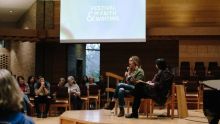
- Festival of Faith and Writing. The biennial
Festival of Faith and Writing attracts 1,700 registrants and internationally
known writers and speakers who work from a faith-infused perspective,
including Frederick Buechner, Joyce Carol Oates, John Updike, Elie
Wiesel, and others.
- The Artist Series. Begun in 2001, the
Artist Series offers the West Michigan community exceptional performances
by musicians from around the world. The events, held in Calvin’s
Fine Arts Center, are audience friendly, featuring musicians who chat
about their music and often conduct seminars and clinics with students
during the day of their performances.
- World Affairs Council of West Michigan.
In 2002 Calvin became the host of the Great Decisions Lecture Series,
a community event sponsored by the region’s World Affairs Council.
- Calvin hosted a nationally televised Republican Party
presidential debate during the 2000 primary season.
- The Calvin Film Forum at the new Bytwerk
Video Theater offers to students, alumni, and the Grand Rapids community
a popular series of lectures by visiting filmmakers and screenwriters,
as well as screenings and discussions of important films.
- The Center Art Gallery offers a variety
of exhibits each year, including themed presentations curated by Calvin
professors, the work of featured guest artists, and faculty and student
shows.
- The various institutes, programs, and study centers on campus frequently
offer public lectures. One of the most notable
is the annual Henry Lecture, sponsored by the Paul B. Henry Institute
for the Study of Christianity and Politics. This lecture features
noted public servants, such as U.S. Senators Paul Simon of Illinois
and Dan Coats of Indiana, who reflect on the role of Christian faith
in politics and government.
For years Calvin has offered its campus facilities for
conferences, workshops, and other special events. In response to rising
demand, in 2002 Calvin built the Prince Conference Center, which not
only meets the college’s convening and hosting needs but also
is used by a variety of non-profit and other organizations.34 Construction
of the Prince Conference Center, which represents a major investment
of physical plant, staff, and financial resources in service of external
agencies, has enhanced the college’s capacity to host large conferences
year round. During the summer numerous large conferences also continue
to use space in the residence halls and other campus facilities. Regular
annual visitors include the Central District Youth Conference of the
Missionary Church, which has sent 1,400 young people to Calvin each
June for 26 years. Three other annual conferences that draw more than
1,000 visitors include the West Michigan Conference of the United Methodist
Church, the Rotary Youth convention, and the convention of the Reformed
Presbyterian Church. A full listing below for the summer of 2004 shows
how busy the campus remains each summer as a community-serving host.
Table 6.4 Events Hosted on Calvin’s
Campus, Summer 2004
2004 Summer Conferences |
| Date |
Group |
Attendance |
May 28 - 30
June 1 - 5
June 2 - 6
June 7 - 15
June 9 - 12
June 10 - 13
June 12 - 19
June 16 - 18
June 19 - 22
June 20 - July 16
June 21 - July 30
June 23 - 27
June 28 - July 9
July 7 - 10
July 8 - 11
July 12 - 16
July 17 - 19
July 24 - 30
August 2 - 7
August 9 - 13
August 16 - 20 |
United Men
CCCU Conference
United Methodists
CRWM SMP Lodging
Red Cross
CRC Chaplains
Synod
S.T.E.P.
CDYC Jr. High
Entrada
Faculty Summer Seminars
CDYC Sr. High
Facing Your Future
Women’s Basketball Camp
Rotary Youth
Nike Swim Camp
Facing Your Future
Reformed Presbyterians
Calvin Summer Workshops in Media & Theatre
Knollcrest Music Camp, Jr.
Knollcrest Music Camp, Sr. |
250
65
1,000
30
250
150
440
150
600
60
50
800
40
100
1,100
100
40
1,200
75
225
150 |
| |
Total estimated
attendance |
6,875 |
For Lifelong Learning
One of the most popular attempts at community outreach and service
at Calvin has been the Calvin Academy for Lifelong Learning (CALL),
a membership-driven organization in which senior citizens enroll in
short-term (four- to six-week) courses for a nominal fee. CALL also
sponsors a noon lecture series and a film travel series that draws
over 600 season ticket holders and up to 200 guests for each program.
The purposes of CALL, founded in 1996, are to serve the members by
enriching their “lifelong spiritual, intellectual, cultural,
and social lives,” and to “create an abiding partnership
between Calvin College and senior citizens in greater Grand Rapids
who wish to share knowledge, talents, and experience.”35 In the spring of 2004 CALL’s membership exceeded 550. In 2001
CALL sent its leaders to participate in the first statewide conference
of the Institutes for Learning in Retirement, and it affiliates with
the Elderhostel Institute Network.
The college supports CALL through its offices of Alumni and Public
Relations and Lifelong Education. The college president serves as
the superintendent of the program and appoints two Calvin faculty
or staff members to the CALL board. The college provides the use of
classrooms and the auditorium in the Fine Arts Center, as well as
office space and technical support. Most courses are taught by current
and former Calvin faculty and staff members, and the coordinators
of the program are emeriti Calvin faculty and staff members. CALL
has demonstrated its gratitude to the college by establishing a scholarship
to support an older Calvin student.36
Calvin in the Community
Calvin’s programs of service and engagement in greater Grand
Rapids are many and varied. Last year more than 1,800 students and
100 faculty members participated in service activities sponsored by
the college’s Service-Learning Center, and many more served
the community in other ways. A few examples will serve to illustrate
this enormous body of work.37
One well-traveled route from Calvin into the community is through
local schools. Many academic departments at Calvin operate outreach
programs in area schools. For example, the Art Department has a liaison
program with Coit Arts Academy, giving faculty time to art students
in that urban neighborhood. The department also hosts an annual meeting
and workshop for area art educators. The Biology Department sponsors
a K-3 environmental education program that has a special focus on
urban school children. Calvin foreign language faculty members serve
as language consultants for community development programs in local
school districts. The college has a long history of close cooperation
with schools in the Christian Schools International system, an organization
of 450 Christian schools in the Reformed tradition not only in North
America but also on other continents, headquartered in Grand Rapids.
Numerous Calvin faculty and staff members have served on the board
of the Grand Rapids Christian School Association as well as the boards
of individual schools. Calvin also made land available virtually cost-free
for the Grand Rapids Christian Schools to develop the 36-acre Gainey
Athletic Facility on the college’s far eastern perimeter.
In addition to many outreach programs in the Christian schools, Calvin
is deeply involved in the public schools of Grand Rapids. Former Calvin
provost Gordon Van Harn served on the Grand Rapids Public Schools’
Board of Education (1997-2002). Between 2000 and 2004, Calvin sent
762 student teachers into area schools; the majority of the students
(437, or 57.3 percent) entered the public schools. The majority of
Calvin’s first-year teacher education internships are done
in the Grand Rapids Public Schools, and the majority of Calvin’s
teacher education graduate placements are in public, not private,
schools.38 Over half of the certified teachers graduating
from Calvin who are placed in teaching positions enter schools in
the state of Michigan. In 2002-2003 (the latest year for which data
are available), 70 of 126 graduates (55.5 percent) were placed in
non-public schools, as shown in the following table.
Table 6.5 Education Department Job
Placement Data, 2002-2003
| Certificate |
Number |
Placed |
Public |
Charter |
Non-Public |
| Elementary |
83 |
65 = 78% |
19 |
10 |
36 |
| Secondary |
74 |
49 = 66% |
14 |
03 |
32 |
| Special Education |
12 |
12 = 100% |
5 |
5 |
2 |
| Totals |
169 |
126 = 75% |
38 |
18 |
70 |
| |
|
|
|
|
|
| Type of School |
Michigan |
Other States |
Outside USA |
Total |
|
| Public |
13 |
22 |
1 |
36 |
|
| Non-Public |
3 |
22 |
12 |
72 |
|
| Charter |
16 |
2 |
0 |
18 |
|
| Totals |
67 = 53% |
46 = 37% |
13 = 10% |
126 |
|
In the preceding three years, almost half of Calvin’s
teacher placements (201 of 404, or 49.8 percent) were in public schools,
as the following table shows.
Table 6.6 Education Department Job
Placement Data, 1999-2002
| Certificate |
Number |
Placed
(%) |
Public
(%) |
Non-Public(%) |
| |
01-02 |
00-01 |
99-00 |
01-02 |
00-01 |
99-00 |
01-02 |
00-01 |
99-00 |
01-02 |
00-01 |
99-00 |
| Elementary |
76 |
N/A |
68 |
56 (74%) |
N/A |
65 (96%) |
35 (63%) |
N/A |
30 (46%) |
21 (37%) |
N/A |
35 (54%) |
| Secondary |
86 |
N/A |
79 |
65 (75%) |
N/A |
68 (86%) |
34 (53%) |
N/A |
30 (44%) |
31 (48%) |
N/A |
38 (56%) |
| Special Ed |
12 |
N/A |
17 |
11 (92%) |
N/A |
16 (94%) |
8 (73%) |
N/A |
12 (75%) |
3 (27%) |
N/A |
4 (25%) |
| Total |
174 |
154 |
164 |
132 (76%) |
126 (82%) |
149 (91%) |
77 (58%) |
52 (42%) |
72 (48%) |
55 (42%) |
71 (58%) |
77 (52%) |
For many other people in the Grand Rapids area, the way
they first encounter Calvin College is through music. For 70 years,
the Calvin Oratorio Society has annually given a Christmas presentation
of Handel’s Messiah in downtown venues as a “Christmas gift”
to the city. Each year, the Music Department offers three dozen on-campus
concerts featuring student ensembles and faculty recitals, all of which
are open to the public and free of charge. Calvin student groups and
faculty regularly perform in the Grand Rapids area and beyond.39
Some of these community engagements are long-standing
and “traditional”; others are new and grow out of the professional
or personal interests of individual faculty or staff members. For the
most part there is little overarching coordination of these initiatives.
For instance, no composite list exists of Calvin’s various academic
outreach programs in the local schools. Recognizing a potential problem
of miscommunication and duplication of efforts, Calvin began building
institutional structures in the late 1990s to achieve better coordination
of these efforts, in order to make them more responsive to community
needs, to enable better assessment and improvement, and to sustain them
for the future.
Calvin@BurtonHeights
One of the most important of Calvin’s recent efforts
in community engagement is the Community Outreach Partnership Center
in the Burton Heights neighborhood of Grand Rapids, about two miles
west of the college. The Burton Heights project, known as Calvin@BurtonHeights,
involves faculty, staff, and students from a wide range of departments
and offices of the college in collaborative community development work
that is connected to learning and service.40 The project
is funded by a three-year, $399,949 grant from the Office of University
Partnerships at the U.S. Department of Housing and Urban Development
( HUD). Calvin partners with several agencies in the project, including
the Garfield Development Corporation, Garfield Park Neighborhood Association,
Burton Heights Business Association, Grand Rapids Area Chamber of Commerce’s
Neighborhood Business Specialists Program, Buchanan Elementary School,
Burton Health Clinic, and Health Intervention Services. The project
has four main components, including business and housing,41 education,42 health,43 and community organizing.44 Through the HUD national program, communities benefit by utilizing
the significant and often untapped resources of colleges and universities,
and college faculty, staff, and students benefit by bringing real-world
application to academic study. The Calvin@BurtonHeights project has
been a catalyst to help the college focus its community engagement efforts
within a neighborhood using a strong local partnership model. Calvin@BurtonHeights
has served as a way to link a number of existing Calvin outreach programs,
including academic outreach programs in local schools, partnerships
developed in the teacher education program,45 service-learning
components of academic courses, and the like. It also has helped individual
programs solidify their commitments to a community-engagement approach
to education. Calvin’s neighborhood nursing program provides a
good case in point.
Calvin has had a nursing program since the 1930s; it
developed a BSN program in cooperation with Hope College in the early
1980s. In the fall of 2000 the two colleges determined that they were
now each able, both financially and in faculty qualifications, to
support independent programs, since it had become increasingly difficult to manage a joint nursing program between two colleges that are
40 miles apart in distance and have very different committee structures,
library and computer systems, and even academic calendars. Calvin’s
new nursing program was phased in over a three-year period beginning
in 2002. The first class graduated in May 2004. The department received
accreditation by the Commission on Collegiate Nursing Education (CCNE)
in the spring of 2004.
The nursing program was the first new academic program
developed after the implementation of the college’s new core curriculum.
Indeed, a desire to incorporate the aims and spirit of the new core
was another important factor in the Calvin nursing professors’
desire for a separate program. The goals of the community-focused nursing
curriculum grew naturally from the virtues emphasized in the core curriculum,
especially compassion and justice,46 and they fit well with
the aims of the Calvin@BurtonHeights program. As part of its new program,
the Nursing Department established partnerships with three underserved
neighborhoods in the central city: Creston, Baxter, and Burton Heights.
Active community organizations in each neighborhood now work with Calvin
to assess and meet their communities’ health care needs. Students
work in clinical placements in the three neighborhoods throughout all
four semesters of the program. The construction and ongoing refinement
of the program are driven by community residents’ responses to
surveys about their needs. Residents’ responses have been affirming;
the program shows that Calvin is interested in real partnerships that
meet the needs of the community.47
Back to top
A Valued Partner: Engaging Our Constituencies
5c The organization demonstrates its responsiveness
to those constituencies that depend on it for service.
5d Internal and external constituencies value
the services the organization provides.
|
True engagement requires this kind of responsive communication
and interaction with neighbors and partners, including shared committees
and boards of oversight; adequate opportunities for evaluation, collaborative
review, and assessment in the interests of furthering common goals and
commitments; and the creation and use of appropriate feedback mechanisms.
The tremendous growth of programs of community engagement
at Calvin has presented organizational challenges. Sustaining the excellent
initiatives that have begun, developing them into mature relationships,
and building them into the permanent planning, budgetary, and curricular
structures of the college depend on effective communication with community
partners and on clear coordination of the college’s efforts and
programs. Calvin’s most recent programs in Grand Rapids show how
to structure these community partnerships. A new position created at
the college—a director of community engagement—signals the
college’s desire to give its varied local efforts more coordination.
Engagement with the Church
There is regular and ongoing feedback about Calvin’s
partnerships with the Christian Reformed Church (CRC) and other Christian
churches and denominations, particularly those that also connect with
civic agencies and organizations in Grand Rapids.
The Christian Reformed Church
As described in chapter two, Calvin and the CRC are linked
at several levels. The CRC operates five agencies of ministry and two
educational institutions (Calvin College and Calvin Theological Seminary).
While the denominational Board of Trustees uses the term supervises
to define its governance of the agencies, it cooperates with the college and the seminary. This wording preserves the academic integrity
of both educational institutions from undue interference by the church.
Sixteen members of Calvin’s 31-member Board of Trustees are representatives
of regional church bodies. The formal mission statement and strategic
plans of the CRC are approved by the college’s Board of Trustees
in this context of cooperation. As noted in chapter three, the college
and church are also linked through the CRC’s financial support
of the college. “Ministry share” giving—mandated contributions
of CRC congregations to the college channeled through the denomination’s
offices—constitutes a living endowment of the college. These
gifts to the college total approximately $2.9 million annually, about
4 percent of Calvin’s annual operating budget. Additionally, the
executive associate to the college president serves on the Ministries
Administrative Council of the CRC, giving an average of three days per
month in coordinated and cooperative efforts with the executive administrative
leadership of the denomination.
The college shares its resources and services with the
CRC, including the Hekman Library and the Heritage Hall Archives, which
are major repositories of denominational publications and records; the
Prince Conference Center, which frequently hosts CRC meetings at reduced
rates; and the Calvin Institute of Christian Worship, which serves CRC
congregations more frequently than it serves any other denomination.
With a few exceptions, the Calvin campus annually hosts the meeting
of the synod, the denomination-wide representative body of the CRC.
For most of their histories, Calvin College and Calvin Theological Seminary,
the only seminary of the CRC, were joined as institutions through a
common Board of Trustees. The two institutions were legally separated
in 1992 but still share some faculty and other significant resources,
e.g., the Hekman Library, which houses the seminary library and jointly
employs the seminary librarian, and the Calvin Institute of Christian
Worship, which shares several staff persons with the seminary. The Lilly
Vocation Project at the college has led to a renewed discussion between
the two schools about their shared interest in the training of education
ministry leaders.
The CRC has carefully evaluated the relationship between
the church and the college and has provided recent feedback to the college.
In 2002 the CRC’s Board of Trustees commissioned a comprehensive
review of all agencies and institutions of the church, including Calvin
College, to assess efficiencies and effectiveness. The Ministry Program
Review Team of the CRC studied the college through a review of its mission
documents and through interviews with and a survey of a sample of Calvin
employees.48 The results of this review were shared with
the college at the February 2003 meeting of Calvin’s Board of
Trustees.49 Second, in the same year (2002) the CRC Ministries
Administrative Council conducted a survey that asked church members
to respond to questions about CRC agencies, including Calvin College.
Both evaluations showed that the relationship between
the CRC and the college has fully recovered from the damages it suffered
in the late 1980s and early 1990s. The Ministry Program Review Team
noted “a strong appreciation for a close connection between Calvin
and the CRC” at the college, and commented that “[t]he people
serving the CRC at Calvin express joy in serving and display a strong
sense of vocation.”50 The college and church “are
joined in a model of governance that is somewhat unusual” in American
higher education, but the review team stated that it “appears
to work well for both college and denomination,” and found many
areas of shared concern between college and church, including the need
to share scarce resources; to maintain the Reformed identity of the
college in concrete ways while working at increasing its racial, ethnic,
gender, and denominational diversity; and to address social issues of
common concern such as homosexuality.51 Of church members
who responded to the survey, 92 percent had a “positive overall
opinion” of Calvin College.52 Asked whether they would
“recommend that a family member or friend attend Calvin College,”
79 percent said yes, up from 70 percent in a 1992 survey and up from
65 percent in a survey done in 1987.53 Similarly, 71 percent
said that the college was “vital to the CRC,” compared with
70 percent in 1997 and 64 percent in 1992.54
Probably no single initiative by itself restored the
relationship. The college has worked intentionally at building regular
communication with the administrative leadership of the church. As the
college completed work on its current strategic plan, the administration
prepared a report summarizing the relevance of the plan to its relationship
with the CRC and the denomination’s own strategic planning.55 The college has submitted an effectiveness report with its annual budget
to the Ministries Administrative Council of the CRC.56 As
of April 2004, the college will report semi-annually. To reach out to
the grassroots level, the college president sends semi-annual letters
to all the pastors of the denomination and solicits feedback from them
by means of a postcard that can be mailed back to the college.57 In 2002, when Cornelius Plantinga’s book, Engaging God’s
World, was published for use in the required first-year course Developing
a Christian Mind, the college mailed a copy to every minister (more
than 1,000) in the Christian Reformed Church. Partly as a consequence
of these efforts, the relationship between the college and the church
is very strong, and the church’s confidence in the college appears
to have been restored.
The Larger Christian Church
Probably the most important current college program of
engagement with the larger Christian church community in the Grand Rapids
area is Pathways to Possibilities (P2P), a Calvin College–local
church urban youth initiative. The program grew out of Calvin’s
discussions in the mid-1990s with area churches concerning the needs
of at-risk youth.58 At that time, two college administrators,
Steve Timmermans and Randal Jelks, sat down with the pastors of several
churches in the area of Franklin Street and Neland Avenue in the inner
southeast side of Grand Rapids and listened to their needs. The college
hoped to help the pastors build programs to better meet the needs of
the youth of their communities. Among those needs, as identified by
the churches, was a need for their children to envision an alternative
future for themselves, one that included going to college.
Begun in January 1997 with initial funding from the W.
K. Kellogg Foundation, P2P continues with corporate funding, including
grants in recent years from the Herman Miller Foundation, Richard D.
VanLunen Foundation, and Meijer Corporation. It is overseen by a steering
committee made up of the pastors of the partner churches.
P2P is run from Calvin’s Office of Pre- College
Programs, under whose large umbrella there are now five main interlocking
components:
- Church Partnerships—These
form the cornerstone of P2P. Churches gain resources to expand their
existing youth outreach to include educational activities, and the
college benefits from the steady presence and personal relationships
that the ministries have with the youth in their churches and neighborhoods.
- Campus Visit Program—This
program, which helps inner-city youth imagine a world beyond their
neighborhoods, brings kids from elementary school to high school (grades
4-12) to participate regularly in on-campus activities. These have
included exploring the Ecosystem Preserve, studying mastodon bones,
learning about black history, preparing for the ACT exam, and living
in a residence hall.
- Local Church Initiatives (LCI)—These are church and community-based programs that
support learning and prepare youth and families for college. The P2P
Venture Grant Program provides grants of up to $1,500 for partner
churches to start, expand, or revise their programming in a way that
better meets the needs of the church as it develops, improves, and
sustains the LCI.
- Striving Toward Educational Possibilities (STEP) Conference—This conference
is a simulated college experience for students in grades 7-10. The
students register for courses, stay in the residence halls, attend
classes taught by college faculty, students, and local professionals.
Parents, too, experience the campus, meet college staff, and attend
workshops
- Entrada Scholars Program—This
program predates P2P, having begun in 1987. This four-week college
experience reaches a select group of ethnic minority eleventh and
twelfth graders from near and far. The students enroll in regular
Calvin College summer term courses with current Calvin students, earning
college credit and experiencing college life fully. Almost half (47
percent) of these students have enrolled at Calvin after their Entrada
experience, and nearly all (96 percent) enroll in some college or
university. Of the 174 Entrada students who have enrolled at Calvin,
16 percent were initially P2P participants. The Entrada Scholars Program
enrolled its largest class, 57 participants, in 2004.59
In addition to these main programs, the Office of Pre-
College Programs administers a full calendar of events for area youth,
mostly under the P2P umbrella, including computer instruction programs
(Discovery Club Fellowship and Project Connect) and a conference on
Martin Luther King, Jr., called “A Call to Action: MLK Young Leaders
Weekend,” for area high school students.60
A Ford Foundation grant in 2000 supported the college’s
work with three other church-related colleges—Goshen, Greenville,
and Knoxville—to replicate the Pathways to Possibilities program
with local churches at their sites.61 The Ford Foundation
proposal was based on an evaluation of P2P in 1999.62
In addition to the evaluative instruments required by
funding agencies,63 the college uses several means to assess
its pre-college programs. The Entrada Scholars and STEP programs use
student evaluations before and after enrollment, as well as focus group
discussions with staff. The Campus Visit Program uses focus group discussions
with church leaders who work to connect their church, youth, and families
to the various opportunities. Another important, regularly tracked measure
of these programs’ success is the percentage of students graduating
from them who enroll in college.
The college conducted an overall evaluation of P2P in
2003, after the completion of its original funding stream. The evaluation,
which specifically focused on the relationship between Calvin and its
partner churches,64 was done by an internal evaluator, Rhae-Ann
Booker, who is the director of pre-college programs at Calvin, and an
external evaluator, Xiaofan Cai, a doctoral student from Western Michigan
University. The evaluation showed that true collegechurch partnerships
were not easy to achieve, requiring constant feedback and adjustment.
A main criticism that arose in this evaluation was that while the program
had developed out of the college’s engagement with area church
pastors, it had drifted over time in the direction of what the churches
regarded as a planned set of programs that the college presented to
the churches and that the churches simply hosted. Churches needed to
better integrate P2P events into existing programming aimed at youth.
As a result of the evaluation, the steering committee and the college
made some changes in the way the program is coordinated at the churches,
making it possible for churches to organize events specific to their
own congregations under the P2P umbrella. In a follow-up survey, the
college invited partner churches to propose changes to the partnership
arrangement that would be best suited to their individual congregational
needs.65
Besides the programs under the P2P umbrella, Calvin also
partners with local churches in other important efforts. One is the
MCI/WorldCom program at local elementary schools, mentioned earlier
in this chapter. Semi-annual reports for the pre-college programs are
filed with the grant agencies that require regular evaluation in cooperation
with the church pastors and school principals.66
Another important college-church partnership is the Parish
Nurse Program, sponsored by the Nursing Department. A parish, or church,
nurse is a registered nurse who works with a specific congregation
to help church members maintain and improve their quality of health,
body, mind, and spirit. The parish nurse interacts with church members
and staff, people in the neighborhoods, and other health care providers,
responding to health care concerns and empowering individuals to take
a more active part in their health care management. Calvin College is
a partner with the International Parish Nurse Resource Center. Calvin’s
36-hour Basic Parish Nurse Preparation Course was offered for the first time in the fall of 2003 as a continuing education program (but
without college credit), and it will continue to be offered each semester.
As of May 2004, 36 registered nurses have completed the course, and
many are now working as parish nurses in the greater Grand Rapids area.
After each session in the program an evaluation is conducted, and there
is an overall course evaluation done at the conclusion.67
Engagement with College Alumni
The Calvin Alumni Association (CAA) was founded in 1907
and has grown to be a large and active organization with 53,000 members,
a mailing list of nearly 39,500, and 34 chapters across North America.
The alumni giving rate stands at 31 percent, slightly better than the
average rate of Calvin’s peers (see Table 6.7).
Table 6.7 Peer Comparison of Annual
Alumni Giving Rate
| Institution |
Alumni
Giving Rate* |
Calvin College
Abilene Christian University
Albion College
Alma College
Baldwin-Wallace College
Bethel College (St. Paul)
Bradley University
Butler University
Dordt College
Gordon College
Hope College
Illinois Wesleyan University
Messiah College
Ohio Northern University
Pepperdine University
Saint Olaf College
Samford University
Seattle Pacific University
Taylor University-Upland
Trinity Christian College
University of Evansville
Valparaiso University
Westmont College
Wheaton College
Xavier University |
31%
21%
47%
32%
17%
20%
29%
24%
47%
34%
35%
27%
28%
27%
17%
36%
17%
21%
36%
22%
23%
24%
33%
41%
31% |
| Average (Mean) |
29% |
*Source: U.S. News, America’s Best Colleges
2004
The other oft-cited benchmark for alumni satisfaction is a college’s
legacy student population, and in this area Calvin shines brightly.
In 2001 a CCCU study listed Calvin’s legacy percentage for first-year students at 34.2 percent. The average percentage of peer institutions
was 11 percent.68
The work of CAA is mentored by the college’s Office of Alumni
and Public Relations in a unique interdependent relationship that is
neither the independent model of large universities nor the dependent
model of smaller institutions. Rather, CAA is partially funded by the
college and allowed to do targeted fundraising and marketing on its
own, giving the organization a true sense of ownership in assisting
the college and servicing alumni. A major endeavor of the association
is the production of The Calvin Spark, the alumni quarterly
magazine, which is celebrating its fiftieth year of publication in
2004. An alumni board of 23 people from across the continent meets on campus three times annually to engage college
faculty and staff in a variety of areas, from admissions to careers
to faculty support.69 The 34 alumni chapters work within
a framework of seven potential service areas, from organizing local
events to raising scholarships to gathering referrals for the Admissions
Office. CAA’s board has representation on the governing boards
of the Calvin Center for Christian Scholarship and the Calvin Ecosystem
Preserve, and on the Scholarships and Financial Aid Committee. As noted
in chapter one, Calvin alumni also have a substantial stake in college
governance through their representation on the Board of Trustees.
In engaging its alumni, the college has taken up challenges similar
to those in its relations with other main constituents. The alumni association’s
five-year strategic plan, which functionally is also the strategic
plan of the college’s Office of Alumni and Public Relations,
addresses these issues. As the alumni base has widened to include graduates
who are not members of the Christian Reformed Church, the college has
developed new strategies for making and keeping active connections with
these alumni, integrating them into the ongoing life of the college
while maintaining loyalty among older alumni who are plugged into the
more traditional matrix of the college, CRC congregations and Christian
schools in their communities. The strategic plan notes the need to reflect the increasing diversity of the college and to “reach out
to an ever widening international audience.” The Alumni Relations
and Public Relations offices and CAA connect to cities as well as suburbs—the
traditional alumni strongholds—so that when, for example, Calvin’s
January Interim course in business visits Wall Street, it makes contacts
with New York City alumni. When Calvin’s Capella Choir and other
musical groups go on tour, they now schedule dates not only in Christian
Reformed churches but in other churches as well.70
In addition to reaching out, CAA does much inviting of alumni back
to campus. Nine class reunions are held every year. Members of the 50-year
class are invited back at Commencement. During that weekend they receive
a certificate and a medallion, and at the Commencement ceremony itself,
they sit together in the front of the Calvin Fieldhouse and are publicly
recognized. Distinguished Alumni Award recipients are now invited to
speak at Commencement. Across graduating class boundaries, alumni gather
by professional field (e.g., lawyers, physicians, and graphic designers).
All of these efforts aim at instilling the sense that although the community
of Calvin graduates is very large and diverse, it still identifies
closely with and is loyal to the college.71
CAA builds communal bonds in additional ways as well. It subsidizes
the cost of the alumni newsletters published by the academic departments.
It supports faculty scholarship through the Faculty Grant Program, which
awarded $25,000 in grants in 2003-2004. The Graduate Lectureship Series
brings a minority alum in graduate school to campus each fall to give
an invited lecture. CAA’s board helps the college recruit minority
faculty by supporting the Graduate Minority Fellowship Program administered
by the Office of the Provost. CAA participates by naming the fellowships
after minority alums. CAA awards perhaps $75,000 in total scholarships
for legacy, chapter, service, minority, and international students.
The association board makes several awards, including the Distinguished
Alumni Award, Outstanding Service Award, and Faith and Learning Award,
the last of which honors an emerita or emeritus faculty member. The
college also maintains engagement with alumni by electronic means, through
a new alumni version of KnightVision and an online edition of the alumni
magazine Spark that provides additional links and resources.
Since 55 percent of the 53,000 Calvin alumni live in West Michigan,
CAA devotes a great deal of special attention to this close and very
loyal constituency. One of its newest outreach ventures is Calvin Around
Town, a program of events begun in 2000 by the Grand Rapids chapter
of CAA and partially underwritten by the Office of Alumni and Public
Relations. This program provides alumni and friends of the college with
an inside look at prominent city institutions and sites. Some recent
events included:
- a tour of the new DeVos Place Convention Center in
downtown Grand Rapids, led by an architect from the firm that designed
it
- a reception in the remodeled Ryerson Public Library
in downtown Grand Rapids, hosted by a Calvin graduate who also chairs
the Grand Rapids Library Board
- a private tour of the Dead Sea Scrolls exhibit at
Grand Rapids’ Van Andel Museum Center, hosted by scrolls experts
Bastiaan Van Elderen of Calvin Theological Seminary, Ken Pomykala
and Dan Harlow of Calvin College, and alumnus James VanderKam of the
University of Notre Dame
Area alumni also participate in performing ensembles. The Calvin Alumni
Choir is the most distinguished of these groups, with a 27-year history,
eight CD recordings, a busy annual schedule of concerts in various venues—locally,
nationally, and internationally. The choir toured the Netherlands and
Belgium in the summer of 2004. The Calvin Alumni Orchestra, which is
ten years old, performs twice each year. The Calvin Alumni Theater Company
has a more ephemeral existence, having been revived several times to
mount major performances. Its latest performance was in 2001, when it
presented a modern rendition of Creation from a medieval mystery cycle.
River City Improv, the alumni improvisational comedy team, has performed
several times each year over the last decade. A Calvin College “legend,”
Glenn Bulthuis, has been performing at the college and on the road with
his band, the Tone Deafs, since 1977.72
Regional alumni are strong supporters of Calvin College sports teams.
They attend all manner of competitions, from cross country meets to
club hockey games and swimming and diving competitions. The main attraction
for them, however, is men’s basketball. Calvin College regularly
leads the nation in average home attendance for this NCAA Division III
sport, and the regular season contests with Calvin’s arch-rival,
Hope College, have been televised for three decades. Currently, these
games are broadcast on the local PBS affiliate. Since 2001 broadcasts
of the games have been sent by satellite to dozens of sites around the
U.S. and Canada, so Calvin and Hope alumni can gather at various venues
to enjoy them.73 CAA makes good use of these occasions as well as the
road trips of various sports teams to organize alumni events and maintain
contact with alumni across the continent.
Engagement with Parents
The college’s recognition of the importance of building strong
relationships with the parents of students is prompting some new initiatives,
with special attention to those parents who did not attend Calvin College
and know little about its sponsoring denomination. Beginning in 1993,
the college president began sending a letter to parents three times
each year, always including a reply and feedback mechanism in the form
of a response or comment card. Then, as noted in chapter two, a satisfaction
survey conducted in 200374 convinced the Enrollment and External
Relations Division of the need to do better at communicating with the
parents of Calvin students and keeping them involved in the long-term
life of the college.
The division significantly expanded its small Office of Parent Relations
in 2003, believing that a strong parent organization can provide support
to the Academic Affairs and Student Life divisions by assisting, for
example, in issues arising from the transition to college. A full-time
position of director of parent relations was created in 2003 to further
these relationships. Calvin-Parents, distributed by the Office of Parent
Relations, is a new e-mail bulletin for parents, grandparents, and family
members of Calvin students. The bulletin is distributed two to four
times per month and informs Calvin parents and family of campus events,
programs, and news.75
Listening to Partners in Grand Rapids and West Michigan
Calvin’s leaders in developing community service projects gained
some fresh insights on their work from a conference on community partnerships
held at Indiana University–Purdue University at Indianapolis in
June 1997. The college then created a Community Partnerships Task Force
and began to reorient outreach efforts toward a community partnership
model. In 2001 the college received an Engaging Communities and Colleges
seed grant from the Council of Independent Colleges (CIC) to work on
community partnerships and service-learning with the Grand Rapids Area
Center for Ecumenism and its director, David May.76 The CIC
grant then enabled the college and another partner, the Garfield Development
Corporation, to apply for and receive a major grant from the U.S. Department
of Housing and Urban Development for the Calvin@BurtonHeights initiative.
This initiative follows the grant program guidelines in moving toward
a paradigm of cooperation based on a mutual assessment of needs and
capacities.77
The college uses several means of direct communication and feedback
with its community partners. For example, the Community Listening Sessions
at Calvin (conducted since March 2001) are meant to offer faculty, staff,
and students opportunities to listen to and talk with community partners
who play a significant role in education, anti-racism, and the life
of the city.78
Several advisory councils have been created to facilitate open communication
with community and church leaders. The first of these, the President’s
Multicultural Advisory Council, provides opportunities for the college
to strengthen collaboration with ethnic church communities. On the council
are representatives from Grand Rapids, Miami, Los Angeles, Mississippi,
and New Mexico. The council assists the president and the President’s
Cabinet in seeking engagement in ways that are sensitive and responsive
to these diverse communities.
In the fall of 2001 the Regional Council Program was established for
the purpose of enlisting alumni and friends of the college to advise
Calvin’s administration on programming and college advancement.
Members are invited to serve by the president and chair of the Board
of Trustees. The members’ career experiences, personal expertise,
and professional achievement contribute to the work of the councils.
The primary purpose of the councils is to carry out, on an ongoing basis,
external review and recommendations on the programs and potential of
the college. Twice each academic year, 40 council members (representing
two councils), convene on campus to review departments, programs, and
special activities. Council members also serve an important role as
ambassadors for Calvin, promoting the college and its mission within
their home regions. Periodically, the councils present reports to the
Board of Trustees based on their observations of the work of the college.
In his opening presentation to Regional Council members, President Byker
said, “It is my hope that the Regional Council will help us look
at ourselves more critically; serve as a ‘sounding board,’
allowing us to debate new ideas; provide an external/regional perspective;
and offer advice, expertise, and valuable criticism.”79
Calvin’s Development Office also supports a Business Advisory
Council, a Parents Council, an Engineering Advisory Council, and a Community
Advisory Council of the Artist Series. The combined membership of these
councils exceeds 60 people.80
Engagement with the local Dutch-American community, a traditionally
strong constituency of the college, remains active. Three staff members
of the college’s Heritage Hall Archives are on the board of the
Dutch-American Historical Commission. One serves as an officer of the
Association for the Advancement of Dutch-American Studies, Michigan
Historical Society, CRC Historical Committee, CRC Sesquicentennial Committee,
Grand Rapids Public Museum’s Ethnic Advisory Committee, and State
Historic Preservation Review Board (including a term as president).
Heritage Hall partners with the CRC and Calvin Theological Seminary.
Finally, there are two important Web resources that serve all these
programs of engagement. One is the Calvin Experts Guide, designed to
help the working press connect with Calvin experts who may be able to
serve as a resource for news stories.81 Arranged alphabetically
by topic, the guide is produced by the Media Relations Office and serves
as a road map to the Calvin faculty. The other is the Resource Guide
to Speakers and Programs produced by the Community Relations Office.
Offered annually to churches, schools, and other civic groups,82 it describes Calvin faculty and staff members who are experts in their
fields and who are available for schools, community groups, retreats,
workshops, and conventions. It is also available in a PDF file on the
Web.
Back to top
Capacity and Commitment to Engagement
5b The organization has the capacity and the
commitment to engage with its identified constituencies and
communities.
|
A major theme of Calvin’s An Expanded Statement of the Mission
of Calvin College (ESM) is that the college forms a specific kind
of community, a “ learning community.” The nature of the
Calvin community grows out of “our educational tasks as well as
the principle that learning is done communally.” Students and
faculty participate collaboratively, but the community extends beyond
the classroom, so that the college’s commitment to community affects
not only its internal life but also the “way in which it forms
partnerships to work with others toward common goals.”83 The ESM notes that the character of Calvin’s community-building
initiatives springs from one hallmark of the Reformed tradition within
historic Christianity—its emphasis on engagement with the world
that aims to learn from it, transform it, and redeem it. Unlike some
traditions within American Protestant Christianity, the Reformed tradition
“does not see the world as a malevolent structure to be avoided;
rather, it sees the world as God’s creation and as a community
of which we are a part even as we work to reclaim it for Christ.”84
The college is committed to engagement with its constituent communities
not as an end in itself, but as a means to work out its purpose as a
Christian educational institution, and to bring justice, compassion,
and right relationships to the world it serves. These concepts are given
specific definition in the ESM as they relate to commitments of partnership
with the college’s constituencies,85 and they frame
the college’s continuing work in this regard.86
Calvin’s close relationship with the CRC has meant that for
most of the college’s history, Calvin’s main constituencies
have been associated with the denomination, from international agencies
such as the Christian Reformed World Relief Committee to individual
local congregations. To fulfill its more encompassing vision for service
in the world, Calvin has been working hard at broadening its community-building
relationships. Yet the longer pattern of Calvin’s involvement
has often overshadowed these more recent efforts and has sustained an
assumption around West Michigan of a lack of interest on the part of
the college. And to be fair, the ESM is largely silent on the college’s
service to broader national and international religious realms, and
it says very little about its relationship with the city of Grand Rapids.87
By contrast, the two most recent strategic plans have stressed a broadening
pattern of service. 88 And over the past decade the college
has made significant strides in making itself known and in offering
its services to Grand Rapids and to the broader religious world. Several
factors combined in the late 1980s and early 1990s to awaken the college
to the need to develop diverse connections and serve diverse groups.
At that time the college was seeing that an increasing number of its
students and faculty were coming from non- CRC denominations. Meanwhile,
as previously noted, a complex crisis of confidence was brewing between
the college and its sponsoring denomination over the relationship between
science—and independent scholarship more broadly—and the
church, and over the role of women in church leadership. By the time
of the 1994 self-study report, the college had embarked on a clear path
through this crisis. The college was also reaching out to the world
beyond the campus, in partnerships with alumni, church, and community
leaders, and with national figures and organizations that were identified by their compatibility with the mission of the college.89 The “servant partnership” concept, developed by former president
Anthony Diekema, provided an important road map for continuing and developing
these initiatives,90 and during the past decade the college
has dramatically expanded this work. Whether it proves to be sustainable,
however, depends on how deeply community engagement and partnership
become embedded in the curriculum.
Engagement Embedded in the Curriculum
At Calvin, excellence in teaching, distinction in scholarship, and
quality in service are not seen as competing expectations but as interrelated
goals. Faculty and staff are taking up the challenge of connecting students
to the communities in which they live. This project begins immediately
on the students’ arrival on campus, with a program called Streetfest,
which sends first-year students out into the neighborhoods of Grand
Rapids for a half-day service and learning experience during their first week of orientation. Groups of 12 or 24 work with organizations
all over the city—many in the Burton Heights neighborhood—performing
a variety of community service projects such as yard work, street cleaning,
house painting, building repair, food pantry assistance, playground
clean-up, ice cream socials at nursing homes, and the like. The program
is sponsored by the Calvin Alumni Association.91
Academically Based Service-Learning
While Streetfest is designed to engage new students right away with
the ideas and experience of service-learning, Academically Based Service-Learning
(ABSL) takes it deep into the formal curriculum. The Calvin@Burton Heights
Community Outreach Partnership Project is one of many ways in which
faculty members engage service-learning as a pedagogical strategy. The
college has encouraged these efforts through faculty development projects
and workshops so that today, ABSL is embedded in the curriculum and
is a respected pedagogical approach that enhances student learning.
The Service-Learning Center gives ABSL a director and a permanent
place in college governance and planning. The Service-Learning Center
itself is a venerable institution at Calvin. Launched as a student-led
tutoring program called KIDS (Kindling Intellectual Desire in Students)
in 1964, it evolved into Student Volunteer Service (SVS) in 1980. As
SVS, the program continued its emphasis on inner-city education but
expanded to include assistance in local food pantries, nursing homes,
and domestic violence shelters. Calvin students became valued volunteers
in hospitals and social service organizations. Later, SVS became an
official program in the Student Life Division. In 1991 Calvin joined
Campus Compact, a national coalition of colleges and universities with
a state organization, Michigan Campus Compact, whose purpose is to increase
student involvement in and institutional support for community service.
A faculty study committee followed, and in 1993 SVS was transformed
into the Service-Learning Center (SLC). With a record of 40 years of
work, the SLC has established strong relationships with many community
organizations in a spirit of partnership that demonstrates what it means
for Calvin students and faculty to be “agents of renewal”
in the world. 92
The SLC has a staff of five persons, including a director, associate
director, community partnerships liaison, and two support staff persons.
It coordinates the efforts of faculty members seeking to integrate service-learning
into their courses. It also provides information and referrals for students
and others who wish to get involved in the local community, and it works
to develop student leaders as residence hall–based community partnership
coordinators, spring break leaders, blood drive coordinators, coordinators
for the America Reads tutoring program, and others.93 Currently,
more than 1,800 students, and one-third of the Calvin faculty, participate
in a variety of service-learning projects each year.
Other Curricular Structures
ABSL and the Service-Learning Center are not the only examples of
community engagement embedded in the college curriculum.
Calvin’s largest program within the Student Life Division, the
Career Development Office, works with academic departments to arrange
internships and practicum experiences. Internships provide valuable
learning opportunities for students while providing a flexible, creative,
and cost-effective temporary work force for employers. To participate,
students must first attend an internship training session, which covers
the details of finding an internship, including insider tips from employers
regarding resumes, interview skills, and networking. As discussed in
chapter three, these internships engage 1,000 students per year in employment-like
settings and put the college into working relationships with more than
200 corporations and non-profit agencies each year.94
In addition to these formal curricular initiatives, community engagement
is an important component of several of Calvin’s research institutes.
The Calvin Institute of Christian Worship provides expertise and grant
support and brings traveling workshops out to churches and ministries
across North America.95 The Henry Institute provides research
consultation services and helps coordinate internships in state, local,
and federal governmental agencies.96 The Spoelhof Business
Institute exists to connect the campus to the business community, providing
funding for student business internships and faculty externships in
business settings.97
Administrative Structures of Support for Programs of Ongoing
Engagement
As the programs of community engagement have grown during the past
ten years, the college has also begun to address the issue of the building
a structure to coordinate these programs. Currently, the programs are
only incompletely coordinated and integrated across the campus. Take
student internships, for instan