

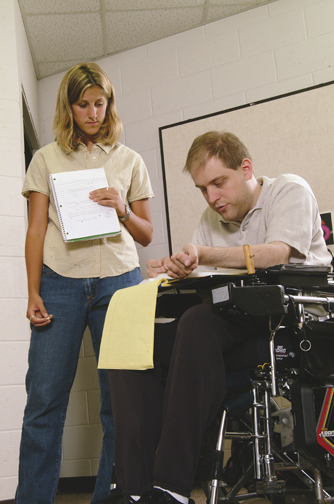
Professor Jim Turner finds a home at Calvin and, assisted by a unique
student partnership, excels in the classroom as well as in scholarship.
As a boy, poring over his father’s college math textbooks, Jim Turner was fascinated by the strange symbols, captivated by what they might say to him. “I thought they contained the mysteries of the universe,” he says. “That intrigued me—mathematics as a language that was, in some sense, more powerful than the spoken language.”
In pursuit of the mysteries, young Jim Turner also read volumes of science fiction; there he first encountered the idea of non-Euclidean geometry. “That really got me—the idea that you could think seriously about things beyond our common experience and not just fantasize about them.”
Then came junior high algebra, Jim’s first meeting with more-than-elementary mathematics. “It was disastrous!” he laughs. The secrets he thought he had sensed in mathematical symbols didn’t begin to open up for him until tenth grade geometry. “Mathematics and I found each other again,” he says, and they’ve not been parted since.
Eventually, his interest in mathematics drew Turner to questions he knew he couldn’t answer with formulas and equations. While doing research at the University of Virginia he began to immerse himself in philosophy and theology. This seemed, at times, to distract him from his research, these questions about a creator, the origin of the universe and mankind’s place in it. But they were too compelling for him to ignore. What’s more, Turner could find no other mathematicians who were trying, as he was, to make connections between their science and the large questions of religion and philosophy.
Until he began to search the Internet. Looking there for reliable guides on the creation-evolution debate, Turner noticed that certain names cropped up over and over, and that these names all were affiliated with Calvin College. “The more I looked into it, the more I found this was a place that was serious about Christian scholarship—and those were two words that I thought were never going to be linked in any place of seriousness.”
So when he saw that Calvin had an opening in the mathematics department he applied immediately, even though that opening was for a statistician, which he is not. “The reason I was really excited about coming here was the focus on the interaction between science and faith, because the detachment between them was very hard for me for many years.”
At Calvin, Turner says he’s been encouraged to pursue his readings in philosophy and theology. And that thinking has been, in turn, productive for the mathematics department.
“There’s something about the way the world is made and the way we exist in it—the world is friendly to us—so that we can actually model it mathematically, but then expand our thinking outside it,” Turner believes. “We can think of possibilities way beyond the way this world operates!”
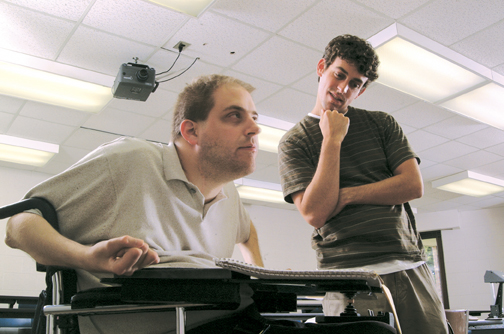
Professor Jim Turner has found innovative ways to respond to students'
questions in a classroom setting.
Next January, Turner will teach a section of the new course, required
of all freshmen, “Developing a Christian Mind” (DCM). Turner
will explore what that means with students by elaborating the topic
of symmetries. The class will trace symmetries through art, music, mathematics
and physics to the heart of creation and, as the apocryphal wisdom literature
suggests, to the mind of God.
“It’s difficult to design a mathematics DCM course that
students who aren’t math majors will voluntarily take,”
says mathematics department chair Gerard Venema. “Jim has done
some very creative thinking about that because of his interests in philosophy
and theology and their connections to mathematics. He’s doing
something that no one thought of before.”
Creativity in teaching for Jim Turner means thinking not only about the content of a course, but the sheer mechanics of it as well. A quadriplegic since the age of 16 when his spinal cord was partially severed in a diving accident, Turner has no use of his legs or fingers. That means he can’t use the standard teaching device of mathematics professors—the chalkboard.
When he began teaching at Calvin three years ago Turner used overhead transparencies he prepared ahead of time to demonstrate the mathematical problems of that day’s class. It was a method that had seemed to work well enough for him in the university settings where he’d taught before. But with Calvin students, he soon found, he would have to innovate. “There’s a tighter community at Calvin,” Turner says. “They learn together and they work better, they’re happier, when they have the professor interacting with them in class.” That would mean showing students the answers to their questions in the moment they were posed, in class, something impossible with overheads prepared earlier in his office.
To meet the challenge of responding in “real time,” Turner first tried a portable computer that allowed him, with a pen laced to his hand, to write equations on the screen, equations it then projected overhead. Though it was a better method than standard overheads, Turner found that there was still enough lag time between a student’s question and his ability to get the answer written and projected that the interactive moment was lost.
What to do? Working together, Venema and Turner enlisted the help of two math-secondary education majors. They were to serve as Jim Turner’s hands at the chalkboard, writing the equations as he spoke them, both those in his prepared lecture and those given in spontaneous response to student questions.
What all parties discovered was that the method turned out to be more than a necessary adaptation to Jim’s disability; it became a partnership between Turner and the student aide that enhanced the learning experience for everyone involved. Not only could Turner respond in “real time” to students’ needs; from Lisa Ponstine, his calculus aide, he learned new teaching strategies. “As an academician I’ve never had a math ed course in my life. Lisa, being a math ed major, had ideas for involving the students. She was a remarkable help to me.”
For her part, Lisa, of Grandville, Mich., says that, as a student herself, she could more easily anticipate students’ difficulties and what, on the board, would help clarify them. “He was very open to my elaborations of his material,” she says of Turner. And she found it invaluable experience in preparing to stand some day at her own chalkboard. “When someone asked a question in class I would be processing an answer and waiting to see if Professor Turner answered the way I would have, or differently. I was thinking as a teacher, but, because I didn’t have to answer out loud, I had my mistakes covered!”
As paradoxical as it may seem, Turner has also found the challenge of teaching beginning calculus in a liberal arts classroom productive for his research in highly theoretical mathematics. “It’s given me new perspectives on all the different ways one can approach a mathematical problem, and mathematics in general. And also, particularly students here, because they’ve challenged me quite a bit, have gotten me thinking about what’s important about doing mathematics and doing it a certain way.”
Turner’s give and take with students has, as of this past summer, begun to extend beyond the classroom, thanks to a grant from the National Science Foundation, a grant he shares with Venema. Among other things, the $108,000 grant funds both professors to give research experience to undergraduates over a three-year period. So now Jim Turner’s fascination with mathematics is opening up the world not only for him but for the next generation as well.
Turner’s Research: Homotopy Theory
During graduate school at MIT and in post-doctoral work at the University of Virginia Jim Turner chose to study and research homotopy theory, a branch of mathematics where geometric figures meet algebraic equations, producing a powerful tool for understanding complex objects and their processes of transformation. In robotics, for example, homotopy theory helps scientists and engineers know what a robot under development could actually do. Homotopy theory finds applications in all the “hard” sciences, and in the social sciences, too, like helping economists understand changing market forces.