| |
In
my second year of graduate school at University of Virginia, I shared an
office with Mike, a sixth-year graduate student whose area of research expertise
was the same as mine—British modernism. I was a new teacher, so I would
often pepper him with questions about how he organized courses, graded student
work and handled classroom dynamics. During one of those conversations,
he summarized his pedagogical approach by saying: “Our students are still
Victorians. They believe in God, their family, their country and their own
success. Our task is to make them Modernists, to make them skeptical of
all that seems certain. College is like the shipwreck of the Pequod in Moby
Dick. Some of the students remain defiant, like Tashtego nailing his red
flag to the mast, as their ideals are sucked into the vortex of skepticism
while most of them become Ishmaels, surviving by clinging to their coffins
of irony, their newly adopted positions that enable them to watch from a
distance as their ideals sink below the horizon. In either case, we remain
the Ahabs, leading this crew to a destruction of innocence.” While
it is an extreme metaphor, it is not completely idiosyncratic or secular.
One hears of a person’s faith being “shipwrecked” by college or other
life experience, and teachers, even here at Calvin, sometimes boast of
their ability to disabuse students of their simple assumptions about life
or faith. It is also a metaphor that captures the stakes and the risk
of education. However, it is a metaphor that troubles me. As with Ahab’s
pursuit of the whale, there seems to be an unrecognized hubris that animates
the confidence in undermining another’s beliefs, an unexamined certainty
about uncertainty.
Alternatively, I
have spoken with parents and colleagues who speak of Christian higher
education as a haven from the dangers of the secular university—with its
Bacchanalian dorm life, its relativist, “postmodern” curriculum and its
nihilist professors. Indeed, in this view, a school such as Calvin is
more like Noah’s Ark, a safe place for young adults to ride out the storm
of a decadent culture and emerge two-by-two as mature and productive citizens
of the Kingdom. Again, there is some truth to this metaphor, for the education
and experience at Christian colleges should be recognizably different
from their secular counterparts. There are doctrinal statements and community
commitments that establish different boundaries for ideas and actions
at these institutions. However, this metaphor also troubles me because
it too readily assumes that undergraduate education can and should be
made safe, that we can or should sequester students from all potentially
dangerous ideas, people or experiences.
Instead of a shipwreck
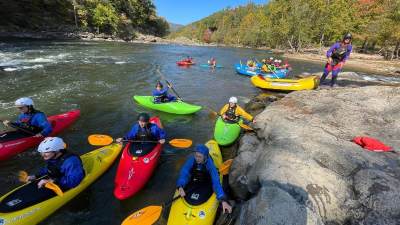
or Noah’s Ark, college education seems to me much closer to a whitewater-rafting
trip. Granted it may be merely self-delusional to envision myself as a
fit, deeply tanned person in his mid-20s rather than as the monomaniacal
Captain Ahab or the 600-year-old patriarch Noah, but I trust not. While
I have only taken a few whitewater-rafting trips, several phrases of advice
offered on those trips have helped me think about the mission of Christian
higher education and about my role as a professor.
Skin to the
Wind
I
do not like being cold, which is a liability in rafting because many trips
occur on rivers fed by melting snow and glaciers. On my first trip, I
determined to insulate myself from the 54-degree water by putting on several
layers of clothes under my life preserver and by wearing a blue waterproof
poncho over all of it. As my teenage sons were quick to point out, I looked
like a blue Pillsbury Dough Boy. When the river guide saw me, he laughed
and said: “The best way to keep warm is to ride ‘skin to the wind.’ You
get wet on this trip, but you dry off quicker and warm up faster the less
you have on.” Similarly, there is a tendency among people of faith to
try to insulate themselves and others from experiences and ideas that
could chill us to the core, the sufferings of life, the honest expression
of disbelief, and the petty and terrible evil within. We clothe ourselves
in reputation, respectability and wealth, and then complacently adhere
to beliefs without reflection. In the end, we look ridiculous trying so
hard to stay dry in a world of suffering. In response, Christian higher
education should train students to become spiritually and intellectually
resilient in a world that is broken, not shield them from that brokenness.
That training often involves students developing a critical empathy for
people and ideas that have the potential to challenge, even break, their
sense of self. However, this training should be conducted in faith, not
in fear, because those who are more deeply aware of this world’s brokenness
are often better prepared to respond to it.
Lean Into
the Wave
Education,
like rafting, also works best when the participants work together. When
water flows over a large, submerged rock, the resulting hydraulics cause
a riptide behind the rock, a “hole” or “keeper wave” that can trap a raft
in dangerously buffeting waves. The backside of the hole builds up water
under the “high side” of raft until the raft flips over. Everyone in the
raft must do two things to avoid this problem: they must paddle together
so that the boat is moving faster than the current of the river and those
on the “high side” of the raft must “lean into the wave” to break through
the riptide. This advice seems straightforward enough when one is sitting
on the shore listening to the guide, but it is strikingly counterintuitive
when facing a seven- or eight-foot wall of water. The typical novice rafter
will take his paddle out of the water and lean away from the wave, a natural
reaction of self-preservation. The guide and other members of the boat
will then quickly remind the new rider of his collective obligation. Similarly,
Christian higher education is a community activity, which works best when
everyone is pulling in a similar direction. Faculty, staff and students
work hard together in serving, reading, writing and thinking both inside
and outside the classroom, and they must accept responsibility to hold
each other accountable to the community standards in a gentle, wise and
consistent manner. We should be encouraging each other to “lean into the
wave” of the next book project, the arduous class assignment, the challenging
honors thesis, the difficult administrative task or the overwhelming personal
trial. Indeed, the shared achievement of rafting or education is one of
the most gratifying rewards of participating in these activities.
Surviving
a Spill
Whitewater-rafting
is not always a story of achievement: people fall out; rafts flip over;
participants are hurt, even killed. A vibrant Christian education involves
analogous risks. Indeed, Christian colleges should perhaps revise their
promotion materials to include a pre-trip warning similar to the one delivered
by one of my whitewater-rafting guides: “Listen. This is not Disneyland.
We are not on a mechanical track. Students will encounter powerful thinkers
and ideas that have been known to knock people off-balance, even to the
point of questioning their beliefs about themselves, about the world and
about God. This experience may cause injury to one’s spiritual, emotional
and intellectual life, even a loss of faith.” Grappling with alternative
explanations of human origin, alternative religious worldviews or alternative
epistemologies can upset even the most grounded of individuals; students
should not, however, be left to rescue themselves. Faculty and staff should
anticipate the challenges of college life and be ready to advise and respond
to students in trouble, recognizing, of course, that not all troubles
begin in college and that not all students are looking to be saved.
Again, the river
guide’s advice to those who fall out of the raft, “swimmers” as they are
affectionately known, is instructive in thinking through how to help students
survive an intellectual, personal or theological crisis. Swimmers are
taught to stay near the raft where help is at hand, and troubled students
should be encouraged to stay close to people of faith. Swimmers are also
instructed to float downstream with their feet up so as not to become
ensnarled in the boulders and tree limbs on the bottom of the river, debris
that can cause permanent injury. Similarly, students should be trained
how to maintain a position through a crisis that minimizes the risk for
life-long emotional, physical or spiritual damage. Finally, swimmers are
reminded to look for the guide in the raft who will be standing ready
to throw the rescue rope. Faculty and staff should also be prepared to
extend words of encouragement that offer students a way to regain their
balance.
Listen to
your Guide
Having
a trustworthy guide is instrumental in this journey. A student should
want someone who has experience on the river, a person who knows the field
intimately, including the difficult ideas in the class, the prevailing
currents of the discipline, and the best position to steer the class through
a difficult stretch of water. A student should want someone who has experience
on longer and more difficult rapids, a person who is actively involved
in the scholarly issues of the material to bring a depth of knowledge
to their teaching. And, a student should want someone who has experience
with people, a person who knows how to counsel and cajole them to navigate
successfully this time in their lives. Such a guide earns the trust of
others, a worthy goal that takes a long time to achieve and must be continually
earned.
Of course, it is
the thrill and personal challenge of whitewater-rafting, not the potential
hazards, which draw most people to the river. The best of a student’s
college experience will offer similar thrills and challenges—the thrill
of mastering organic chemistry, statistics or continental philosophy or
the personal challenge of getting along with a difficult roommate, of
adapting in a semester abroad in Honduras or of mourning the death of
a friend. And a Christian college education should offer more than just
the isolated thrill of a vacation excursion. Rightly done, it develops
the habits, skills and knowledge that enable a person to serve in God’s
kingdom for a lifetime.
Often rafting companies
end their trips just after the most scenic and the most demanding part
of the river, offering their customers a memory that will last. Syllabi
can take a similar shape. Imagine a guide at the end of a trip, the bent
light of a setting sun deepening the golden tone of the canyon walls and
the pick-up spot just around the next corner after the last big rapid.
Pausing in the quiet water to offer a few words of advice, he relishes
the expectancy in the eyes of those in his raft. He squints in the fading
light to pick out the route through the rapid and then pushes off. Smiling
at the exclamations of the rowers, he steers the raft through the final
large wave and then points out the eagle’s nest on the bluff. As they
pull into the pick-up spot, the raft is abuzz with stories of the trip.
The people move off to the passenger bus and back to their lives, but
the guide stays behind to pack up his gear and transport it back to the
beginning of the river for the next day’s journey—tired, content and deeply
grateful. |
|
| This
essay, reflecting on what the educational journey at a place like
Calvin College is all about, was written to the Calvin Board of
Trustees by Chip Pollard for his reappointment as professor of English. |
|