Off-Campus Programs
Academics / Departments & Programs / Sociology / Student Experience / Off-Campus Programs
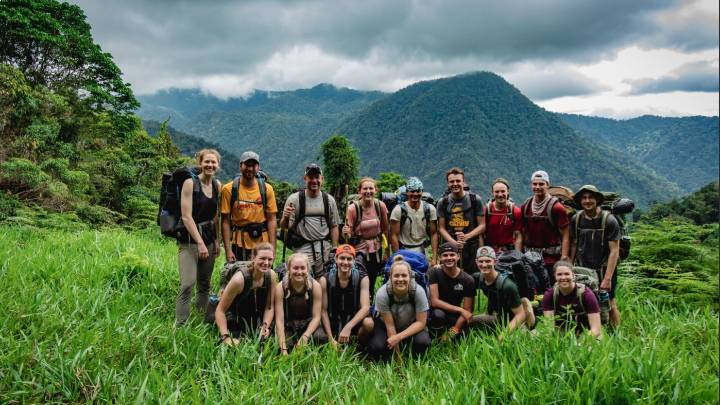
Sometimes the deepest, most lasting learning experiences take place far from Calvin's campus.
Consider the many opportunities Calvin offers to study off-campus» for an interim, a semester or a summer. Several off-campus programs offered by Calvin are geared towards those studying either sociology or social work.
Off-campus interim courses
The sociology and social work departments regularly offer interim courses abroad. Study in these courses includes cross-cultural communication, cultural patterns and international relations.
Semester program

Take the next step:

ACADEMIC OPTIONS
With over 100 majors and programs, you’re bound to find something you love.
Browse by category
- Arts
- Business
- Communication & Media Studies
- Education
Undergraduate education
- Birth to Kindergarten
- Pre-Kindergarten to 3rd Grade
- 3rd to 6th Grade
- Art: Pre-K to 12th Grade
- French: Pre-K to 12th Grade
- Health & PE: Pre-K to 12th Grade
- Spanish: Pre-K to 12th Grade
- Special Education Pre-K to 12th Grade
- TESOL: Pre-K to 12th Grade
- Secondary Education
- English: 5th to 9th Grade
- Math: 5th to 9th Grade
- Science: 5th to 9th Grade
- Social Studies: 5th to 9th Grade
- English: 7th to 12th Grade
- Math: 7th to 12th Grade
- Science: 7th to 12th Grade
- Social Studies: 7th to 12th Grade
- Health Sciences
- Exercise Science
- Kinesiology (Pre-professional Emphasis)
- Nursing
- One Health
- Pre-Dentistry
- Pre-Medicine
- Pre-Occupational Therapy
- Pre-Optometry
- Pre-Pharmacy
- Pre-Physical Therapy
- Pre-Physician Assistant
- Pre-Podiatry
- Pre-Veterinary
- Public Health
- Recreation Leadership
- Speech Pathology and Audiology (BA, MA)
- Master of Speech Pathology
- Theraputic Recreation
- Humanities
- Ministry
- Science, Technology, Engineering & Mathematics
- Social Sciences
- World Languages & Cultural Studies

Apply to Calvin
It all starts here! We accept applications on a rolling basis throughout the year. All completed applications receive equal consideration.
Start your journey
Visit Calvin
Find the visit option that works best for you and get a taste for life at Calvin!
Browse Visit Options Launch the virtual tour
Request Info
Learn why Calvin’s dedication to faith and discovery have earned it the rank of #3 among regional Midwest universities.
Loading...

Costs & Financial Aid
Families from all economic backgrounds—many just like yours—are making Calvin work. Scholarships, grants and loans are the tools that make Calvin possible.
Explore financial aid & Scholarships How much does Calvin cost?