


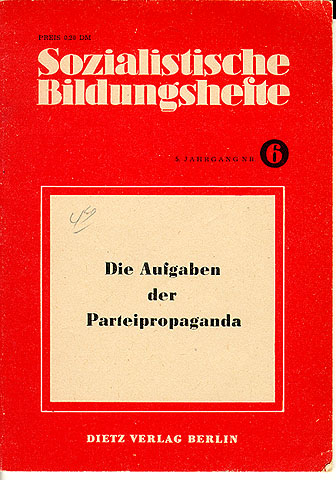
Background: It was less than a year after the establishment of East Germany, and the party leadership had just decided to introduce Soviet-style party education, the so-called Parteilehrjahr. This pamphlet, intended for party propagandists, outlined the new system. One should keep in mind here the Marxist distinction between propaganda and agitation. Propaganda trained people in depth, agitation brought ideas in less depth to the masses. At this point too, the GDR was not yet divided into districts; the old states (Länder) still existed. The system outlined here, with some modifications, remained in effect until 1989.
The source: Sozialistische Bildungshefte, 5 (Nr. 6, July 1950). This was published by the Dietz Verlag, the party publishing house.
The proposal on “The Current Situation and the Tasks of the SED,” which has been sent by the Politbüro to the entire party for discussion and which will be presented to the II. Party Congress, stresses the great importance of the political education of party members in the struggle to transform the SED into a party of a new type. Party members, particularly those in leading positions, are obligated “to work constantly to master the theory of Marxism-Leninism.”
 The
party leadership approved in its meeting of 2-3 July 1950 a decision
“On Improving Party Propaganda,” which is of
great significance for the ideological development of the party.
It is necessary to ensure that all party organizations are clear
about this decision and to work out the details of its implementation.
The
party leadership approved in its meeting of 2-3 July 1950 a decision
“On Improving Party Propaganda,” which is of
great significance for the ideological development of the party.
It is necessary to ensure that all party organizations are clear
about this decision and to work out the details of its implementation.
1. The role of theory and the characteristics of Marxist-Leninist propaganda
The founders of scientific socialism, Marx and Engels, always stressed the great importance of revolutionary theory in the struggle of the working class and maintained that theory is a spur to action. In the forward to his The German Peasant’s War, Engels noted that three aspects, “the theoretical, the political, and the practical-economic must be systematically coordinated” by the proletariat.
In the struggle to build a proletarian party in Russia, Lenin decisively opposed the opinions of the “economists,” who were interested in only one of the three factors of class struggle that Engels discussed. They wanted to put the economic interests of the workers first, to win wage increases, better legislation, etc, and neglected the political struggle and denied the role of revolutionary theory. Lenin proved that the neglect of theory led inevitably to the swamp of opportunism. Lenin repeatedly stressed the close and inseparable relationship of practice with theory, the unity of theory and practice.
“Without revolutionary theory,” Lenin said, “there can be no revolutionary movement... Only a party that is guided by the most advanced theory is able to lead.”
We study theory not for its own sake, but rather to have a firm foundation for our work and to make proper decisions in practical political work. Marxist-Leninist theory is the sure compass that shows us the right way in all situations. In his work On the Foundations of Leninism, Comrade Stalin wrote:
“Naturally theory is useless if it is not tied to revolutionary practice, but in the same way practice is blind when its way is not illuminated by revolutionary theory.”
The glorious progress of the Communist Party of the Soviet Union (Bolshevist) shows how right Marx, Engels, Lenin, and Stalin were in evaluating the significance of revolutionary theory. Marxist-Leninist theory lighted the beginnings of the victorious Bolshevist party and enabled it to defeat all opportunistic enemy elements, to overthrow the dominance of capitalism on a sixth of the planet, to establish the dictatorship of the proletariat, and to build socialism. Supported by the teachings of Marx, Engels, Lenin, and Stalin, and led by the Bolshevist party, the Soviet people have successfully moved along the road to communism.
Stalin’s History of the Communist Party of the Soviet Union (Bolshevist) teaches:
“That the party of the working class cannot fulfill its role as leader of its class, or organize and lead the proletarian revolution, if it has not mastered the most advanced theory of the workers’ movement, Marxist-Leninist theory.
The strength of Marxist-Leninist theory is that it gives the party the ability in any situation to understand the inner connections of the events around it, to see the course events will take, and recognize not only how and in which directions events are going, but also how and in which direction they must develop in the future.
To master Marxist-Leninist theory means to take in the essence of the theory and to learn how to apply this theory to the practical questions of a revolutionary movement under the most varied conditions of the class struggle of the proletariat”
The task of party propaganda is to acquaint party member sand candidates — and also those workers of advanced understanding who are not in the party — with the nature of Marxist-Leninist theory and to help them to make the teaching of Marx, Engels, Lenin, and Stalin their own.
Lenin and Stalin have always given great attention to the development of propaganda work and to the Marxist-Leninist education of the party members and cadre of the Soviet Communist Party. They have stressed the organizing and mobilizing role of the ideas of the Bolshevist party in the fight for the victory of the proletarian revolution and the building of communism. On the advice and counsel of Comrade Stalin at the meeting of the Central Committee of the Soviet Communist Party at the beginning of March 1937 and at the XVIII Party Congress in 1939, the Bolshevist party began a new, remarkably broad, and well thought out educational system in which party members, candidates, and workers not members of the party studied. The ideological-political level of party members, and functionaries in particular, is therefore very high.
We must learn from the propaganda experiences of the Soviet Communist Party and draw the necessary conclusions for our party by developing an effective level of propaganda within the SED.
2. Ideological work — the most important element in the development of the SED to a party of the new type.
The I. Party Congress determined that “the first task in the development of the SED to a party of the new type is to strengthen the ideological-political education of party members and particularly functionaries in the spirit of Marxism-Leninism.”
The work that has since been done certainly has strengthened the ideological and organizational aspects of our party, which was demonstrated particularly in the party elections last fall. A large number of party members had participated in the political education evenings, in the circles to study the History of the Communist Party of the Soviet Union (B), and in the courses at party schools. The party has matured ideologically, and the revolutionary awareness of party members over against enemies of the party and people has increased.
Along side these successes, however, there are serious failures and weaknesses. Despite the ideological and organizational watchfulness and the general strengthening of the party, the ideological educational work of the party is still insufficient and lags behind the work in the economic and political areas. The battles against enemy views, the imperialist theory of “cosmopolitanism,” and the remains of social democracy and sectarianism in the ranks of our party are often weakened by overly conciliatory behavior. The battle against “objectivism,” which means taking the side of the opponent, is not carried out with sufficient energy. It is for this reason that the draft decision “The Present Situation and Tasks of the SED” for the III. Party Congress explicitly says:
“The mastering of Marxist-Leninist theory can only grow out of the battle against the influence of bourgeois ideology in the ranks of the working class.”
Therefore one of the main tasks in strengthening party educational work is to increase the ideological-political level of party members and candidates and to develop new cadres in all areas of our work.
3. Practicality — A serious threat
“The main weakness that presently stands in the way of the ideological strengthening and development of our party is practicality, the underestimation of Marxist-Leninist theory, which is the most important tool of a party of the new type.”
Numerous functionaries in the party, the mass organizations, government and commerce have not yet studied at a party school and neglect independent study. Some excuse themselves with the claim that they have no time, failing to see that they cannot adequately fulfill their tasks if they do not constantly learn and improve by studying Marxist-Leninism. Comrade Stalin said at the XVIII. Party Congress of the CPSU (B) in 1939:
“It is an axiom (absolute requirement; the editor) that the higher the political level and the more conscious the Marxist-Leninist attitude of the functionaries in the respective branches of state and party, the better and more fruitful the level of work will be and the more effective its results. The opposite is also true: the lower the political level and the weaker the Marxist-Leninist attitudes, the more likely that mistakes and errors will occur in the work, and the more likely it is that the functionaries are shallow and lost in details, the more likely it is that they fail.”
There are, of course, some party units, e.g. the county office in Zwickau, that regularly deal with ideological questions and conduct party education for the party organizations in their area. A large number of party offices, however, do not give party education the necessary attention. They do not discuss ideological issues at their meetings and view the directives on propaganda that they receive from the party central or the state offices or conferences merely as information and take no steps to realize them. Occasionally the county or factory conferences will make some sort of decision about educational work, but thereafter the relevant offices fail to implement the necessary measures. At best, it is left to individual functionaries in these areas to do something, which means that the ideological strengthening of the party becomes a spare-time activity. An inspection visit to an instructors’ group in the department of party education in County Magdeburg found that the secretariat member responsible for ideological work did not know if the decisions of the Information Office of the Communist and Workers Parties of November 1949 had even been discussed by the Magdeburg party offices. There was no overview of the state of ideological work. Although the remnants of social democracy are particularly strong in this area, the county office had no thoughts about how to eliminate it. The county office and the secretariat consider only economic and local issues, personal questions and the like during their meetings. The members of the county office do not systematically study The History of the CPSU (B), and excuse themselves by saying they have no time. This emphasis on practicality made the comrades fully blind to the significance of party propaganda. Given this weak ground, the Schumacher agents Thiele and Paul were for a long time able to carry our their sabotage and organize a Schumacher group that was opposed to the party. This example shows how serious the danger of practicality is for the party.
It is therefore necessary to oppose practicality in all areas of our work, to make the necessary time for ideological questions, and to raise party propaganda to a new and higher level. The Party Board dealt with this in its meeting of 2-3 June 1950 and approved the decision “On Improving Party Propaganda.”
4. The significance of the Party Board decision “On Improving Party Propaganda”
The decision is based on the results of education work and in a self-critical way and shows the mistakes and weaknesses of the previous system of party education. The decision says:
“The task of party propaganda is to help members and functionaries of the party at all levels to master Marxist-Leninist science. Despite the successes so far, the existing system of party education and the previous leading and training of propaganda and theoretical workers in the party no longer meets the need.”
One of the greatest weaknesses is the still inadequate Marxist-Leninist education of members and candidates. The political education evenings that we have so far held do not give party members the necessary basic knowledge of Marxism-Leninism. That is repeatedly clear in the letters from comrades to the Department of Party Education of the Party Board, which regularly ask that they be replaced by a systematic educational system. A further problem is the inadequate education of the propaganda and theoretical cadre, and the often overly formal instruction in party schools, which often is far from real life. Students for the party schools are largely selected at random, so that the courses often do not have the desired results.
In light of the enormous tasks of the party in the battle to guarantee peace, to build a unified democratic Germany and to further strengthen the German Democratic Republic, it is necessary to deal with these problems rapidly. According to the decision:
“An atmosphere of learning must fill the entire party.”
According to the draft of the new party statute, it is a duty of each party member to “constantly increase his political knowledge through the study of Marxism-Leninism.” The Party Board approved a change in the system of party education to give the comrades as much help as possible. Through it will be possible to carry out propaganda work in a more planned and organized fashion than before, to educate all party members and candidates according to the level of their knowledge, and better teach them the fundamentals of Marxism-Leninism. The implementation of this decision will move our party further along the road to building a party of the new type, following the example of the party of Lenin and Stalin.
5. The new education system
The decision of the Party Board includes the introduction of a unified educational year for all party schooling that begins on 1 October every year and ends on 30 June (15 June in rural areas). In 1950, the training year will begin on 1 November in order to permit the necessary preparations to be made (publication of material, etc.).
“The establishment of a unified training year in party education will allow the party to conduct Marxist-Leninist education using a common syllabus and books, and will allow for regular evaluation of the results.”
a) Basic political courses are the lowest level of party training
“Basic political courses will be established for all members and candidates of the party as well as for those not in the party (in particular activists) who sympathize with the SED and want to learn. These are for those who lack an understanding of the basic principles of Marxism-Leninism, and will be organized by factory and housing groups as well as in the countryside organizations, in cooperation with the county office. Each such course will have 20 to 25 participants under the care of a regular teacher. The course will last a year and will follow a textbook. . . The basic political course will meet two hours a time twice each month after the end of the work day. In the countryside, the course should meet if possible at least three times a week in winter.”
b) The next level is the circle
“Those functionaries, members and candidates of the party, along with those not in the party, who already understand the fundamental principles of Marxism-Leninism will join circles to study the biography of J. W. Stalin and circles to study the History of the CPSU (B) — Short Course. They must be approved by the factory, housing area or rural local groups and the county offices.
The circles to study the biography of J. W. Stalin last one year (a school year); the circles to study the Short Course last two years. . . There are two kinds of circles to study the Short Course:
a) For beginners, who only study the Short Course;
b) For advanced students, who will also study Lenin’s biography and the most important classic works of Marxism-Leninism...”
Each circle will have a regular teacher, approved by the state leadership.”
New circles may be started only when trained and approved circle leaders are available. The existing circles will follow the unified educational plan after 1 November 1950
c) County evening schools
“Functionaries in local units of the party, the members of the county offices as well as leading party functionaries in factories, MAS [central depots for agricultural equipment], people’s farms, administration, mass organizations, etc., at the county level, who possess the necessary basic knowledge and have already attended the county party school, county evening schools will be organized. The courses last two years. . . The courses will be organized for a specified number of students on weekends or evenings. . . At the end of the course there will be an oral examination. Only functionaries of the party may study at county evening schools.”
d) The Evening University of Marxism-Leninism in Berlin
“The propaganda department of the state party office in Berlin will begin an Evening University of Marxism-Leninism on 1 November 1950. Students at the evening university will be leading party functionaries from the Party Board, the state office, the economy, and administration. They must have attended a county or state party school. Other participants may include professors and other university teachers, artists, physicians, technicians, students, etc., who want to study Marxism-Leninism.” The courses at the evening university run two years and the participants will be chosen by the state office for Berlin as well as the propaganda department of the Party Board. Candidates and non-party members with the required background may also study at the evening university.
e) On the importance of independent study
The decision makes particular mention of the fact that an understanding of Marxism-Leninism comes not only from courses and circles, but that regular independent study of the works of Marx, Engels, Lenin, and Stalin is also necessary. As important as speeches, seminars and discussions are, they cannot replace or make unnecessary independent study. Friedrich Engels noted:
“That since socialism has become a science, it must be conducted like a science, which means it must be studied.”
Independent study is therefore an essential part of party propaganda, the basic way to learn Marxist-Leninist theory. Avoiding independent study means a reduction in the quality of education and leads to a superficial and shallow relationship to theory, to memorization and repetition of a few principles. Refusal or neglect of independent study is practicality in the area of party propaganda, and condemns “such party members to be eternal and inadequate participants in the basic courses.” It denies these members of the working class mastery of the knowledge. Finally, avoidance of independent study means to reject the sources of scientific socialism, the works of Marx, Engels, Lenin, and Stalin. To improve understanding of the classic documents of Marxism, the regular study of theoretical and propaganda articles in the party press is necessary for every party member and candidate, indeed for anyone studying Marxism-Leninism. Reading these articles cannot replace the study of the writings of Marx, Engels, Lenin, and Stalin, but rather it serves as an aid to and an explanation of them.
Independent study is the primary method of party propaganda for the Bolshevist party. The rich experiences of the CPSU (B) give us the opportunity to increase the role of independent study here as well. Through the new approach to party propaganda, through including as many party members and candidates in course and circles as possible, we will create the presuppositions necessary for the implementation of these methods of Marxist-Leninist education by us as well. We will realize the call of Comrade Walter Ulbricht at the organizational conference of June 1950, at which he said:
“Independent Study must become the main method of education for party members.”
f) The new tasks of the Socialist Education Journal
“The former political education evenings will be replaced by the basic political courses and circles... The Socialist Education Journal, which has become a primary means of propaganda for the party, will in the future explain the decisions of the Party Board and other current political, economic, and cultural issues, as well as carry experiences from party work. It should help the independent study of members and candidates and provide reading material for party schools and for discussions at membership meetings.”
g) The tasks of party schools
Party schools will in the future train functionaries for the various branches of our work. They will have already the basic knowledge for the general membership and candidate training and will be given the training they need for particular tasks. [We do not have the room here for a thorough treatment of the tasks and duties of party schools].
Carrying out this comprehensive decision cannot be the job of a particular functionary or department, but rather it is a job for the entire party! Every party office, from the state offices and county offices down to the local groups must take account of the decision and develop a concrete plan for its implementation. We will therefore take up the tasks of the local groups.
6. The education plan of the local groups
The leadership of the local groups must develop an education plan immediately after the III. Party Congress for all members, candidates and nonparty members who want to study Marxism-Leninism. It should make clear how each individual will learn the principles of Marxism-Leninism in the course of the party educational year, either through participation in a basic political course, a circle, a county evening school, the evening university (for those in Berlin) or a course at a party school.
In assigning party members and candidates to the various levels, their level of knowledge, not their position, is the deciding factor. The draft document for the III. Party Congress explicitly notes that those members and candidates working in the governmental and economic branches are obligated to participate in the training. The same is true for comrades in the mass organizations.
Party members, candidates and nonparty members who must learn the basics of Marxism-Leninism should be encouraged to attend the basic political course. A party member, who for example took a six-week course at a party school in the past year and afterward studied independently or participated in a circle to study the History of CPSU (B) can be encouraged to join a circle for advanced students, which will study the biography of Lenin and the most important classic works of Marxism-Leninism along with the “Short Course.” Another example: The first secretary of a factory group who has completed a six-week course and has studied independently thereafter could be encouraged to participate in the county evening school for functionaries. A party member who participated in last year’s circle to study the History of the CPSU (B) but did not understand it entirely could be encouraged to work through it again in the Short Course.
These examples demonstrate that the leadership of the local groups should deal with each party member, candidate and nonparty member individually, and speak with him about the appropriate level of party education. This naturally cannot be the responsibility of a single functionary. The education plan for the members and functionaries of the local groups must be determined collectively by the leadership and then discussed at the membership meeting. The instructors from the county office should assist the local groups in developing their educational plans and help lead them.
The following scheme shows how an education plan for a local group could be done:
[There follows a chart showing how the members of a local group could be assigned to the various courses.]
After the county office has received the education plans of all its local groups, it will determine, based on the number of available propagandists, how many basic political courses, circles to study the biography of Stalin, circles to study the History of the CPSU (B) for beginners and advanced students, etc, should be conducted in a factory. When, for example one work group in a large factory has 14 and another 9 members for a basic course, these 23 members, candidates and non-party members can form a course. If in a MAS 6 and in the local group of the relevant village 16 members, candidates, and non-party members want to study the biography of Stalin, one will form a circle from these 22 participants, assuming that a qualified circle leader is available.
The county office will determine the number of elementary schools and circles based on the number of current propagandists and those who can be trained by 1 November. Only as many basic courses and circles will be held this year as can be taught by the available propagandists, to ensure a certain level of quality. After completion of the first year’s courses, new propagandists will have been trained. This will allow those party members and candidates to be reached who could not participate in the first year of party education.
The leadership of the local groups is responsible for carrying out the education plan. They must regularly review the plan in their meetings and determine whether the members attend regularly, what they learn, whether they have worked through the prescribed material, etc. Attendance at the basic political course and the circles will be noted by the teacher on a participant’s card, which will be part of the party membership book. The leadership of the local group is required at regular intervals (about every 8-10 weeks) to report to the membership meeting on the implementation of the education plan. At the end of the year, they must also present a thorough report on the results of the educational work of the year, the ideological development of the members and candidates, respond self-critically to the problems and propose the following year’s education plan.
7. On the role of propagandists in the party
The comprehensive tasks set forth in the decision of the party board in the pare of the propaganda work of the party will naturally require a large number of trained propagandists. The leaders of local groups often complain about a “shortage of speakers.” The reason for this shortage is not because we have no propagandists, but rather because the leadership — particularly the county offices — has previously not understood how to develop the necessary propaganda cadre and how to use them effectively. At present, some comrades who serve as agitators in public meetings or as propagandists for educational evenings, weekend courses, etc., are overworked, driven literally from one meeting to another. They must speak about every possible topic, and thus are unable to prepare adequately. They are mostly only “givers,” with no time to read a book, a pamphlet, or even an article. An end must be put to this misuse of our cadres!
We will have enough propagandists if we understand how to chose, use and train them properly, and how to attract and train others. Hundreds of thousands of our party members have attended a party school. Several thousand have taken lengthier courses at state party schools or the party university. Every county has a considerable number of comrades who participated in four and six seek courses at the county party school. Are these comrades always used properly? Are they used as propagandists? No! Of course, everyone who attended a party school is not suited to be a propagandist, but a large number of them are certainly able to handle a basic political course or a circle. Party offices must evaluate those who have attended county and state courses, speak with them, and prepare them for service as propagandists in our new system of party education.
It is necessary to overcome backward and damaging underestimation of propaganda work. The work of a propagandist is a responsible party assignment, and in the Communist Party of the Soviet Union (Bolshevist) service as a propagandist is a particular honor. The propagandist is not only a “speaker.” He does not only give knowledge, but rather he carries on an important educational activity. He is a party teacher and carries as such special responsibility. To do his work well, the propagandist must steadily improve his own education, and work untiringly to gain new and better knowledge if he is to master Marxism-Leninism. It takes longer to develop a propaganda cadre than it does in other areas. They deserve therefore the special care and attention of the party. The propagandist cannot be a “multifunctionary” who carries out many functions and is involved in education only in his spare time. He must have the time, alongside his job, to read the recommended literature, to study it thoroughly, and to prepare his lectures and seminars. The party leadership must therefore see to it that comrades who serve as propagandists are freed as much as possible from other assignments and that new cadres are developed so that in the future our propagandists will be able to carry out their honorable and important party assignment alongside their jobs.
Great tasks lie ahead in every area of social life for our party. We will be able to solve them only if we put an end to the underestimation of Marxist-Leninist theory, if we take the steps necessary to overcome through determined efforts in party education the remains of social democracy and sectarianism, if we build the unity and determination of the party on the principles of Marxism-Leninism, and if we imitate the model of the party of Lenin and Stalin. We must always take to heart what comrade Stalin said at the XVIII. Party Congress of the CPSU (B):
“This we can say with certainty: If we understood how to ideologically arm all cadres in every branch of activity, to steel them to such a degree that they are able to orient themselves in every domestic and international situation, if we understood how to make them fully mature Marxist-Leninists who are able to answer all questions involved in leading the country without serious errors, then we would have reason to see nine-tenths of our problems as already solved.”
Last edited: 11 September 2023
[Page copyright © 1998 by Randall L. Bytwerk. No unauthorized reproduction. My e-mail address is available on the FAQ page.]
Go to the GDR Page.
Go to the German Propaganda Archive Home Page.