
Background: This is a collection of Nazi posters from 1933-39. Posters from 1939-1945 are on another page. Many are taken from photographs made by Dr. Robert D. Brooks at the German Federal Archives. A collection of pre-1933 posters is also available. The images are thumbnails. Clicking will bring up a larger image.
I have gathered the remainder from a wide range of sources. By far the most extensive collection of posters available is that of the German Federal Archives. They have over a thousand on-line. The University of California Library has nearly 300 posters on-line. The University of Minnesota library also has a large collection, and has given me permission to use some of its posters.
This page is part of a much larger site on German propaganda during the Nazi and East German eras.
|
|
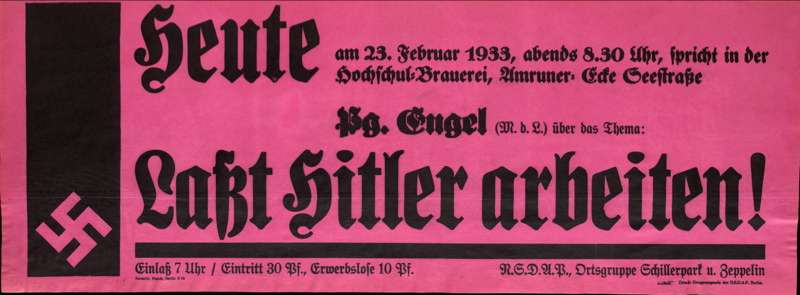
1. This poster announces a Nazi meeting in Berlin on 23 February 1933, less than a month after Hitler took power. The title of the speech is: “Let Hitler work!” Courtesy of the University of Minnesota Library. |
|
|
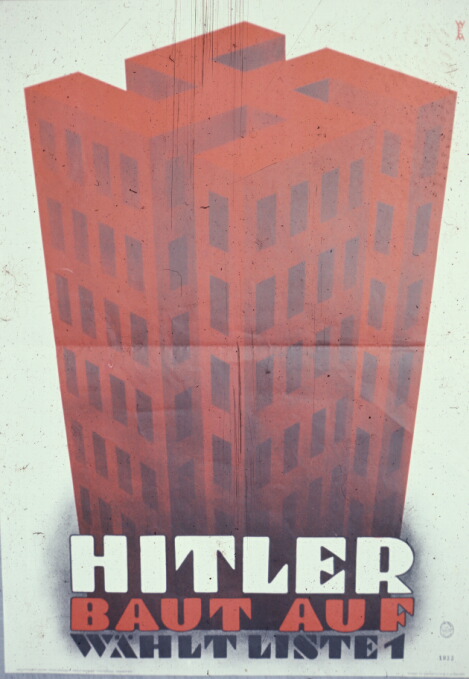
2. This poster for the March 1933 election is captioned: “Hitler Builds.” Courtesy of Dr. Robert D. Brooks. |
|
|
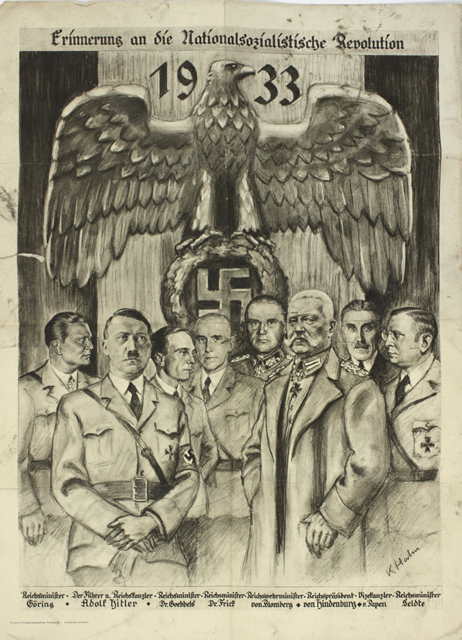
3. This 1933 poster shows Nazi leaders along with Reich President von Hindenburg. I take the image with permission from Alexander Historical Auctions. |
|
|
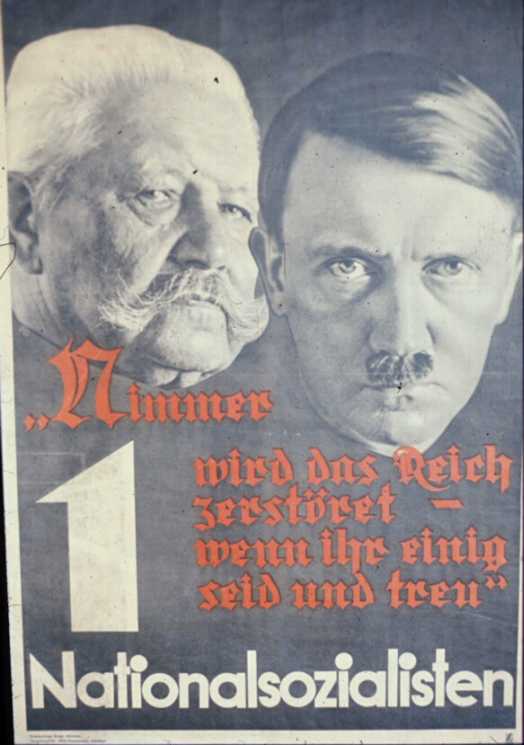
4. This poster is from the March 1933 Reichstag election, the last one in which Germans had a choice. The poster shows President Hindenburg and Chancellor Hitler. The caption: “The Reich will never be destroyed if you are united and loyal.” Courtesy of Dr. Robert D. Brooks. |
|
|
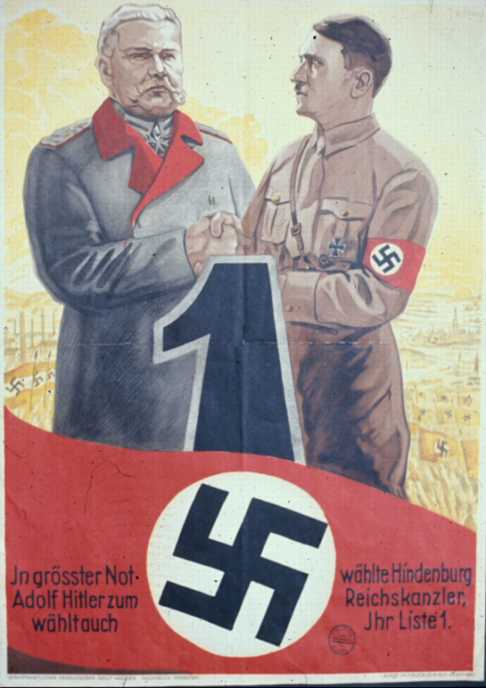
5. Another March 1933 poster. The text: “In the deepest need Hindenburg chose Adolf Hitler for Reich Chancellor. You too should vote for List 1.” Courtesy of Dr. Robert D. Brooks. |
|
|
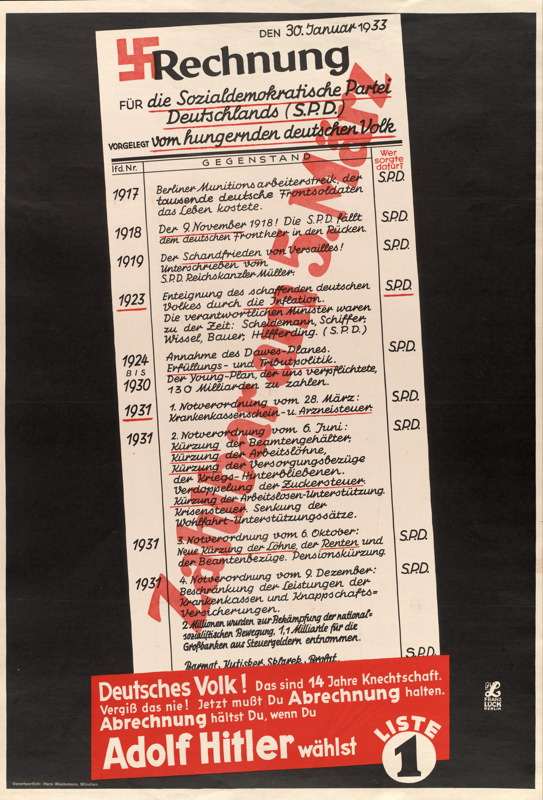
6. This poster is for the 5 March 1933 Reichstag election. The top text: “Bill for the Social Democratic Party (SPD), presented by the starving German people.” It lists the alleged sins of the Socialists, and concludes: “German people! That is fourteen years of serfdom. Never forget it! Now you must demand payment. You will receive that payment if you vote for Adolf Hitler.” Courtesy of the University of Minnesota Library. |
|
|
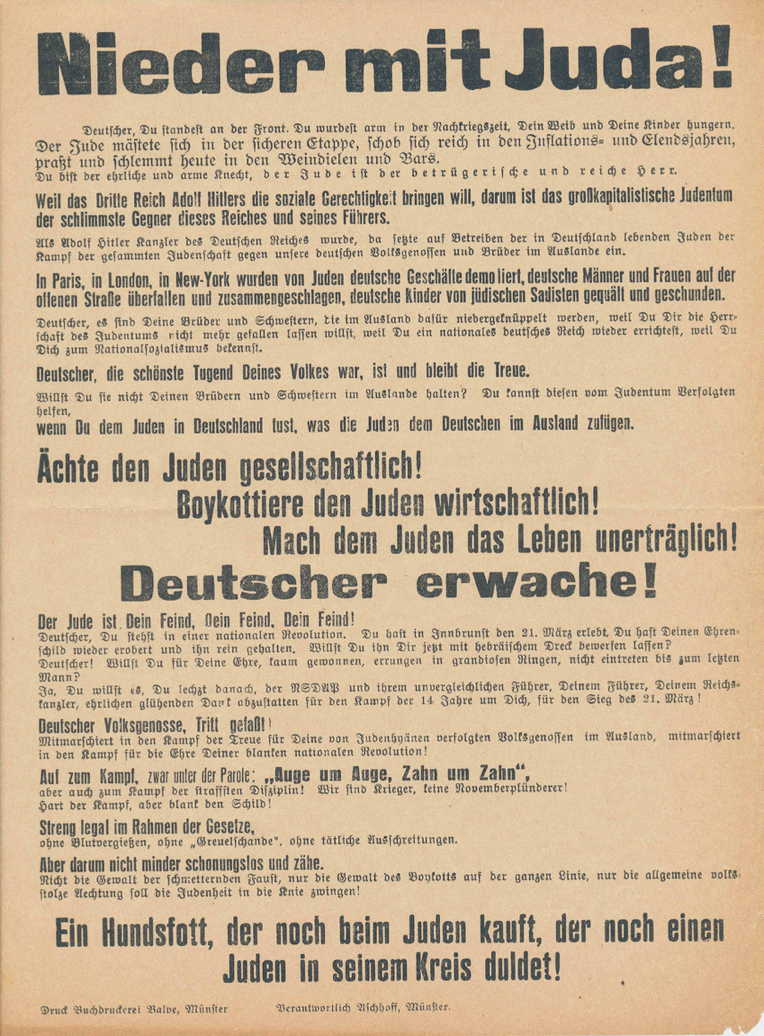
7a. This poster issued in Münster is from late March 1933. I can’t be sure from the text whether it was issued before of after the announcement of the nation-wide anti-Jewish boycott of 1 April 1933. The text is translated here. Courtesy of this site. |
|
|
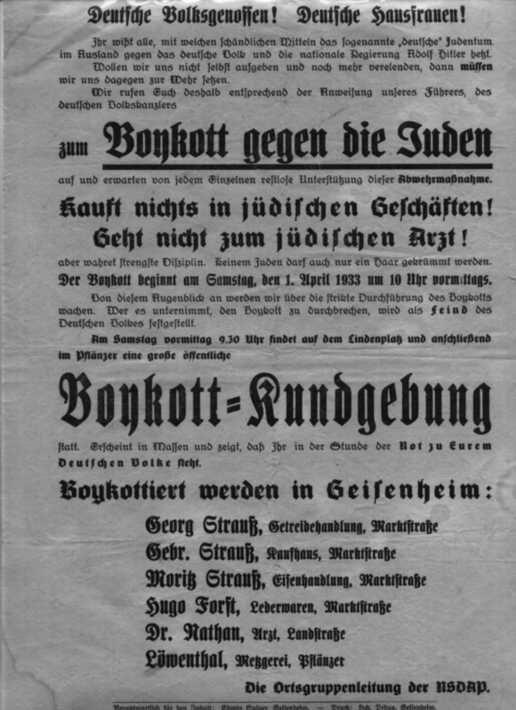
7. As their first major anti-Semitic action after taking power, the Nazis organzed a nation-wide anti-Jewish boycott on 1 April 1933, alegedly to protest anti-German actions by Jews around the world. This poster announces the boycott in the town of Geisenheim. The text is translated here. Courtesy of this site. |
|
|
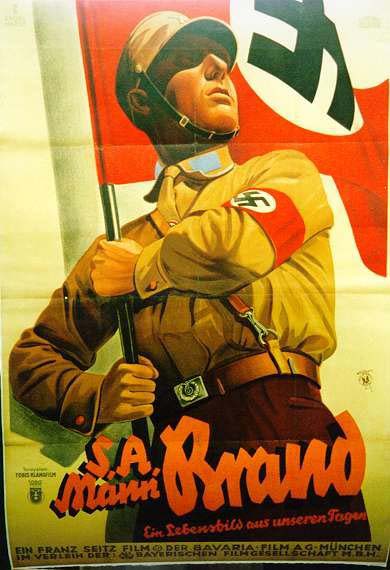
8. A 1933 poster advertising the film S.A. Mann Brand. |
|
|
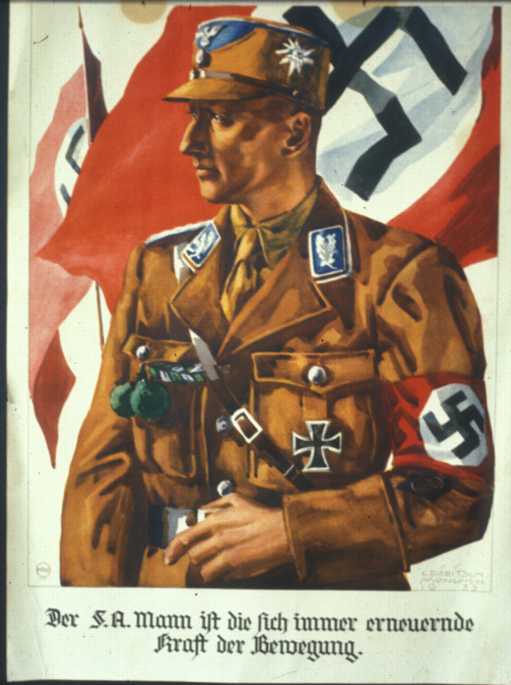
9. Another poster glorifying the S.A. I can’t date this one, though it looks to be from the early years of the Nazi regime. |
|
|
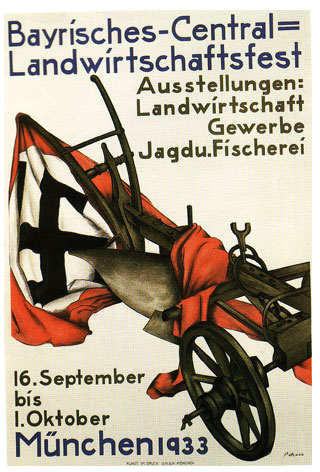
11. A 1933 poster announcing an agricultural fair. It’s eight months after Hitler took power, and the Swastika is showing up everywhere. This poster is provided by J. Castillon. |
|
|
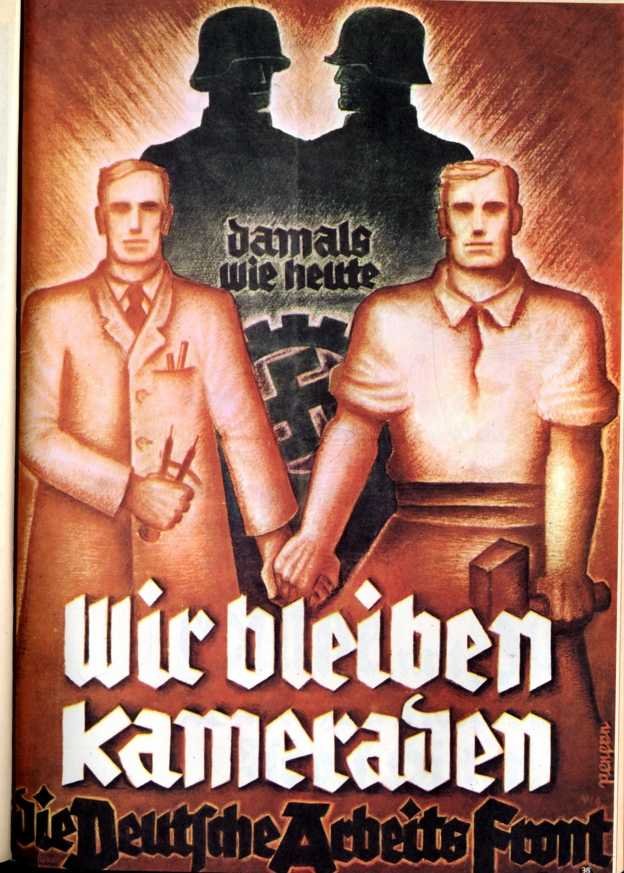
12. This poster links the German Labor Front (the DAF) to World War I. The point is that just as soldiers were comrades regardless of their standing in civil life, so all German workers were comrades in the DAF, regardless of whether they were white or blue collar. This appeared in 1933. |
|
|
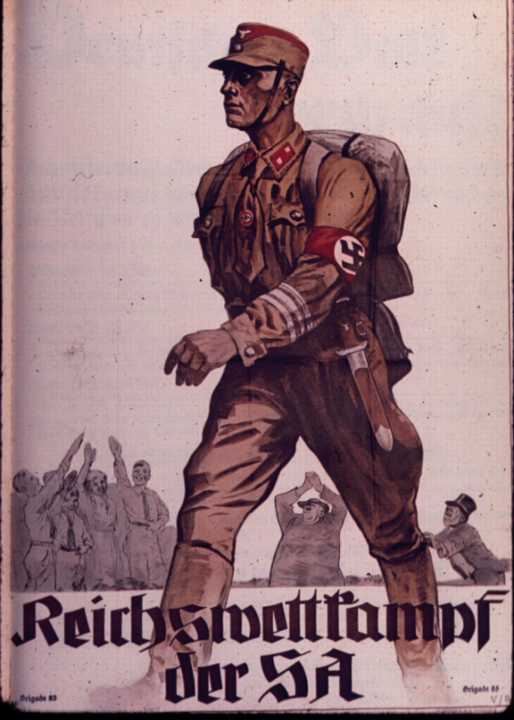
13. A 1930’s poster announcing the national S.A. competition. Courtesy of Dr. Robert D. Brooks. |
|
|
14. A 1933 poster announcing Leni Riefenstahl’s film of the 1933 Nuremberg Rally, a film thought for years to have been lost, but copies do in fact exist. |
|
|
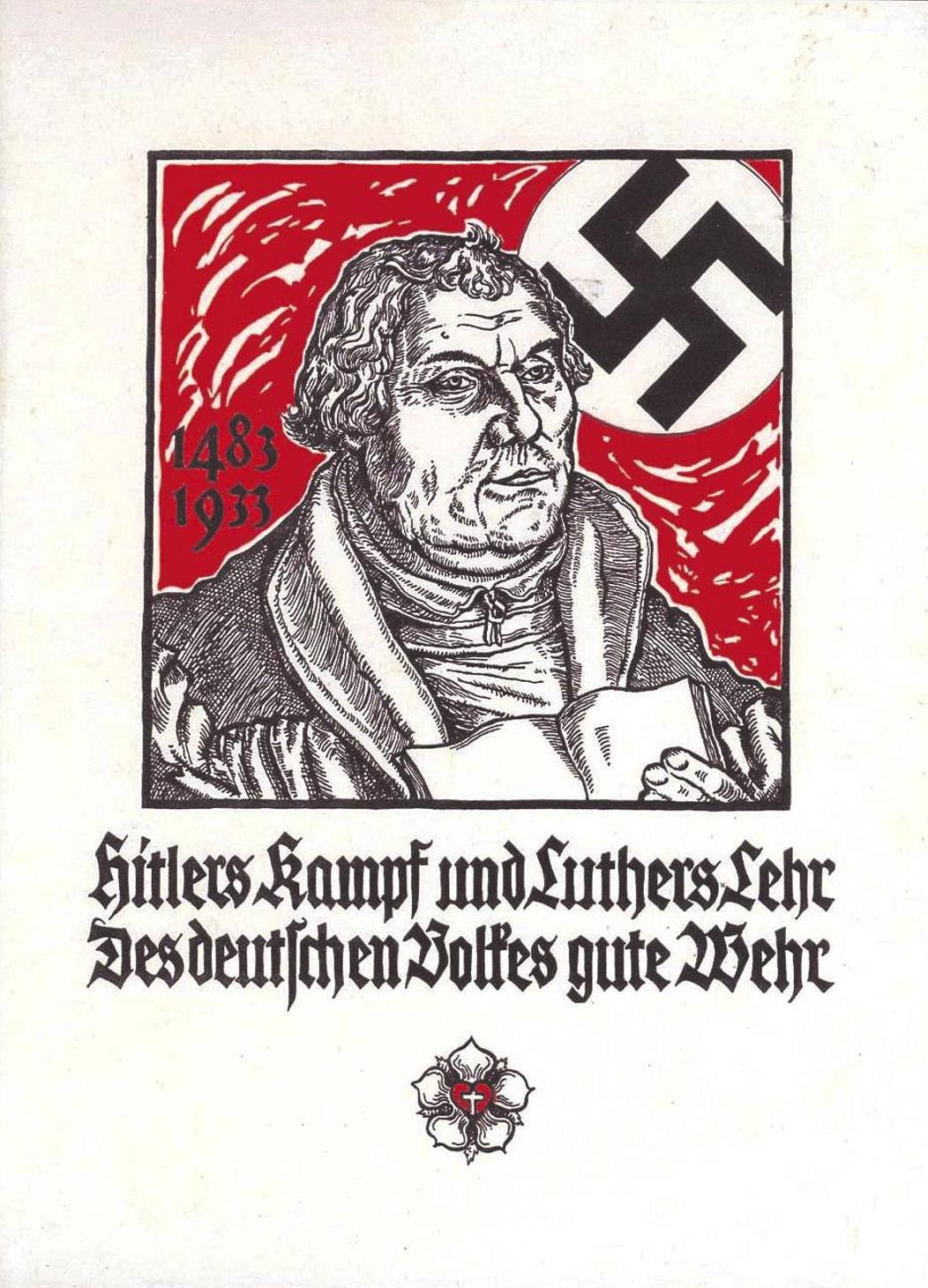
14a. This poster was issued on the occasion of Martin Luther’s 450th birthday. The text: “Hitler’s battle and Luther’s teaching are the German people’s sure defense.” I know nothing about its background and would welcome enlightenment. |
|
|
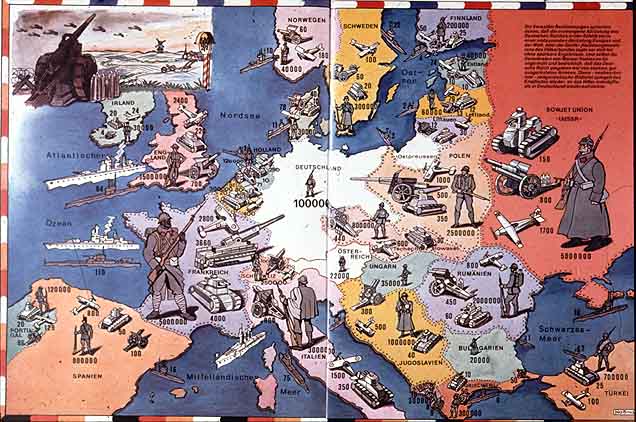
15. This visual from the mid-1930’s shows Germany in white, with the 100,000-man army permitted by the Treaty of Versailles, surrounded by heavily armed neighbors. |
|
|
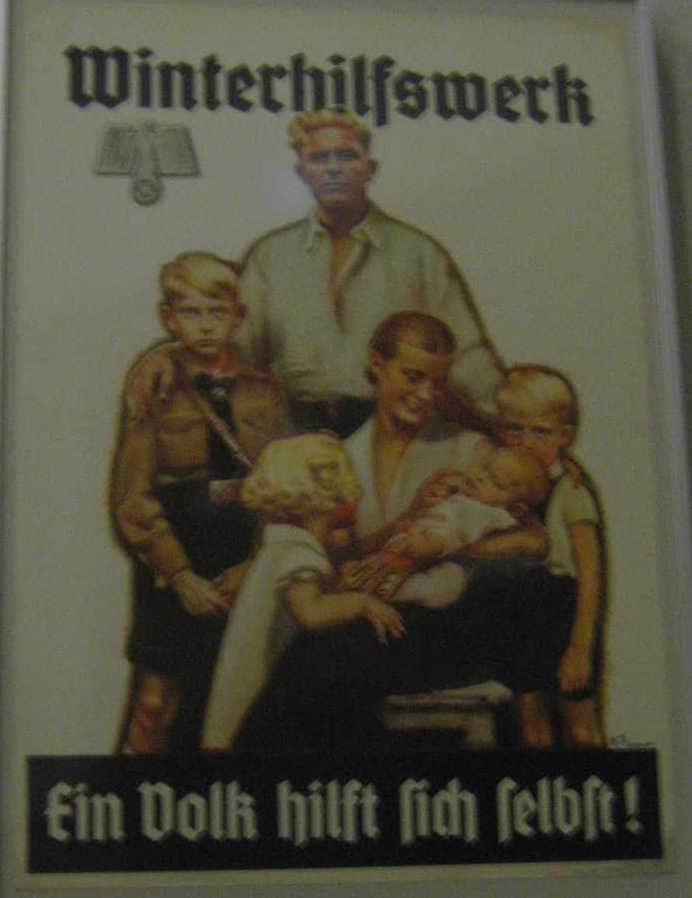
16. The Winter Aid (Winterhilfswerk ) was the Nazi Party charity. Each year there was a drive to solicit donations to help the needy. Contributions were not entirely “voluntary.” The text translates as: “No one shall go hungry! No one shall be cold!” Photo courtesy of Dr. Robert D. Brooks. |
|
|
16a. Another Winterhilfswerk poster from the 1930s. I make the image at a museum in Leipzig. |
|
|
17. This poster advertises the Nazi charity, the NSV. The text translates: “Health, child protection, fighting poverty, aiding travellers, community, helping mothers: These are the tasks of the National Socialist People’s Charity. Become a member!” Courtesy of Dr. Robert D. Brooks. |
|
|
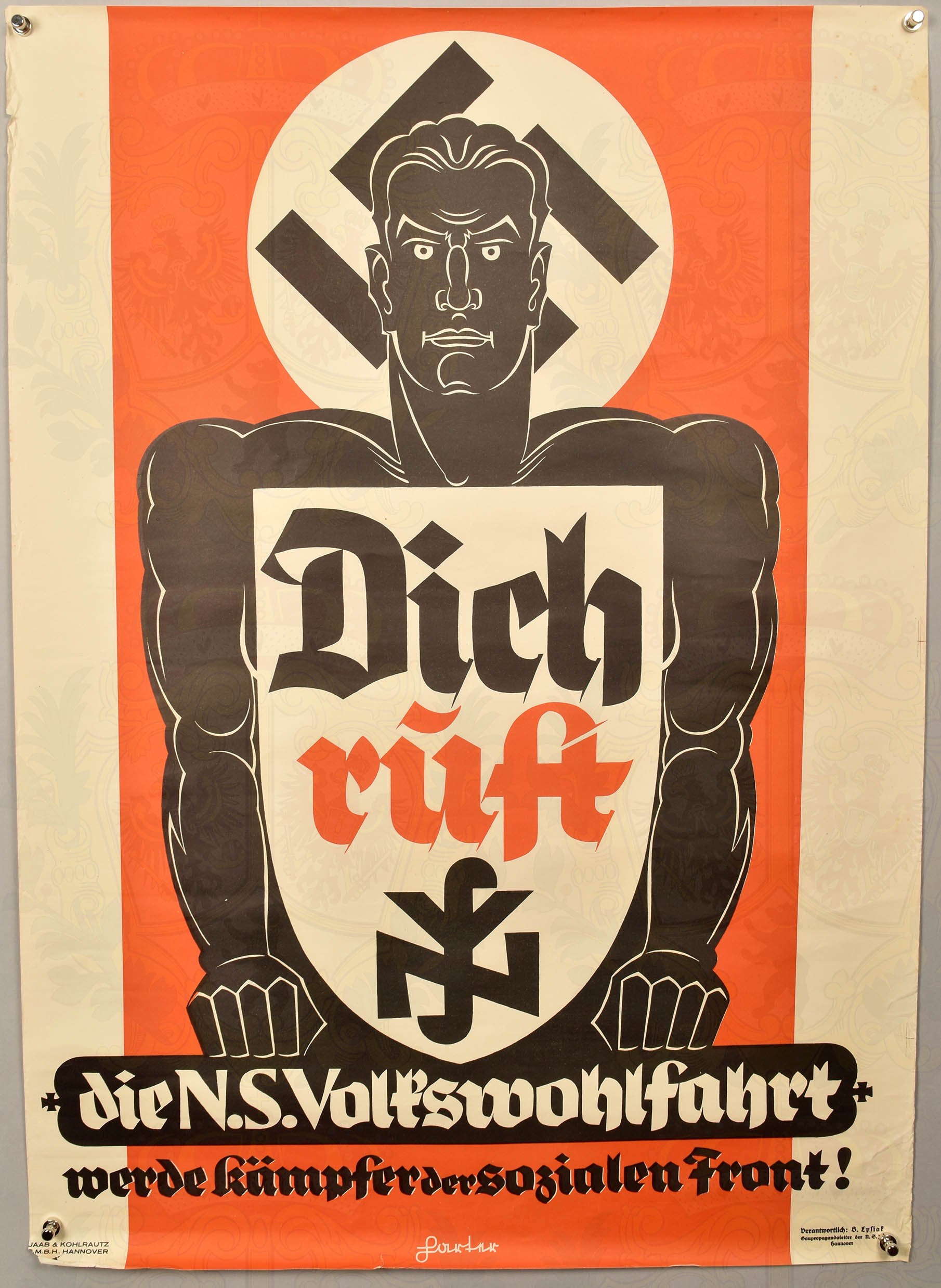
17a.Another NSV poster from the 1930s: “The NSV Calls to You.” |
|
|
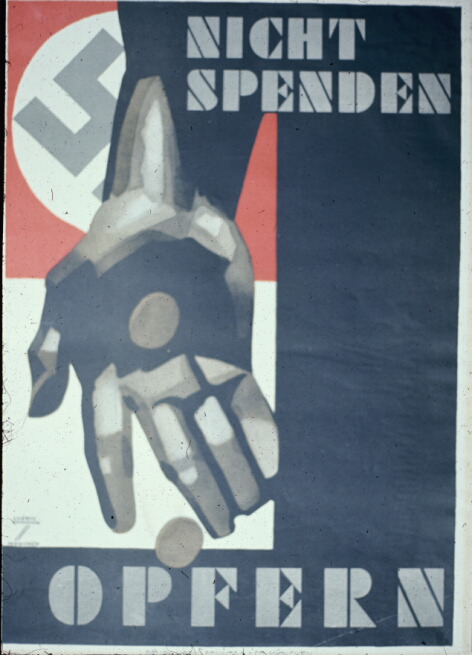
18. This poster encouraged sacrificial contributions to the Winter Aid. The text translates: “Don’t give. Sacrifice.” Courtesy of Dr. Robert D. Brooks. |
|
|
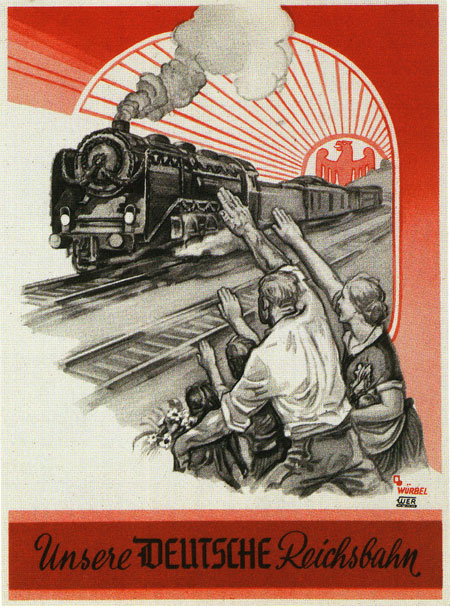
19. A poster promoting the German railway system. This looks to be from the 1930’s. This poster courtesy of J. Castillon. |
|
|
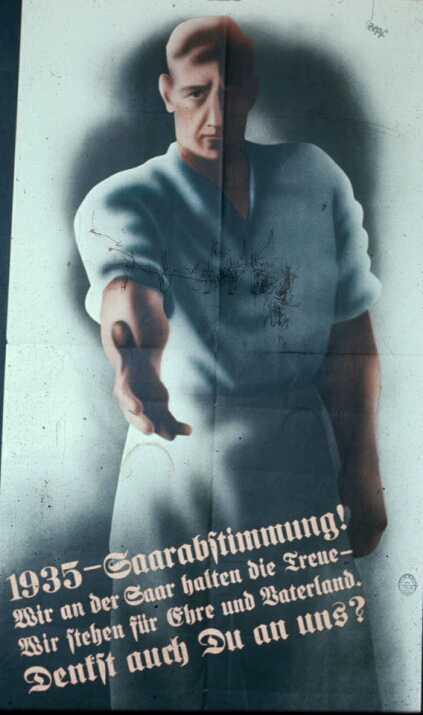
20. Under the Treaty of Versailles, the Saar was placed under French administration, pending a plebiscite to be held in 1935. This poster encouraged Germans to be aware of the upcoming referendum. The text translates: “1935 — Saar Plebiscite! We in the Saar are loyal — We stand for honor and the fatherland. Are you thinking of us?” Courtesy of Dr. Robert D. Brooks. |
|
|
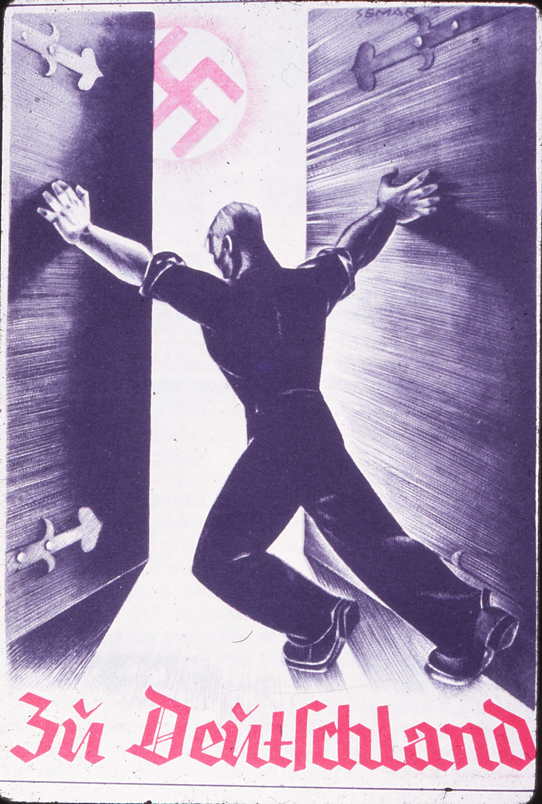
21. This poster was used during the Saar plebiscite of 1934. The caption: “To Germany.” The plebiscite was to determine if the Saar was to return to Germany. |
|
|
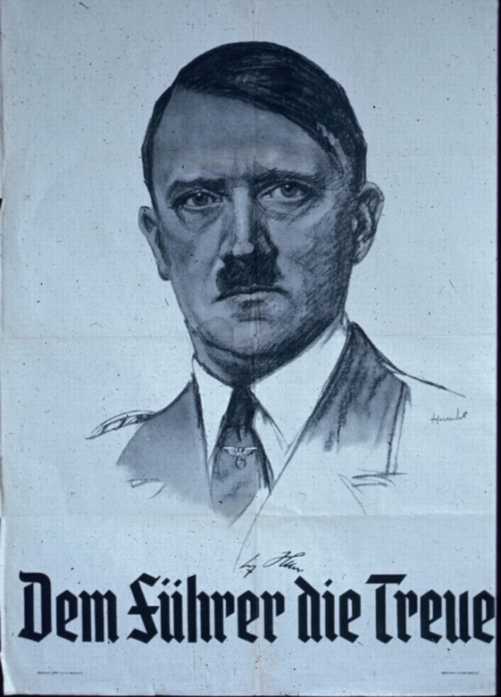
22. This poster was also issued during the Saar plebiscite of 1934: “Be true to the Führer.” Courtesy of Dr. Robert D. Brooks. |
|
|
23. A 1934 referendum poster. The text: “Führer, we will follow you.” Courtesy of Dr. Robert D. Brooks. |
|
|
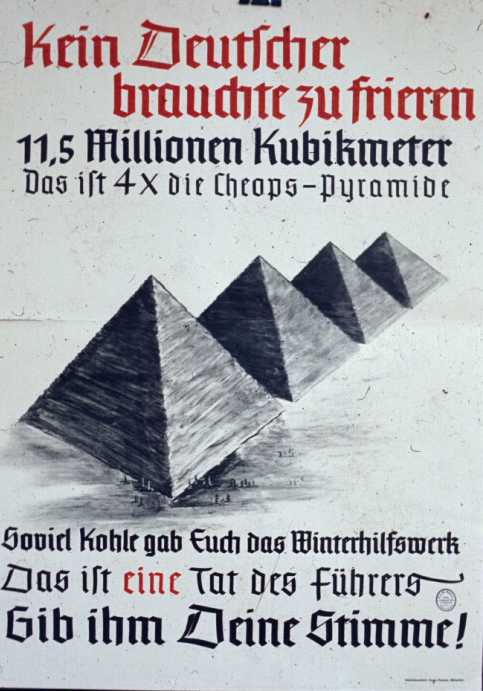
24. This poster dates to the 29 March 1936 referendum. The text reads: “No German must freeze. 11.5 million cubic meters of coal have been provided by the Winter Relief. That is 4 times the volume of the Great Pyramid of Cheops. That is one of the Führer’s accomplishments. Give him your vote!” Courtesy of Dr. Robert D. Brooks. |
|
|
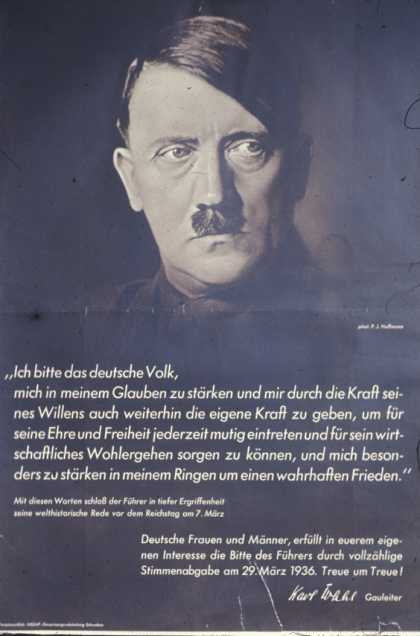
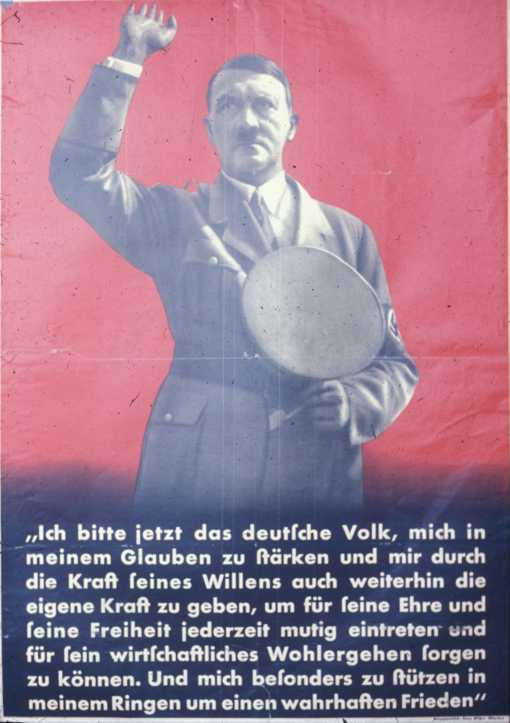
25. This poster promotes Hitler’s 1936 referendum. Since it quotes Schwabian Gauleiter Karl Wahl, I assume it comes from his area. Hitler is quoted as saying: “I ask the German people to strengthen my faith and to lend me its strength so that I will always and everywhere have the strength to fight for its honor and freedom, to work for its economic prosperity, and particularly to strenthen me in my struggles for genuine peace.” Karl Wahl says: “German women and men, it is in your own interest to fulfill the Führer’s request and vote on 29 March 1936. Be loyal to him who is loyal!” Courtesy of Dr. Robert D. Brooks. |
|
|
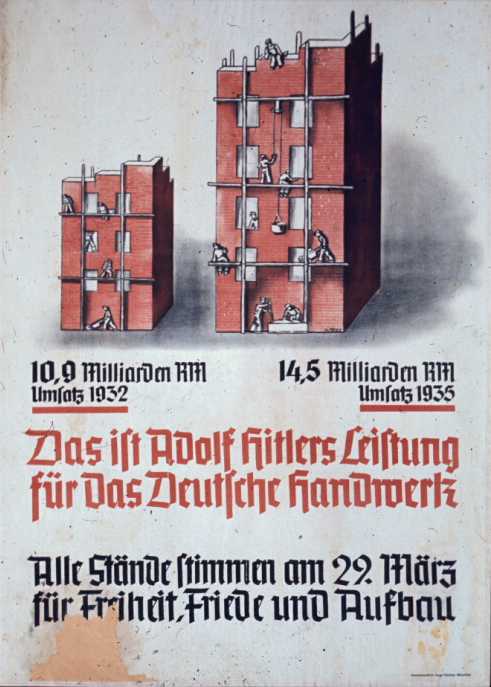
26. This poster is from the 1936 referendum. The text says that German construction expenditures rose from 10.9 billion Marks in 1932 to 14.5 billion in 1935. “That is what Adolf Hitler has done for German craftsmen. All classes vote on 29 March for freedom, peace and construction.” Courtesy of Dr. Robert D. Brooks. |
|
|
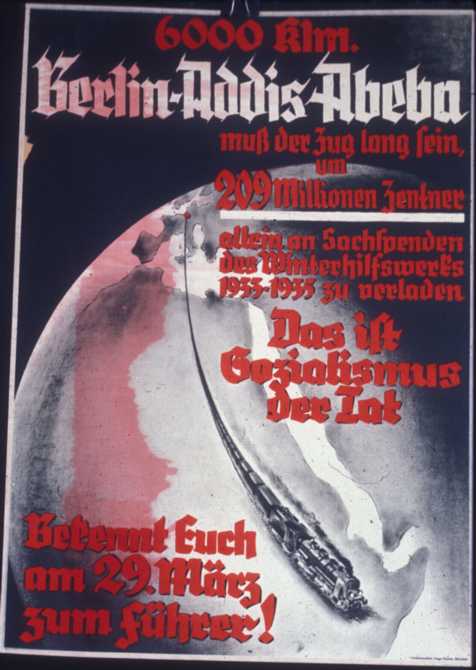
27. This poster is from the 1936 referendum. The text: “The train would have to be 6,000 kilometers long, stretching from Berlin to Addis Ababa, if it had to carry the 209 million hundredweights of materials contributed to the Winter Relief drive during the years 1933-1935. That is socialism in action. Support the Führer on 29 March!” Courtesy of Dr. Robert D. Brooks. |
|
|
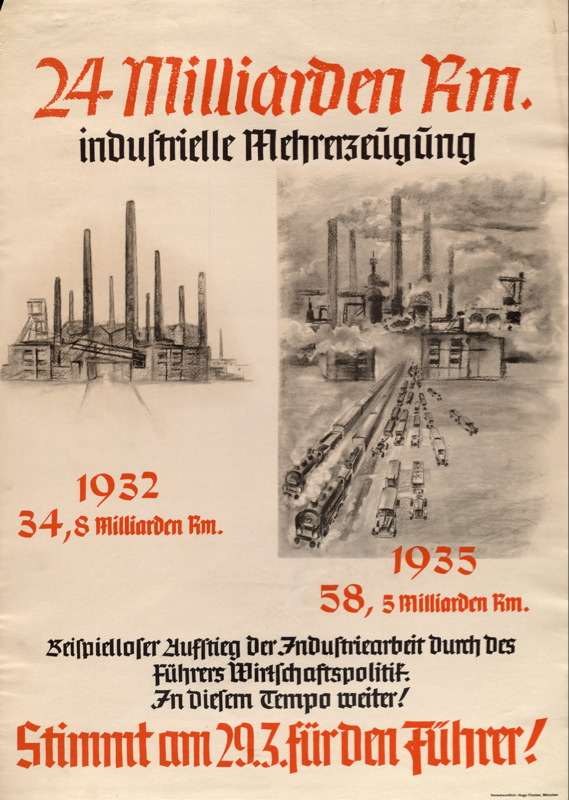
28. This poster is from the 1936 referendum. The text says that German industrial production has risen from 34.8 billion marks in 1932 to 58.3 billion in 1935. “An unprecedented increase in industrial production is the result of the Führer’s economic policy. Keep it going! Vote for the Führer on 29.3!” Courtesy of the University of Minnesota Library. |
|
|
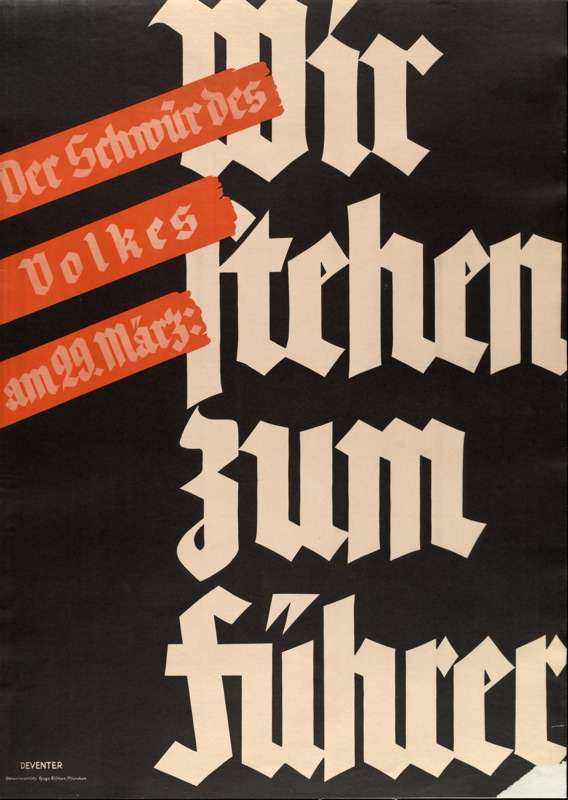
29. This poster is also from the 1936 referendum. The text: “We stand with the Führer. The oath of the German people on 29.3!” Courtesy of the University of Minnesota Library. |
|
|
30. This poster is probably from the 1936 referendum. The text: “Before: Unemployment, hopelessness, desolation, strikes, lockouts. Today: Work, joy, discipline, comaradarie. Give the Führer your vote!” Courtesy of the University of Minnesota Library. |
|
|
31. This one, too, is probably from the 1936 Referendum. The caption: “Check the war-mongers of the world. Every vote for the Führer!” Courtesy of Dr. Robert D. Brooks. |
|
|
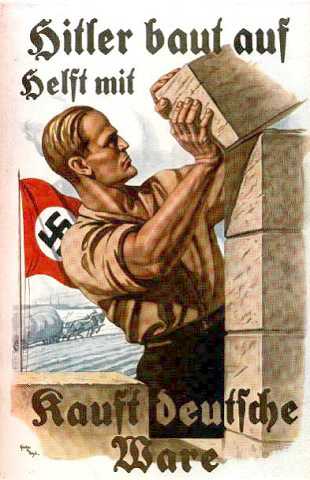
32. This poster probably comes from the mid-1930’s. The caption: “Hitler is building. Help him. Buy German goods.” |
|
|
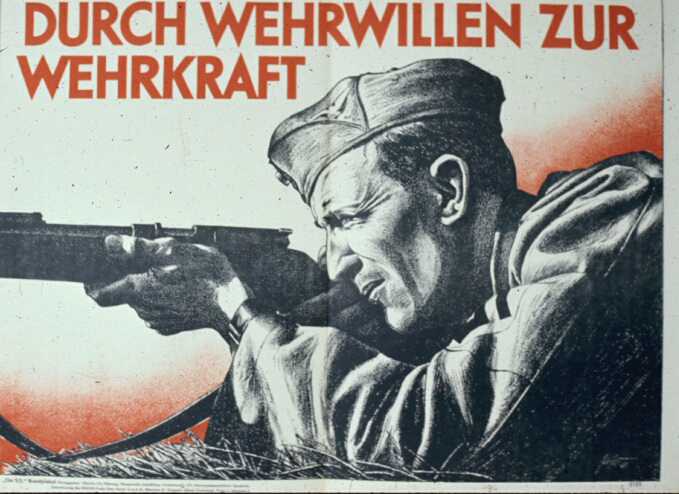
33. I’d guess this one is from the mid-1930’s. The caption: “Through military will to military strength.” |
|
|
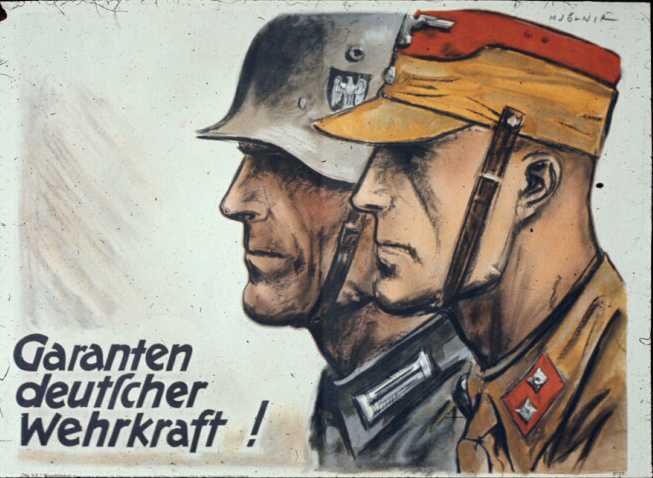
34. This poster by Mjölnir (Hans Schweitzer) uses one of his favorite themes. An S.A. man stands next to a soldier. I am not sure of the date. The text: “The guarantee of German military strength!” Courtesy of Dr. Robert D. Brooks. |
|
|
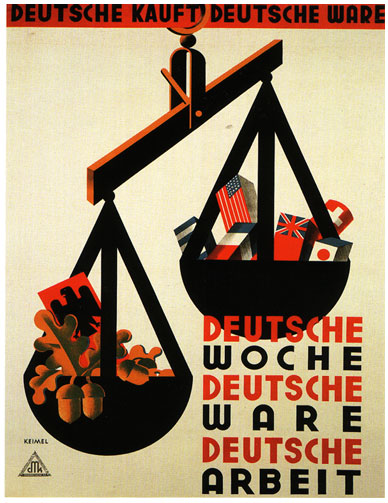
35. This poster is from the 1930’s, and encourages Germans to buy domestic rather than imported goods. The top translates as “Germans buy German goods.” The bottom text translates: “German Week/German Goods/German Labor.” |
|
|
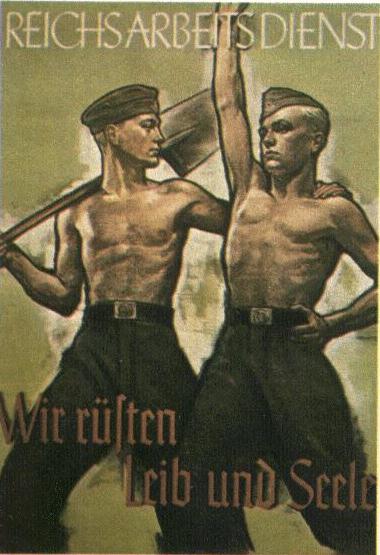
36. I’m not sure of the date on this poster, but it’s probably from the mid to late 1930’s. It promotes the Nazi labor service, for which men were expected to volunteer. The caption: “We build body and soul.” |
|
|
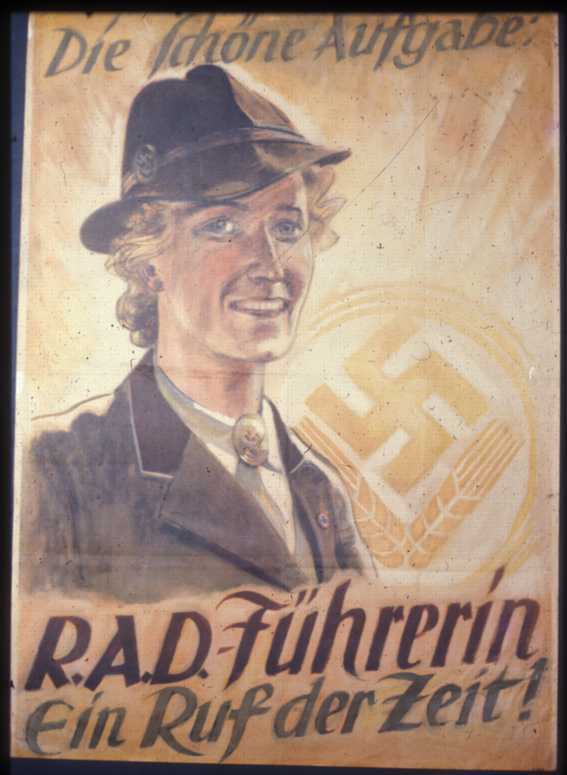
37. This poster is from the 1930’s encourages women to sign up for the labor service. The caption: “A wonderful task: Reich Labor Service Women’s Leader: A job for today!” Courtesy of Dr. Robert D. Brooks. |
|
|
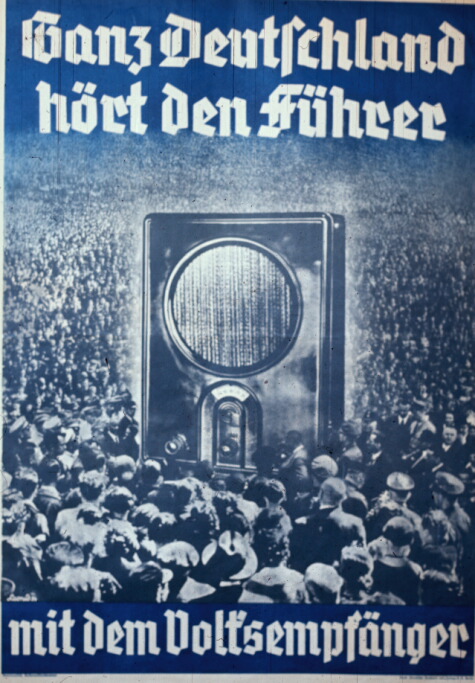
38. The text translates: “All Germany hears the Führer on the People’s Receiver.” The Nazis, eager to encourage radio listenership, developed an inexpensive radio receiver to make it possible for as many as possible to hear Nazi propaganda. Courtesy of Dr. Robert D. Brooks |
|
|
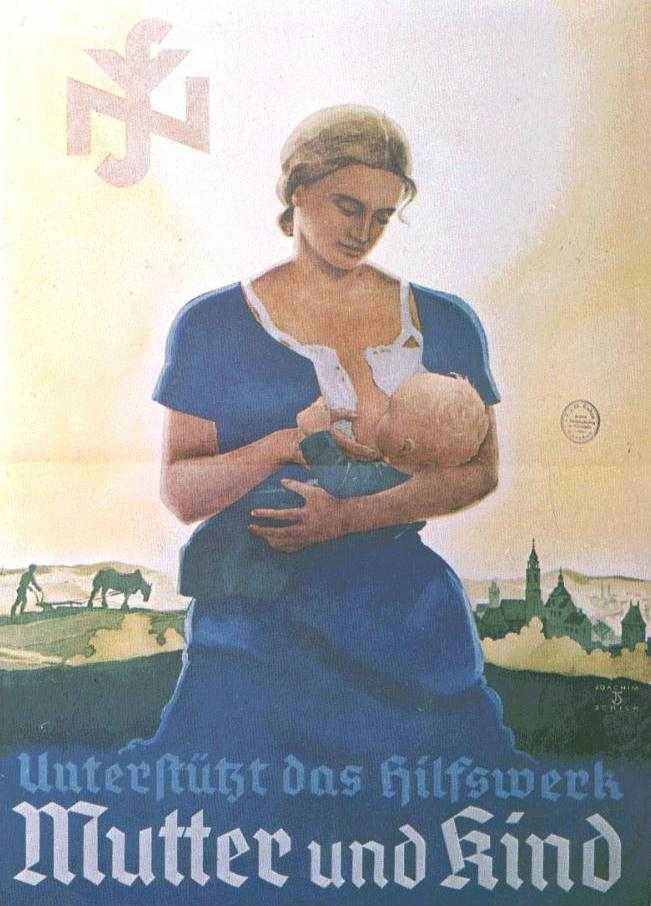
39.This poster probably dates to the mid-1930’s. It promotes the Nazi charitable organization (the NSV). The text: “Support the assistance program for mothers and children.” |
|
|
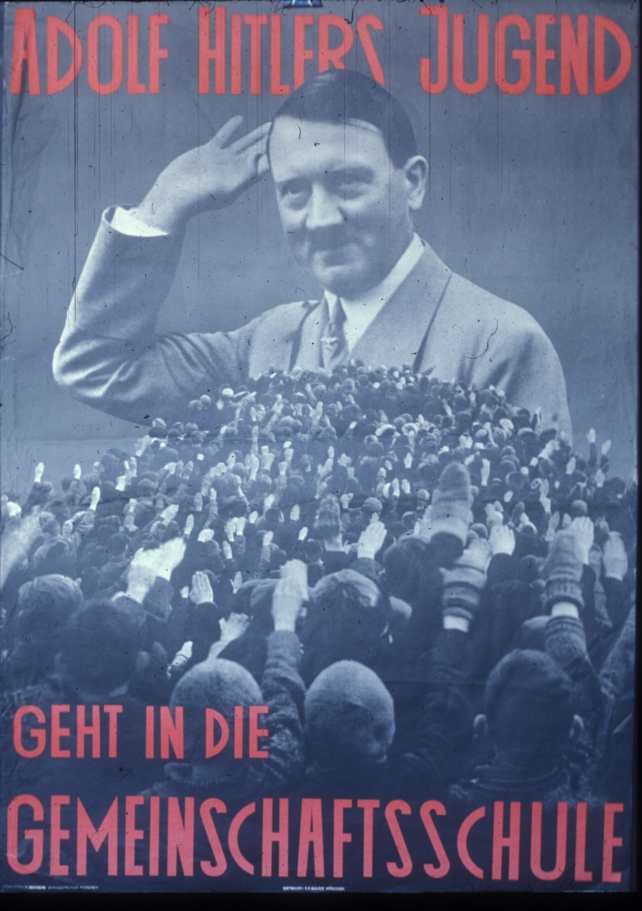
40. This poster from 1936 or 1937 promoted education. The caption: “Adolf Hitler’s youth attends community schools.” Courtesy of Dr. Robert D. Brooks. |
|
|
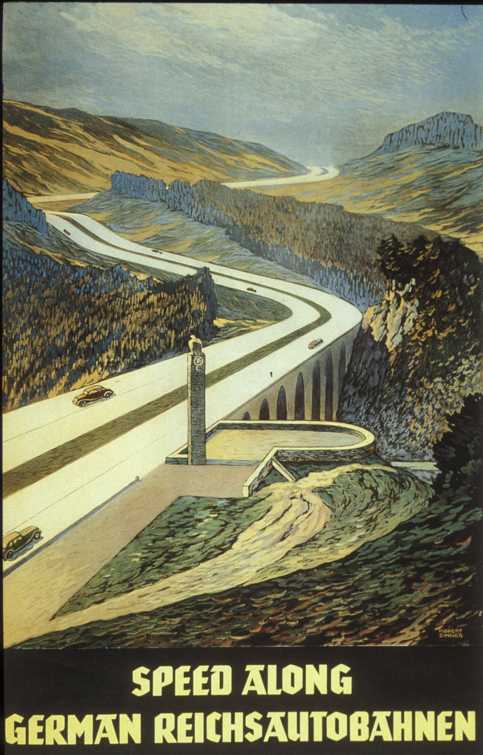
41. A tourist poster promoting the German highway system. This is from the 1930’s. |
|
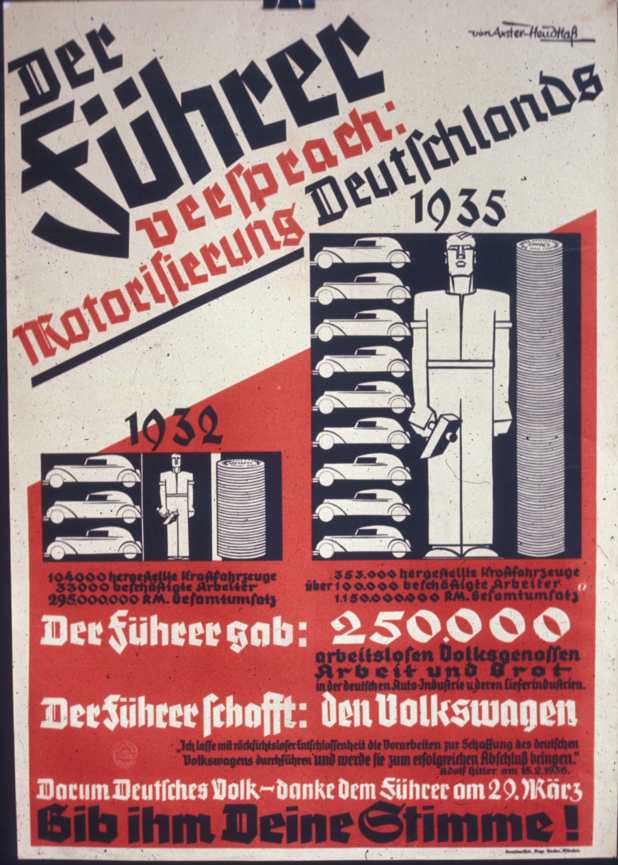
42. This 1936 poster urges people to vote for Hitler by noting what he has done to promote automobile ownership in Germany. The caption: “The Führer promised to motorize Germany. In 1932, 104,000 motor vehicles were manufactured, 33,000 people were employed, and goods with a total value of 295,000,000 marks were produced. In 1935, 353,000 vehicles were manufactured, Over 100,000 people were employed, and the value of goods produced was 1,150,000,000 marks. The Führer gave 250,000 people’s comrades jobs in the auto industry and its suppliers. German people: Thank the Führer on 29 March! Give him your vote!” Courtesy of Dr. Robert D. Brooks. |
|
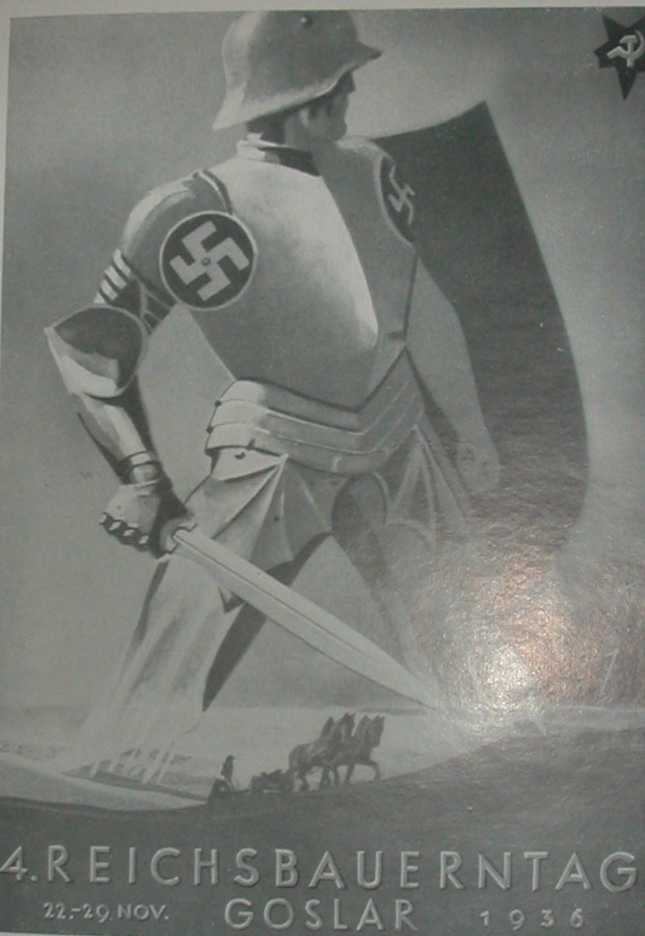
43. This poster, of which I only have a black & white version, was issued for the 1936 National Farming Rally, rather a Nuremberg rally for agriculture. The poster takes note of the major anti-Bolshevist campaign then in progress, evident from the Soviet star in the upper right. |
|
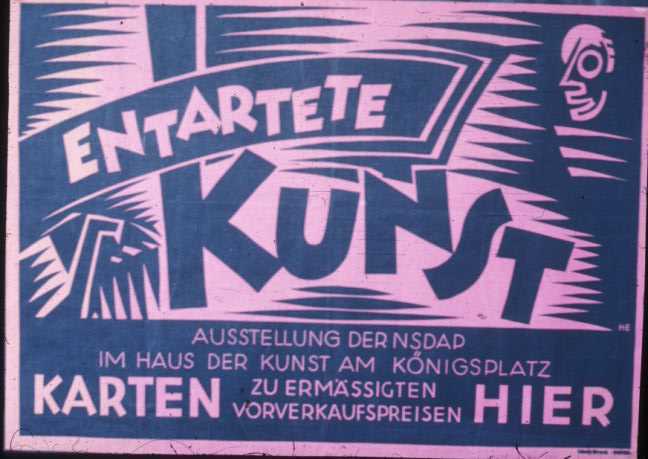
44. The Nazis staged a massive exhibition of “degenerate art” in Munich in 1937. Rather awkwardly, it drew more visitors than the exhibit of approved art. This poster announces the exhibition. The best book on the exhibition is Stephanie Barron, “Degenerate Art”: The Fate of the Avant-Garde in Nazi Germany (Los Angeles County Museum of Art, 1991). |
|
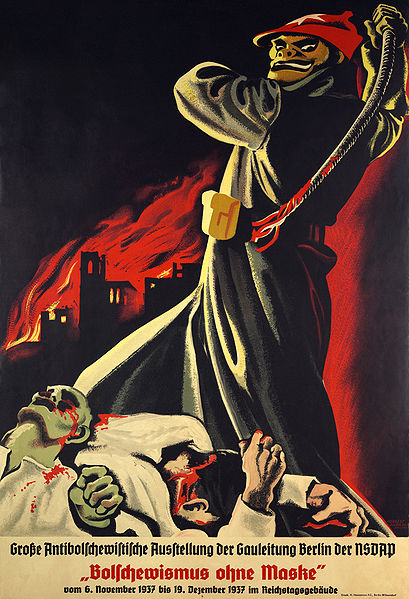
45. The Nazis staged an anti-Bolshevism exhibition in 1937. The program for the event is also available. I take this image from Wikipedia, which credits it to the Library of Congress. |
|
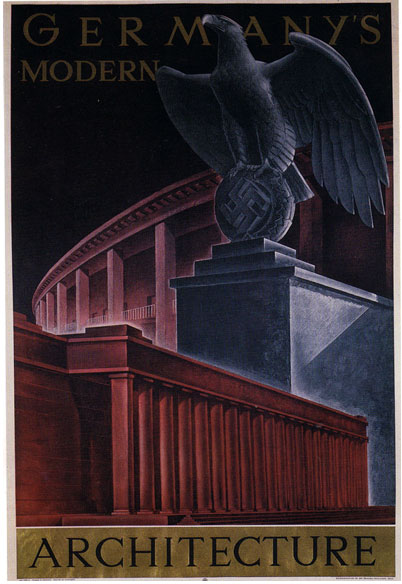
46. A tourist poster annoucing Germany’s accomplishments. I think this was from the 1937 Paris World Fair. This poster was provided by J. Castillon. |
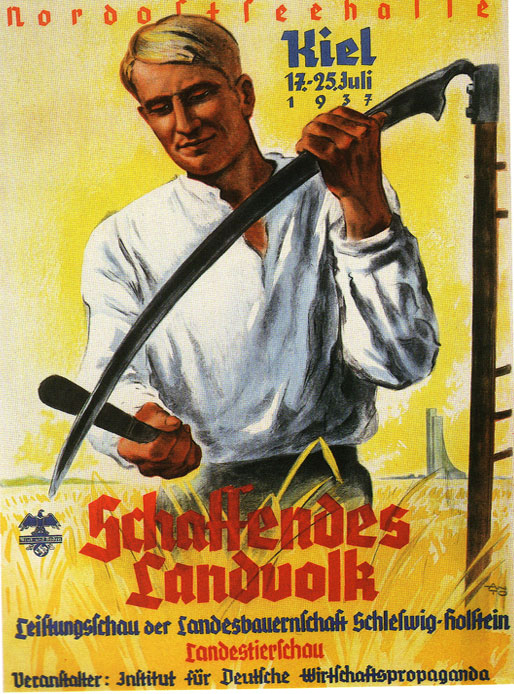 |
47. A 1937 poster announcing an agricultural fair in Kiel. This poster was provided by J. Castillon. |
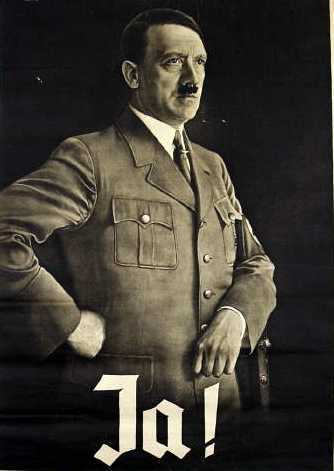 |
48. This poster urged a “Yes” vote on one of the four referendums Hitler called during the 1930’s. I believe this is for the April 1938 referendum, but am not entirely sure. |

|
49. Another referendum poster from 1938. The text: “Yes on 10 April.” Courtesy of Dr. Robert D. Brooks. |
|
|
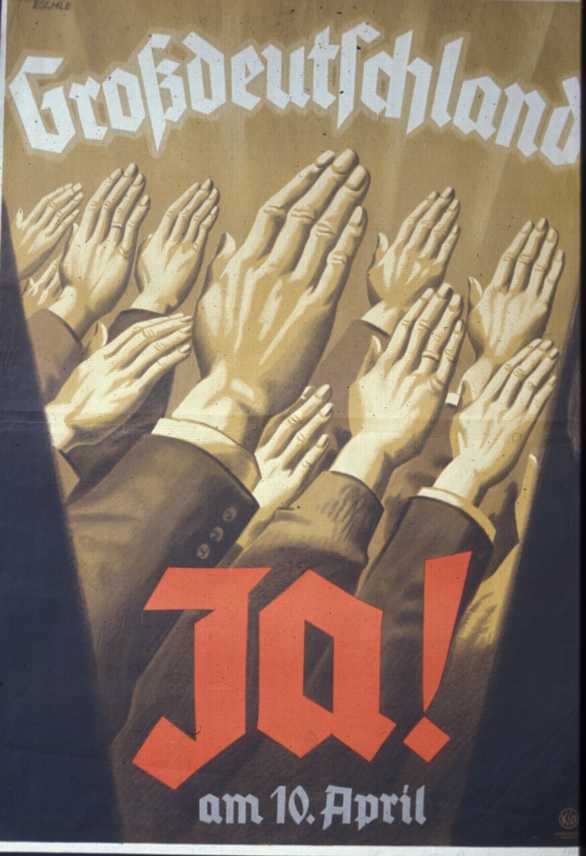
50. Another referendum poster from 1938. The text: “Greater Germany: Yes on 10 April.” Courtesy of Dr. Robert D. Brooks. |
|
|
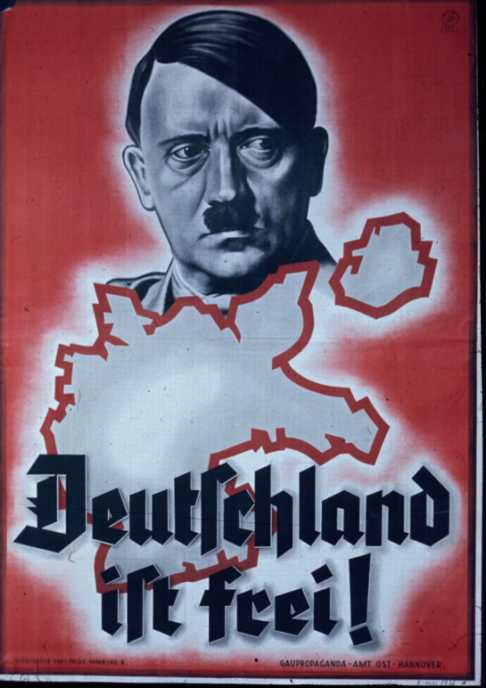
51. This poster is from the 1938. The caption: “Germany is free!” Courtesy of Dr. Robert D. Brooks. |
|
|
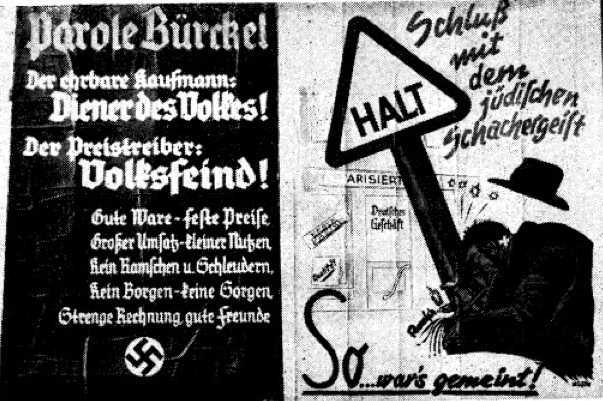
52. These are two March 1939 posters from Vienna. Nazi Gauleiter Bürckel had ordained price reductions on many items in a speech shortly before that accused Jews of commercial misdeeds. The first poster states: “Bürckel Says: The honest merchant is a servant of the people! He who charges excessive prices is an enemy of the people! Good products — fixed prices. Higher sales — Less exploitation. No hoarding or dumping prices. No borrowing — No worries. Clear bills — Good friends.” The second has a direct anti-Semitic theme: “Down with the Jewish bargaining spirit!” These were printed in Das Kleine Blatt, a Vienna newspaper. |
|
|
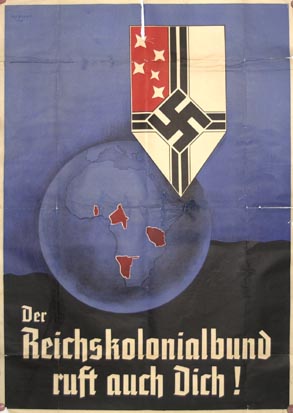
53. The Reich Colonial League was a Nazi Party affiliate propagandizing for the return of Germany’s former African colonies. the caption translates as: “The Reich Colonial League Calls to You, Too!” The poster probably dates to the 1930’s. |
|
|
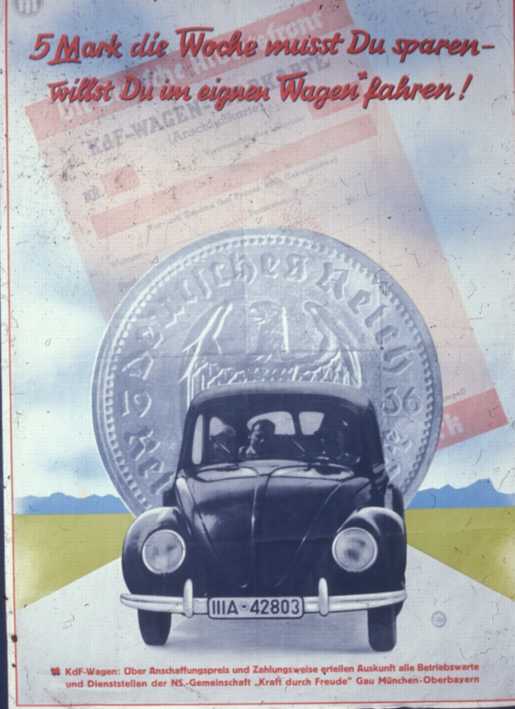
54. This poster from around 1939 advertises the Volkswagen. The text: “Save 5 marks a week and you will drive your own car. “ Courtesy of Dr. Robert D. Brooks. |
|
|
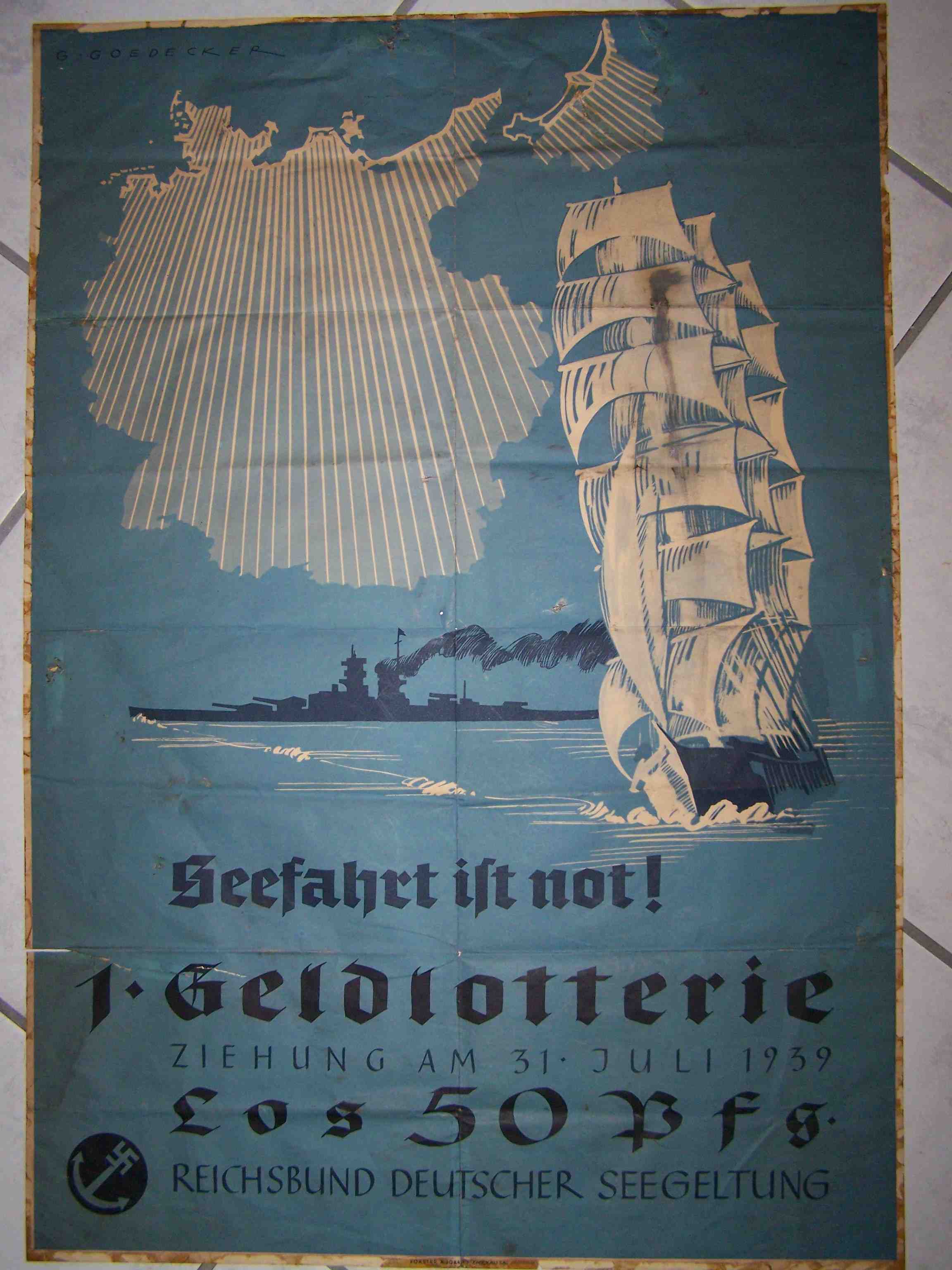
55. This 1939 poster announces a fundraising lottery for the Reichsbund Deutscher Seegeltung, the Nazi organization that promoted public interest in naval affairs. |
|
|
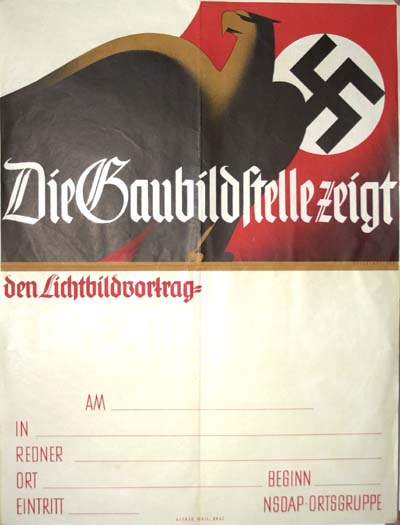
56. This is a poster used to advertise local Nazi meetings with slide shows. The Gaubildstelle was the party office that arranged such shows, of which there were many. There is space to fill in the time, location, speaker and topic. I’m not sure of the date on this one. |
|
|
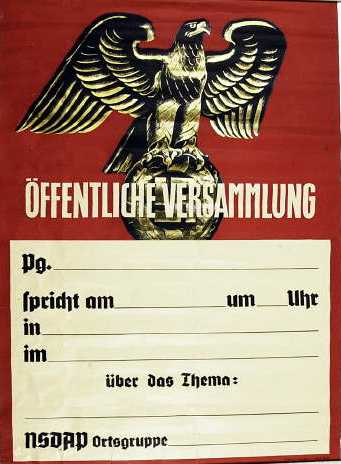
57. This is a another poster used to advertise local Nazi meetings. There is space to fill in the time, location, speaker and topic. I’m not sure of the date. |
|
|
58. This poster promotes the NSKOV, the Nazi organization for veterans. The caption: “Comrades at the front — Comrades for life. Advice and assistance in all areas of need.” Courtesy of Dr. Robert D. Brooks. |
|
|
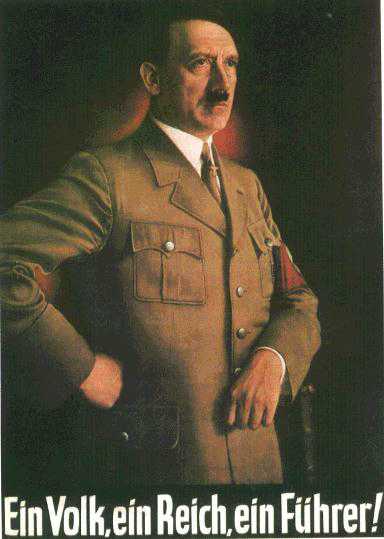
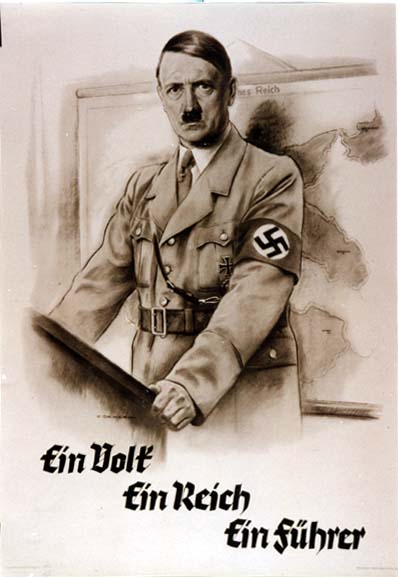
59. This 1938 poster was issued shortly after the Anschluß with Austria. The caption: “One People, One Reich, One Führer.” |
|
|
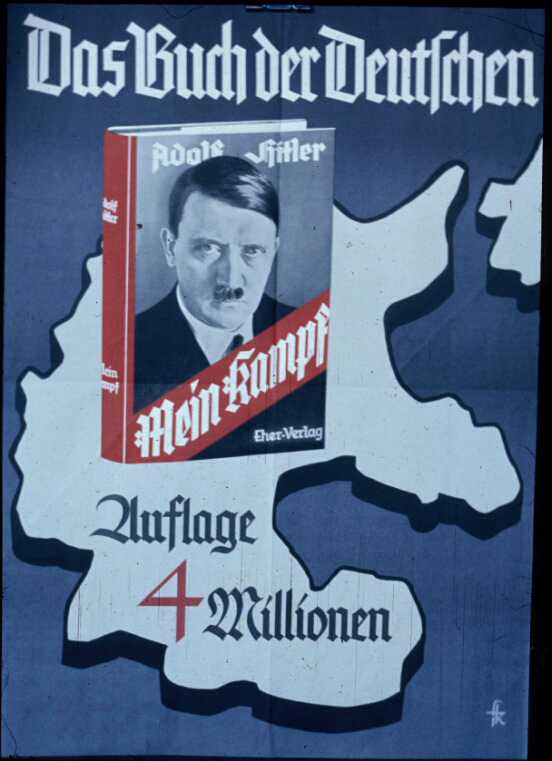
60. This 1938 poster promotes Hitler’s book Mein Kampf, announcing that four million copies have been sold. Courtesy of Dr. Robert D. Brooks. |
|
|
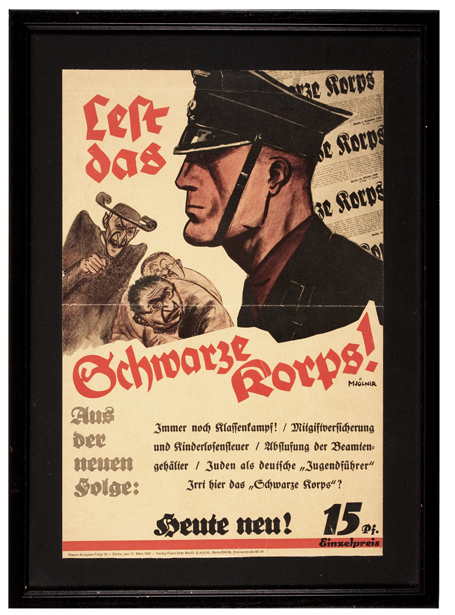
61. This poster advertises the SS weekly newspaper Das Schwarze Korps. I take the image with permission from Alexander Historical Auctions. |
|
|
62. This looks to be from the late 1930’s, but I’m not certain of the date. The text: “I now ask the German people to strengthen my faith and to give me through the strength of its will the strength I need to continue to fight courageously at any time for its honor and its freedom, and to be able to further its economic prosperity. I ask it particularly to support me in my struggle for true peace.” Courtesy of Dr. Robert D. Brooks. |
|
|
63. This poster was also issued shortly after the Anschluß with Austria. The caption: “One People, One Reich, One Führer.” |
|
|
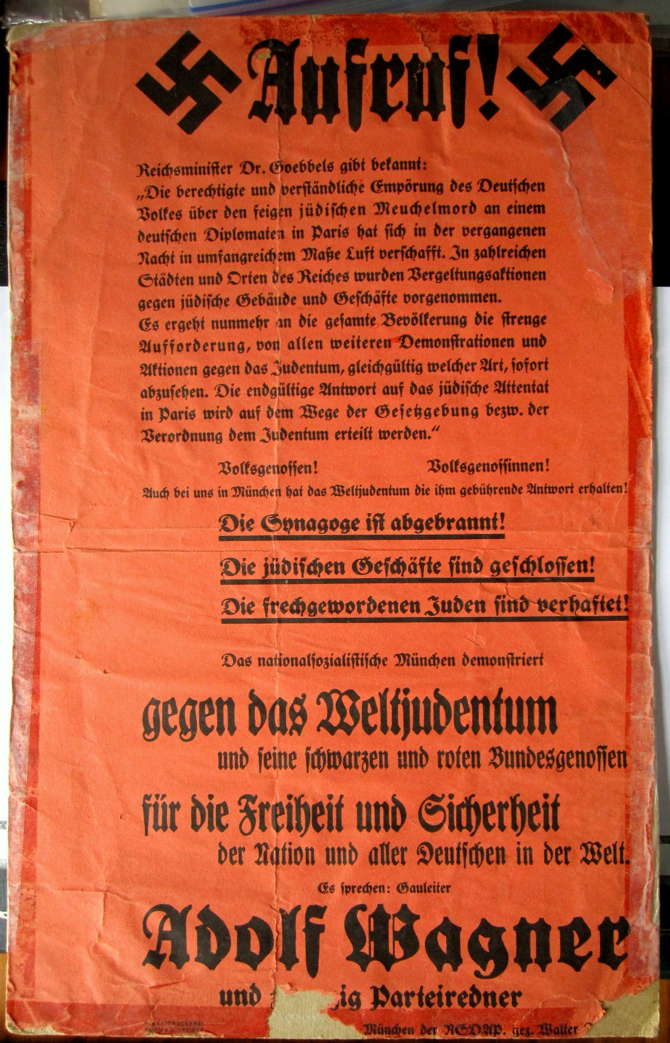
64. The Nazis presented the anti-Semitic pogrom of November 1938 as a justified reaction of the German people to world Jewry. This poster was issued in Munich to advertise an evening of Nazi meetings celebrating the event. It translates: “Notice! Reich Minister Dr. Goebbels announces: ‘The legitimate and understandable outrage of the German people at the cowardly Jewish murder of a German diplomat in Paris led to widespread actions last night. Reprisals were carried out against Jewish buildings and businesses in many towns and localities. The population is now ordered to refrain from all further demonstrations and actions of any kind against the Jews. The final answer to the Jewish crime in Paris will be through legislation or regulations about the Jews.’ Citizens! World Jewry also received the appropriate answer here in Munich! The synogogue is burned down! Jewish businesses are closed! Insolent Jews have been arrested! National Socialist Germany demonstrates against World Jewry and its black [Catholic] and Red allies for the freedom and security of the nation and all Germans throughout the world. Gauleiter Adolf Wagner and twenty party orators will speak.” |
|
|
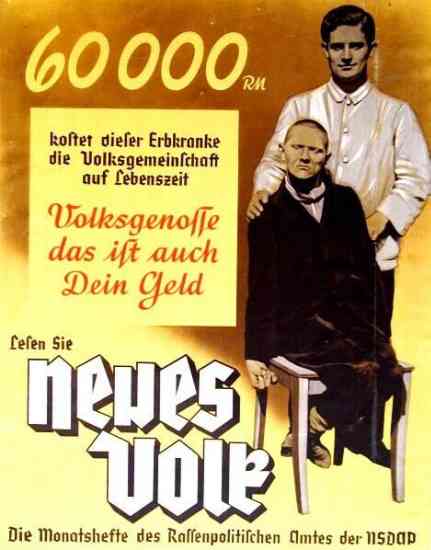
65. This poster is from the 1930’s, and promotes the Nazi monthly Neues Volk (New People}, the organ of the party’s racial office. The text reads: “This genetically ill person will cost our people’s community 60,000 marks over his lifetime. Citizens, that is your money. Read Neues Volk, the monthly of the racial policy office of the NSDAP.” |
|
|
66. The 1939 Nuremberg Rally was to be the “Party Rally of Peace,” but it was canceled when World War II began. |
| Search the Archive: |
[Page copyright © 2001 by Randall Bytwerk. No unauthorized reproduction. My e-mail address is available on the FAQ page.]
Go to the 1933-45 Page.
Go to the German Propaganda Home Page.