


Background: These are the official GDR definitions of Propaganda, Agitation, and Agitator. They are taken from the political dictionary published by the Dietz Verlag, the party’s publishing house. In brief, propaganda treated a few issues in depth, agitation presented many ideas to the masses, but in less depth. Or as it was jokingly put, propaganda explained the glorious future of communism, agitation explained the bumps and potholes along the way.
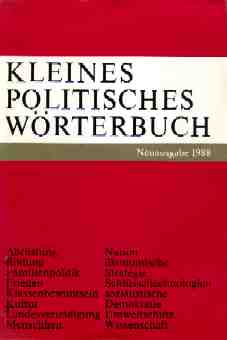
The source: Kleines politisches Wörterbuch: Neuausgabe 1988. (Berlin: Dietz Verlag, 1988) pp. 17-18, 795-797.
A component of the political leadership of society through the working class party, focused on bringing the party’s message to the masses. In close cooperation with propaganda, agitation advances political persuasion and training. Agitation leads to action, mobilizing the masses to further form the developed socialist society in the GDR, as well as to create fundamental prerequisites for the gradual transition to communism. In order to accomplish the goals of the party, Vladimir I. Lenin wrote: “We have to reach both as theorists and propagandists as well as agitators and organizers” all classes of people. The strength of agitation lies in its truthfulness, in exact knowledge of the experiences of the masses in building a socialist society, as well as in spreading and transmission of new and progressive ideas. It must be closely tied to practice in the realization of political and economic tasks. Building on the foundation of Marxism-Leninism, socialism seeks to create socialist persuasion. It educates the workers in socialist patriotism and proletarian internationalism, as well as builds their strong class position in the battle against the enemies of peace and socialism. The effectiveness of agitation is demonstrated in the concrete actions of workers to strengthen socialism in every area. An important part of agitation is the persuasive explanation of the decisions of the SED [Socialist Unity Party of Germany] and the government of the GDR, and maintaining a constant dialogue between communists and the citizens. This carries out Ernst Thälmann’s desires for daily, systematic dialogue with the masses. Agitation conducts the discussion with bourgeois ideologies and ideas. Marxism-Leninism teaches that there can be no compromise between socialism and bourgeois ideology. These ideologies are irreconcilably opposed to each other. This is especially important in light of the intensification of the ideological struggle between socialism and imperialism. Lenin insisted that the communists work patiently with the masses to understand the special and psychological features of all walks of life and every occupation, in order to make their political work understandable, persuasive and clear. Above all, effective leadership of political agitation requires the ability to correctly determine its contents, direction and form in the respective period of the struggle. Effective political mass agitation is characterized by consistent party-mindedness, elevated ideas, a closeness to life, persuasive reasoning, variety in the choice of means, and clarity. Its most important tool is the example. The means of agitation include: press, radio and television; oral agitation (individual conversations, discussions in small circles, lectures, forums, etc.); written agitation (brochures, tracts, flyers, etc.); visual agitation (posters, bulletin boards, exhibits, etc). Agitation uses these various methods in a coordinated manner.
A functionary involved in the political work of the masses, who is designated by an elected leadership group to lead political discussions. Above all, in work collectives he explains the decisions of the party, mass organizations, government and current events from a class perspective. Through personal conversations and small group discussions, it becomes possible to find solutions at the local level, answer questions directly, and to meet the assigned goals. The agitator must be regularly informed by the leaders about the newest governmental decisions so that he is qualified for independent argumentation. To a large extent, his effectiveness is determined by his party-mindedness and his personal example. The agitator should have broad political experiences and friendly relationships with his colleagues. The foundation of his work comes from his superiors, publications, the mass media, as well as their information on issues in socialist construction and the international situation. As a result of agitation by the party and mass organizations, mass political work is broader, more focused, and more effective.
The systematic spreading and thorough explanation of political, philosophical, economic, historical, as well as scientific, technical, and other types of ideas. In contrast to imperialist propaganda, which seeks to conceal the real goal of capitalist domination from the people by manipulating their consciousness, Marxist-Leninist propaganda, which is based on the objective laws of development under the current concrete-historical situation of our epoch, characterized by the worldwide transition from capitalism to socialism, establishes the scientific social strategy of the Marxist-Leninist party and supports the fulfillment of the historic mission of the working class. The Marxist-Leninist propaganda of the SED promotes the well-being of the people and the safeguarding of peace, and also contributes to a developed society in the GDR and thus builds the fundamental prerequisites for the gradual transition to communism. This propagates the far-reaching political, economic, social, spiritual and cultural changes that come with the development of a socialist society. Propaganda is an essential part of the ideological work, which is the heart of all the party’s activities. The works of Karl Marx and Friedrich Engels, Vladimir I. Lenin, the decisions of the party, the experiences of the revolutionary German workers movement, and the realization of the common goals by the communist and workers parties are fundamental to the Marxist-Leninist propaganda of the SED. Anchored in the program of the SED, the propaganda of the SED concentrates on equipping the working class and other productive classes with the revolutionary ideas of Marxism-Leninism, presenting the policies of the party in a persuasive manner. The most important goal is to explain to the workers the tested domestic and foreign policies in personal conversations at work, at home, and in the mass organizations. It must also encourage citizens to think, feel and act in a socialist way, and encourage their initiative and creativity in the fight for peace, in order to further strengthen socialism and at the same time firmly oppose bourgeois ideology. An important concern is to propagate the historical superiority, values and achievements of socialism, as well as to publicize its unparalleled accomplishments. It should also build pride in what has been accomplished and encourage personal responsibility, to both do more and protect what has been accomplished. This places new demands on the quality and effectiveness of propaganda. Marxist-Leninist propaganda is, above all, directed at deepening the socialist patriotism and proletarian internationalism of all working people. Its goal is to strengthen the knowledge and conviction of the leading role of the working class and its Marxist-Leninist party, and to actively develop and strengthen socialist consciousness among the working people as well as the Marxist-Leninist worldview and morality of the working classes. Socialist consciousness is the foundation of the workers’ productive productive activity. It develops primarily in the process of work. Therefore the political-ideological work concentrates more and more on the development of educational strengths of the workers’ collectives, and thus promotes the purposeful participation of the workers in the determining and achieving societal tasks. That requires that ideological work focus on the main goal, the unity of economic and social policies, focusing on the realization of economic strategy, and the fulfillment of the national economic plan. Each must recognize his responsibility for the strengthening of the economic power of the GDR. Propaganda contributes to the class consciousness of the workers of the GDR, the consciousness of their responsibility in the fight for peace, their socialist outlook on work, socialist property, their love for the socialist fatherland and for the party of the working class. It uses all the revolutionary, progressive and humanist traditions, its firm ties to the CPSU [Communist Party of the Soviet Union], the people of the Soviet Union and other countries of the socialist community, their solidarity with the revolutionary worker movements in capitalist countries, as well as all those forces fighting for peace and social progress. The constant threat to world peace and the future of humanity by the most aggressive circles of Imperialism, requires the readiness to defend the socialist fatherland uncompromisingly against all attacks of the enemy. The spreading of Marxist-Leninist ideas is inseparably bound to the constant and determined exposure of imperialist strategy, policies and ideology. Marxist-Leninist propaganda consistently opposes the phenomena of anti-communism, anti-Sovietism, and nationalism, and right and “left,” revisionism and opportunism, in whatever form they appear. Among the fundamental principles of Marxist-Leninist propaganda is the unity between theory and practice, between word and deed, between political, economic and ideological tasks and their offensive polemic character. In order to ensure the effectiveness of ideological work, the SED not only devotes substantial attention to the method, but to the contents as well. It considers the mutual relationship between understanding and feeling and therefore makes use of all means in order to make propaganda lively and effective in the minds of the people. The leading role of the SED grows with the building of the developed socialist society of the GDR. As a result, Marxist-Leninist propaganda wins greater significance. Party education and mass propaganda both have major roles. Agitation is also inseparably connected to Marxist-Leninist propaganda.
[Preliminary translation by Katherine Lynch. Final page copyright ©2000 by Randall L. Bytwerk. My e-mail address is available on the FAQ page.]
Go to the GDR Page
Go to the German Propaganda Archive Home Page