


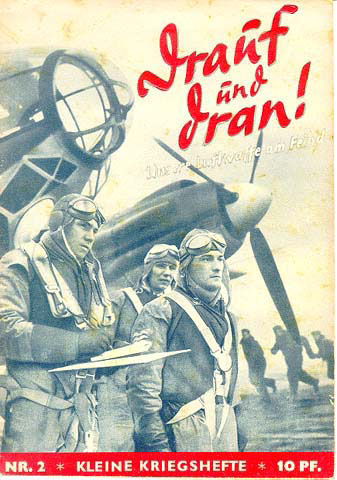
Background: These three articles, “Hunting Pirates in the [English] Channel,” “Landing as if Dreaming” and “The Battle over the Heligoland Bight” were published in the second of a series of booklets on the war. Its date is in the early spring of 1940, before the invasion of Denmark and Norway. It was at least partially aimed at the youth. My copy has a drawing by the original owner showing a German fighter chasing an English fighter.
The source: “Auf Piratenjagd im Kanal,” “Wie im Traum die Landung ausgeführt” and “Die Luftschlacht über der Deutschen Bucht,“Drauf und Dran! Unsere Luftwaffe am Feind. Kleine Kriegshefte Nr. 2 (Munich: Zentralverlag der NSDAP., 1940), pp. 1-2, p. 25 and pp. 26-28.
It was a difficult yet satisfying task: “Scout the mouth of the Thames and hunt for armed British ships.”
The men were filled with an iron will as they flew toward their goal. Most of them had earned the Iron Cross and had often been to the English coast.
 The observer sits in the cockpit. He had made a name for
himself during the Spanish Civil War as “Iron Gustav.” The crew
is proud of him: “He charges in like Blücher and his bombs
always hit their targets...”
The observer sits in the cockpit. He had made a name for
himself during the Spanish Civil War as “Iron Gustav.” The crew
is proud of him: “He charges in like Blücher and his bombs
always hit their targets...”
“The English Channel is a wonderful area,” says the mechanic, as the others peer through binoculars across the glassy water.
Where have the once so numerous ships gone? Vanished!
After a time things liven up. It’s no pleasure flight any longer. It is a mission for tough guys who can look danger straight in the eye.
Nerves are strained. One looks left, the other right, and searchlights rise into the heavens from the English coast. Things are happening down below. Be on watch. At first there are just “cheap targets,” as the pilot calls the little ships. The crew is looking for bigger game.
“Hey, down there, that’s what we want — I’d guess 4,000 or 5,000 tons. That’s the one we want.”
The dark spot grows larger. The pilot curves slightly. The “prey” must be “surprised.”
But the Germans have been seen. Peppery greetings rise to meet them. The English pirate quickly receives his “just reward.” The illegal weapons must naturally be punished. Down ... dive ... the button is pressed and the first bombs follow their path, hitting the English ship dead center!
Through increasing smoke, the Englander defends itself, every gun shooting. A second dive! A hit! And again. The third bomb hits!
The whole ship seems to rise under the explosions. Our warplane jumps several times under the air pressure.
Down there, a smoking wreck! Two pillars of flame rise, mixing with white and black smoke to form a splendid symphony of color!
The ship is done for: its fate is seated in a few minutes. The crew deserts the ship as fast as it can. They have learned the disadvantages of serving on an armed merchantman!
Course northeast! The crew is in good humor. An icy wind blows outside. Searchlights illuminate the English coast once again. Their deadly fingers reach into the heavens, searching with wide and narrow beams. In vain! They do not find us!
Underneath are mine fields, the English ones to the left, the Dutch to the right. Lights shine from Holland.
The canal is behind us. Not a Tommy in sight, no fighters or intruders are in the vicinity, Down below, however, a British destroyer is seeking to escape. It has seen the German machine and is very excited. The dark gray wake shows its path.
“A worthwhile flight. It’s great to hunt English pirates in the Channel!” With these words the four men leave their aircraft, receiving the hearty greetings of the ground crew.
A wounded flyer tells this story.
We were on a mission against the enemy, me as the observer next to the pilot and the gunners in the cockpit. In a battle over enemy territory we were hit several times by an enemy plane. They did not seriously damage our aircraft, but wounded the pilot in the head, breast and legs. He sunk in his seat and his hands fell from the controls.
With the approval of the crew which was readying its parachutes, I forced myself next to the half-dead pilot, despite my wounded foot. Against my own expectations, I was able to turn the plane and bring it over German territory, but that entirely exhausted my aeronautical abilities. As an observer, I knew neither how to take off or land. I made several wide circles over a landing field, during which the plane threatened to stall several times, undecided about whether I should risk a potentially fatal landing. I noted movement on the part of my comrade. He was still alive.
I yelled in his ear: “Land! Land! He finally heard me, and pulled himself back from death, opening his eyes, wiped his bloody face and sat up. As if in a dream, he took the controls and put his foot on the rudder control. With a weak smile, he began to land the plane. He did not forget to set the flaps, which he lowered a bit on the way down.
His smile spread a little as he felt that we were on the ground, but then his smile faded. We sat motionless in the machine for a long while, hardly daring to take the life he had given to us, until the ground drew hurried to us.
God grant me such a death!
Who will not bow with me in respect before this unknown pilot?
The English Air Force received a devastating blow on 18 December as it attempted to attack the northwest German coast. 26 of 52 attacking aircraft were shot down in the air battle that developed north of Helgoland and moved over the Heligoland Bight. The brilliant and unstoppable attacking spirit of the German Luftwaffe, displayed so clearly in this battle, proves that any future British attempt to attack Germany will meet as disastrous a conclusion. The day will forever be a glorious page in the history of the German Luftwaffe.
“The show developed as it had to develop,” said Lieutenant Schumacher, the German squadron commander, of the big five-hour battle. “The British attack occurred under favorable weather conditions, with blue sky and little fog. It was spotted early. My squadron, fighters and destroyers, were sent to the area the English would have to pass through if they wanted to attack the coast. I kept a small reserve over the North Sea coast.
There was nothing more for me to do. I was sure there would be a fight with the Tommies. I was in touch with my planes by radio. My job was to sit in my fine Messerschmidt and see to it that as many English as possible were shot down.
There was not much to see as I took off. There was mist over the islands along the coast. Up a thousand meters, however, the view was fantastic, 50 to 60 kilometers visibility. It was a beautiful view. To the north and east were towering clouds, and my planes were everywhere plunging toward dots. These dots were English warplanes.
My machine pressed on. Soon it passed through white clouds of gasoline that streamed from the tanks of enemy planes, then through clouds of smoke rising form English bombers that had been shot down. Above me I saw a few scattered Tommies. I headed in their direction. Around 3000 or 3500 meters, I took aim at an English plane and shot toward the cockpit. The Tommies broke off and looked for safety.
But my plane was faster. I did not let my target out of my sight, making a second attack. A few shots, then I climbed to make a third attack. I came at him from an angle of 50 or 60 degrees and shot a burst straight toward the cockpit. I must have hit, since I saw smoke. The Tommy was done for.
At the same instant I was attacked by a comrade of the downed British flyer. There was a strong odor of gasoline. My tank had been hit. Open the window! The engine slowed down. Slowly, carefully, I headed home and landed with the last drop of gas. I counted numerous holes in my machine.
I had been gone 20 or 25 minutes. I was the last to take off and the first to return. My colleagues followed after. There was scarcely a machine that did not wave its wings before landing as a sign of a victory.”
Captain Falk was on a reconnaissance mission with part of his squadron as the news of the enemy attack reached him.
“I changed course immediately. The flak bursts showed me the right direction. It was messy up there. I had never experienced anything like it before. Wherever one looked, Tommies were falling. Everywhere British planes were being chased by Germans. I headed for an English bomber, and quickly had three hits on my machine, one just missing my head. But soon I had the English plane in my sights, and opened fire. The British bomber fell like a rock, leaving a cloud of smoke as it plunged into the water.
By the end, our five planes were 150 kilometers out over the ocean, and every few minutes we shot down another Tommy. I went after a second Tommy. Smoke was already coming from the seriously damaged Wellington when suddenly a black stream of smoke came from the engine of my Messerschmidt. The enemy gunner who had been firing to the end had hit me. I was 130 kilometers from the coast, and had to depend on the second engine to get me home. But I was able to land anyway.”
The pluck and daring, the firmness, toughness and strength of duty and will with which the German flyers carried on the glorious battle was unprecedented. One captain lost an eye to an English bullet. Blood streamed over his face. Torn by tremendous pain, he remained in control of his plane. The pilot of another plane was shot in his breast, the radioman in the arm, but both got the Messerschmidt back to base. A lieutenant got splinters in his arm and breast when a bullet hit the signal box next to him. His damaged motor could hardly sputter, but he still made a round before landing to announce his aerial victory. A corporal had used all his ammunition. In his rage, he flew toward a heavy English bomber and joined the English formation for a while, shaking his fist at the English.
The German aircraft were as incredible as their flyers. Many planes had 30 or 35 hits. The battle was 150 kilometers out from the coast, yet despite the damage all but two aircraft came home.
[Page copyright © 1998 by Randall Bytwerk. No unauthorized reproduction. My e-mail address is available on the FAQ page.]
Go to the 1933-1945 Page.
Go to the German Propaganda Archive Home Page.