


Background: The Nazis were a totalitarian movement that wanted to involve the party in every aspect of life. The churches were a particular problem, since they also had a faith that claimed every aspect of life. Although the Nazi platform favored a “positive Christianity,” its leaders viewed the church as an enemy that ultimately would need to be dealt with. One way of combating the church was to develop Nazi rituals to replace those of the church. Both the Protestant and Catholic churches had the rite of confirmation. The Nazis were interested in replacing it with a Nazi version. This article from Der Hoheitsträgerprovides suggestions on organizing such rites. The periodical was published by Robert Ley’s Reichsorganisationsleitung, and was “confidential.” However, since it was circulated to over 38,000 people (1942 statistics), there was not much in it that was confidential. For further information on Nazi ceremonies, see some of my published articles.
The source: “Jugendfeier — Lebenswende der Jugend” Der Hoheitsträger, #1/1939, pp. 23-28.
The following pieces are the core of Kieckbusch’s thorough treatment: ‘How Do We Organize Youth Ceremonies?” The proposed organization of the ceremony is taken from last year’s ceremonies by Kreisleitung Northeim. It was developed by party member rings. The musical suggestions were developed by party member Köhler, head of the Music School for Youth and Nation in Hanover. The remaining material was developed by Gau Education Chief Kieckbusch of Hanover, who prepared this material for the Hoheitsträger and the districts in his Gau.
The transition from 14 to 15 is an important event for the youth. Many finish school and leave their parents’ home to take up an occupation. The boys move from the Jungvolk to the Hitler Youth and the girls move from the Jungmädel to the League of German Girls. More than that, each youth now has greater independence, which is signified by the fact that each German upon completion of the fourteenth year has legal freedom of conscience. Each German at 14 is allowed to choose his faith. His inner beliefs can now become public.
A greater sense of independence develops in all other areas of life as well. To hold a brief moment of contemplation at the beginning of this process is both an inner need and an old tradition of our people. The NSDAP would neglect a major part of its responsibility, education and leadership, if it did not provide a way for our youth to celebrate this rite of passage. The Hitler Youth and National Socialist teachers and schools also have their inner and outer parts to play. However, were each of these to organize its own ceremony for the youth, it would disrupt the unified experience of the youth and destroy the ever necessary unity of the National Socialist movement. That danger is particularly great today, since we are at the beginning of developing our ability to lead through ceremonies. And as good as the individual attempts at organizing ceremonies by the various groups may be, it is necessary to maintain the unity of the National Socialist worldview. Here, as in every other area, we must develop a unified National Socialist system of ceremonies. This will naturally have to include all relevant groups. The Hitler Youth, schools, and parents must join to develop a unified ceremony for the youth under the authority of the NSDAP.
What follows is a plan for youth ceremonies which has already proved itself in one district of the NSDAP, and which exemplifies a unified National Socialist approach to ceremonies. In that Gau with its 27 counties, the party, the Hitler Youth and the schools have already made plans for the coming year. Since it has proven itself, it is provided here for all party leaders in the Greater German Reich. (Himstedt)
Basic Principles
The National Socialist ceremony for the youth is organized by the party!
The need for a unified National Socialist ceremony alongside confessional confirmation and communion has led to a variety of attempts to make the ceremony of the youth organization of the school the leading one. Graduation from school, the transition from the Young People to the Hitler Youth, beginning an apprenticeship, etc., are occasions for ceremonies. They are landmarks along the way of a larger process: maturation. At these “turning points,” which have to be seen from a National Socialist standpoint, the party is responsible for promoting the idea in the lives of young Germans. The party leader is therefore responsible for these ceremonies
The name of the ceremony
No satisfactory name for the ceremony has yet been found. Consider the normal personal ceremonies: the Geburtsfeier [birth] (including naming), Hochzeitsfeier [weddings], Totenfeier (funerals). That would make the term Jugendfeier [youth ceremony] appropriate. But if one considers the content of the ceremony, the word Lebensfeier [life ceremony] is appropriate, since it suggests the transition from childhood to adulthood. Instead of the term Jugendfeier,the word Jugendbekenntnis [youth affirmation] has been proposed, which also is related to the content of the ceremony. None of these words is completely satisfactory. Considering such common phrases as “Best wishes on the occasion of your Lebenswende [life turning point], the term Lebenswende may be the most useful. Should a better term be found, we should use it. Terms such as Schulentlassungsfeier [school leaving ceremony], Jugendweihe [youth consecration], Jugendappell [youth appeal], etc., are to be avoided. Schulentlassungsfeieris not appropriate because not all the youth are actually leaving school. Even the trade school pupils have three years of job training ahead of them, and those going to secondary school will study further too. The term Jugendweihehas bad connotations because of its former use by the Marxists, and on worldview grounds we must avoid the term Weihen [consecration]. We do not consecrate or bless, but rather only give eloquent expression to an event, in this case the arrival of maturity.
The ceremony involves all those in the year between 14 and 15,
not only those who are not confirmed or do not take first communion. The party is not a sect, but rather it involves every citizen! The ceremony should be organized in a way that makes it a valuable experience for those who are not confirmed. And children who participate in religious ceremonies should sense that the party ceremony is the most genuine and most German.
If possible, parents and children should be talked to in advance,
in order to make them aware of the nature of our ceremony. But even without such preparation, the ceremony should be understandable and effective.
The preparation of the ceremony
is the responsibility of the local group leader, supported by the education leader. The Hitler Youth leader and school leaders should be informed of the nature of the ceremony so that they know what will happen and can support it. The schools can provide information about the children involved. Parents should receive a dignified announcement of the ceremony, and a request to have their children participate.
The room for the ceremony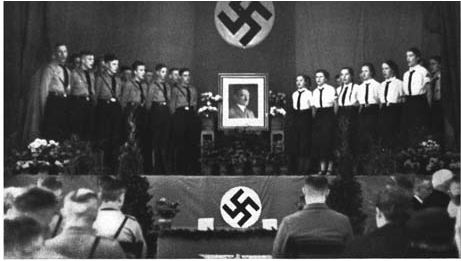
should be as large as possible, and well-lit. It should have the movement’s symbols, and fresh greens and flowers. The youth sit at the front of the room, their family members in the rear. The Hitler Youth and the League of German Girls will sit in uniform (see the picture). It is important that all participants be well-dressed.
The high points of the ceremony are:
The children should thank their parents and make their own affirmation of their coming tasks. Both elements are to be carefully prepared. The affirmation should not be made by an adult! The ceremony should consist of four parts. This allows for other texts to replace those suggested here, which cannot be given for reasons of space. Do not include too many poems. The suggestions here can sound more natural, particularly when read by the youth.
The Course of the Ceremony
Opening
A fanfare, a march in with flags.
Introduction to the ceremony
A quotation from the Führer: “We want a hard generation that is strong, reliable, loyal obedient and decent, so that we do not need to be ashamed.” (Spoken by a uniformed political leader, for example an S.A. Man, an SS Man, or a party leader.)
Music:
(a song)
1. HJ Speaker [Hitler Youth]:
Young people stand here
On the threshold of their lives.
A brief drum roll.
2. HJ Speaker:
We enter joyfully
Through the open door.
We face our fate courageously,
For while fate defeats the cowardly,
God helps the brave!
Drum roll.
3. HJ Speaker:
We the youth are the bridge
From ancestors to grandchildren.
A song
“Now let the banners fly...”
(First the tune is played. The words are available in the Schulungsbrief [another Nazi magazine], February 1938, p. 45.)
The Meaning of the Ceremony
Address:
German youth, German parents!
Germans have always found the transition from 14 to 15 an important moment. It marks the beginning of a new stage of life. It is true that the young person is not yet fully adult. But the body has completed the greater part of its growth. With this physical growth the young person becomes increasingly able to determine his own life. This ceremony marks the point at which boys and girls increasingly become men and women. As you become more mature, you must increasingly follow the laws and meet the duties of life.
Until now you have been a child. If you misbehaved, you did not have to bear the responsibility. Your father or mother made good the damage, and they forgave you. Now you will increasingly encounter people who will not forgive your bad behavior as your mother and father did. They will hold you responsible. If you have been well-behaved and did whatever your father and mother told you to do, you must realize that you will increasingly encounter situations in which your father and mother will no longer be able to help you. You will have to make your own decisions. If you leave school you will begin an apprenticeship, or if you continue school you will have a future occupation in mind. You will move from the Young People to the Hitler Youth or from the Young Girls to the League of German Girls. You will leave the circle in which you had become the oldest, and join a new one in which you will again be the youngest. You face something new in every direction. Whether in your apprenticeship or in further schooling, that is in your professional training, or in your personal lives, greater demands will be placed on you young men and women. How well you meet these demands will determine the remainder of your life. If you obey the laws of life you will succeed, and you will become useful men and diligent women. If you fail to meet life’s demands, you will face a shipwreck. That is the meaning of this ceremony, of your transition. You must decide here between the good and the bad. Life is uncertain. Hard fate may strike some of you, perhaps even destroy you. We are defenseless against such blows of fate, but they are rare. In most cases where life does not go well, it is a matter of personal failure. Each person has his good and bad aspects. It is our will that determines whether the good or the bad wins. That is the meaning of this ceremony. Here, before yourselves and us all, before your people and your Führer, and before God Almighty, you will pledge that the good will win in you, and that you want to become decent German people.
What is good, and what is bad?
We say that the bad is harmful, the good useful. Never make the mistake of asking what is good for you. Only that is good which is gained through honest means and serves the people.
Never forget when you begin your apprenticeship to learn how one earns his own bread, and that the bread you eat today as children of your parents, and that you shall later produce, is the bread of your people. Never forget that the camaraderie you will learn among your comrades is the camaraderie that the entire nation needs from you. Never forget, boys and girls, that you live today in a free and strong Germany, and that your future will be secure only if you preserve this spirit of community. Before Adolf Hitler, your parents and grandparents of the German community were divided into classes and groups, and Germany was defeated. Back then, someone who got his hands dirty by working honestly and industriously for his people was held in contempt by those who earned their money in other ways. German boys and girls, you must never again let Germany be divided into classes and groups, into parties and religious denominations. The community you had as Pimpfe [members of the youth group for young boys] or Young Girls you must also have as members of the Hitler Youth or the League of German Girls, and further on when you put on the uniform of the Labor Service, the army, the SA, the SS, the NSKK, or the NS Flying Corps. You must have it even later when you become a political leader or a member of the Women’s League so that alongside your work or household you can carry on the work of Adolf Hitler, even when the day comes that the Führer is no longer with us. You must be comrades for your entire life, and must respect every citizen who works, or who as a soldier is ready to give his life for Germany, and you must yourself strive to become such a worker or soldier. The life before you is not a matter of good or bad behavior, or parental punishment, or cowardly behavior to avoid parental punishment, but rather it is a matter of proving yourself as a man or a woman. You will not have this strength if you do not have a living faith in God during your entire life. But it must be a faith that leads you to serve God through deeds, not words. It must be a faith that makes you consider yourself God’s tool, called through your work, your struggle, your creation of new life, to serve the eternal maintenance of order, justice, and life itself in this world. You must never feel yourself a servant or slave of God, but rather a fighter for God. One gives a comrade the greatest joy when one gives him a weapon in the certainty that he will never use it against us, but rather use it to defend that which is holy to us all. One does not give a weapon to a fool! God gave us weapons. The creative strength in our hands with which we work, the creative strength in our minds, with which we learn and seek and research, the strength in our hearts and souls, with which we believe, the strengths with which we create new life, these are the weapons God has given humanity. We would be fools if we did not use these weapons to work, fight, create order, and maintain life, but rather served life ill because we were lazy, cowardly, disloyal, immoral. We would then be truly pitiable creatures before God!
Were you like that, you would be ungrateful to the parents who raised you and educated you, who led you to come here under the flags of your people. You would be ungrateful to the teachers who taught you so much, and who helped you to begin to understand your duties. You would be ungrateful to your leaders in the Young People and the Hitler Youth who have helped you deal with some of the difficult questions young people face. At the least, out of gratitude to your parents, teachers, and comrades, you must work to become useful people in the future.
We must here give parents, teachers and the leaders of these boys and girls our thanks. When these children were born, they carried in their blood the ability to become German boys and girls, and eventually German women and men. But when they were born, they could neither speak nor think, nor did they believe anything. We thank their German mothers, German fathers, German teachers, and the leaders of the Young People and Young Girls that they raised these children such that they are now mature enough to stand here before the flags of their people and make an affirmation to Germany. The methods of education and leadership they will experience in the coming years will be different than those of their childhood. You must know that you have a great responsibility also in the coming years to educate and lead these young people. Fulfill that responsibility as well as you have fulfilled those in the past. These words are also directed to the master who accepts these young boys or girls as apprentices, and to the leaders of the Labor Front and the army, who in the coming years will also be involved in the education of these young people.
Boys and girls!
If you have such teachers, leaders and comrades in the future, and use all your strength as well, the Führer’s hopes for you will be fulfilled. You will become a hard, loyal, industrious and successful generation. We will not need to be ashamed of you before the past or the future generations of our people. This is the proud hope and certainty we can give you in this solemn hour, if the affirmation you will now give is not only spoken, but also realized. But we must also give this warning: If you do not stand together, but become disunited, if you are not loyal, but disloyal, if you do not work and are cowardly, you will fall into terrible chaos and Germany will collapse. God will have no home in Germany any longer.
A song is sung (The tune is played through first).
Loyalty stands Where We Stand...The pledge of the youth:
Speaker (one of the youth celebrating the event):
We affirm:
The German people has been created by the will of God.
All those who fight for the life of our people, and those
who died,
Carried out the will of God.
Their deeds are to us holy obligation
All the boys and girls participating:
This we believe.
Speaker:
We affirm that God gave us all our strength,
In order to maintain the life of our people
And defend it. It is therefore our holiest
Duty to fight to our last breath
Anything that threatens or endangers the life
Of our people. God will decide
Whether we live or die.
Everyone present: This we pledge.
Speaker:
We want to be free from all selfishness.
We want to be fighters for this Reich
Named Germany, our home.
We will never forget that we are German.
Everyone present: That is what we want.
Conclusion of the ceremony:
The political leader: The pledge has been made. A new group of our people has joined our fighting and creative people’s community. We are happy in the confidence this experience gave us in the eternal growth of our people. We conclude his pledge and this ceremony with a greeting to the Führer. Adolf Hitler, Sieg Heil!
Singing of the National Anthem and the Horst-Wessel Song.
The flags are carried out.
Here are two other versions of the ceremony.
A Youth Ceremony in Dortmund
The District Leader in Dortmund, party comrade Hesseldieck, gives us the following valuable ideas:
The totality of education in the schools is not to be separated from the worldview education that became the party’s responsibility after the seizure of power. We must claim and influence the totality of education. That requires our involvement at the critical transition points of the youth. As the youth leave school and assume their obligations to fight and work for the German people, the party must be involved, which means it becomes the duty of the respective political leader, the county leader, or the local group leader.
For these reasons, I decided to hold school leaving ceremonies in the name of the party for all boys and girls finishing school. I delegated this responsibility for obvious reasons to the National Socialist Teacher’s Federation. (The NS Teacher’s Federation made all the preparations, and the ceremonies were conducted by the party’s political leaders. The Editors.) The center of each ceremony, the pledge by the boys and girls, was entirely the responsibility of the political leader. All those completing middle, upper and advanced schools were gathered on one day. The ceremony took place in the large Dortmund film theater, the “Capitol.” About 1800 youth participated. I myself led the pledge for the boys and girls. In other local groups, the ceremony was held in similar ways, led by the respective local group leader. In many cases, the youth received a picture of the Führer along with a quotation of National Socialist thought, or else the book Remember that you are a German.
These ceremonies had a powerful effect on everyone, particularly on the youth. We also impressed the opponents of our worldview. That proves to me that this is the right way.
“Ceremony of the Youth” in Segeberg County
The county office in Segeberg (Bad Segeberg in Holstein) conducted a “Ceremony of the Youth” for the first time in 1938. Despite the brief period of preparation, it was a great success.
Many parents who did not want to have their children confirmed came to us with the request to show them the way to their future. This was done in the form of a National Socialist ceremony. It was not a copy or substitute for some kind of religious ceremony, but rather something new. We wanted to show that National Socialism can create new forms that correspond to the greatness of our idea, and that are impressive for those participating. 55 children chose to participate from the local groups of Segeberg county.
Since it was not possible to carry out a single ceremony given the distances, ceremonies were held by the local groups in Kaltenkirchen and Bad Segeberg. Rooms were decorated and all the necessary preparations were made. 26 children participated in the western part of the county, 29 in the eastern part. The success was almost surprising, since the preparations began only at the beginning of the year.
There were no sufficiently large official meeting halls in Kaltenkirchen and Bad Segeberg. We therefore used the largest available private halls, halls in which many of our meetings were held during the struggle for power. Both halls were well decorated with greenery, flowers, symbols of the party, and flags. Both ceremonies followed the following plan:
1. Entrance of the flags with music.
2. The poem “Adolf Hitler” (Anne-Marie Koeppen).
3. The song “Holy Fatherland...”
4. Address by the district leader, party comrade Sach, Bad Segeberg.
5. Music.
7. The oath, and presentation of a book.
7. The song “Raise our flags...”.
8. Sieg Heil and the National Anthem.
9. Exit of the flags.
Each book included a page with a motto, and the following inscription:
Presented on the day when you took on obligations for the life of your people.Not only the members of the local group, but all the inhabitants of the town and its surroundings were invited. 700 people attended in Bad Segeberg, 600 in Kaltenkirchen. I stress that party groups did not order members to attend, but rather that attendance was entirely voluntary. I consider ordering people to attend in such situations unwise, since it gives an impression of compulsion that is not in keeping with the meaning of such a ceremony. Most of the attendees in Bad Segeberg, which has a population of 6600, were from the town itself, while many in Kaltenkirchen, which has 12,000 inhabitants, came from the surrounding areas.
District Education Leader Otto Gubitz.
[Page copyright © 1999 by Randall L. Bytwerk. No unauthorized reproduction. My e-mail address is available on the FAQ page.]
Go to the German Propaganda Archive Home Page.