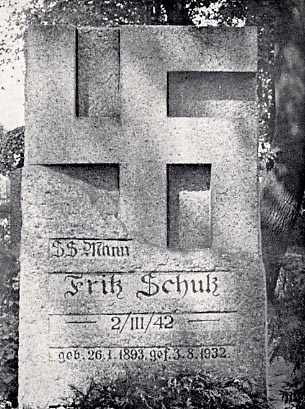

Background: Nazi propaganda extended even to the grave. These photographs are taken from a book on “life ceremonies” (e.g., birth, marriage, and death) published by the Nazi Party office in the Oberdonau region of Austria, which had been incorporated into Germany in 1938. The text next to each picture is a translation of the commentary in the book. The introduction to the book is available on another page.
The source: Lebensfeiern. Richtlinien und Anleitungen für die Gestaltung lebenszeitlicher Feiern (Linz: Gauschulungsamt Oberdonau der NSDAP, 1941).
|
|
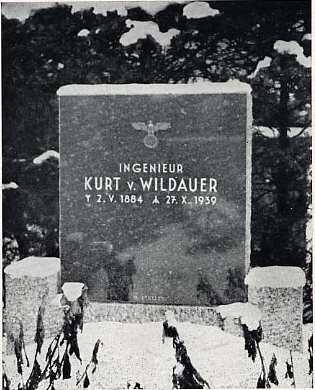
Grave of a political leader “The party symbol in bronze is above the name. The use of the life and death runes is exemplary for believers in god [Gottgläubigen — the Nazi term for those who claimed a vague, but non-Christian, religious belief]. Despite its simplicity, it is a beautiful model.” |
|
|
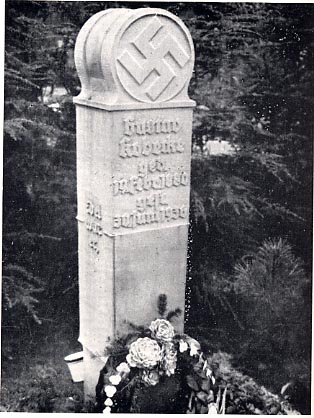
Simple, but tasteful “The swastika is the only symbol, done in a beautiful manner.” |
|
|
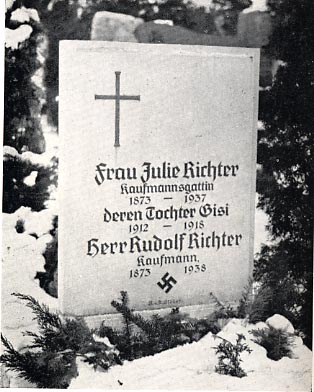
An old gravestone, to which a swastika was added after 1938 According to the guidelines in this book, the swastika is in the wrong place, because the symbol of a religious body is above it. |
|
|
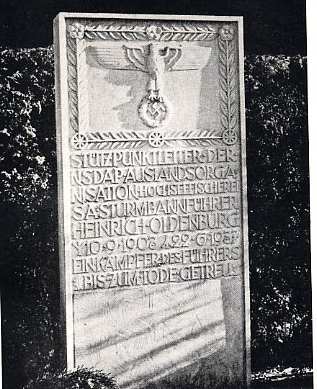
Exemplary gravestone for a leader of the movement “The eagle is given symbolic form, surrounded by leaves from the tree of life. The symbol and text form a harmonious whole.” [Sculptor: August Traupe, Bremen. Obernkirchner sandstone, 1.45 meters high. Taken from the work: “60 Gravestones from the First Greater German Gravestone Competition,” published by Karl Ulrich & Co., Nuremberg]. |
|
|
Grave of an SS man who fell during the struggle for power “A very impressive gravestone. The swastika grows out of the stone.” [Berlin: Luisenstadt Cemetery]. |
[Page copyright © 2004 by Randall Bytwerk. No unauthorized reproduction. My e-mail address is available on the FAQ page.]
Go to the 1933-1945 Page.
Go to the German Propaganda Home Page.