


Background: Das Reich was a widely-circulated Nazi weekly magazine. This article from August 1944 is part of a general propaganda campaign against the United States. It sees American war ads as a sign of the deficiencies of the U.S. The general claim is that the United States is a childish nation, unable to comprehend the depths of European culture that Germany allegedly is defending. The article includes seven American ads. I here include scans of three of the original ads.
The source: Hans Otto Wesemann, “Verkitschte Massenseele. Kriegsinserate der Amerikaner,” Das Reich, 13 August 1944, pp. 5-6.
What a lot of noise the Americans make during this war. There are the major columnists and article writers, whose profusely long articles reach millions of paying customers, the radio announcers who drown their listeners on over two hundred stations, the war correspondents, not to mention such individuals as crazy Senators, generals, Amazons, and publicity-hungry baseball players. One cannot avoid them, nor does the public want to, since it saves them from thinking their own thoughts. But we do not want to talk here about Lipman [sic] and Dorothy Thompson, of Eleanor [Roosevelt] and Westbrook Pegler, but rather of those opinion-makers who reach the souls of the public through advertising.
Their glory is to have made the refrigerator into a North American cultural ideal. They have created a state in which people see the hand of God in a good income, and think the biggest symphony orchestra is also the best. They used the years of peace to get people to use Camel and Palmolive, to train them to drive Chevrolets and use Kelvinator refrigerators. They used America’s freedom to lower everyone to the same level. Thanks to their untiring efforts, the nation’s male hero is the successful businessman, the female hero is the laughing girl one sees everywhere from Florida to Washington who uses the right make-up.
The war has had a big impact on American advertising. Formerly its job was not to bring national duty together with private business interests. That would have encouraged independent thinking, which would have disrupted the goal of uniform life styles. During the early years of the New Deal, the bureaucracy made an expensive attempt to sell its purchasing power theory by using attractive women in low cut bathing suits. It was a total failure. Once the armaments drive began, it was possible to return to the old and tested methods.
 But today, advertising
has a double goal. They are no longer able to satisfy the customers’ wishes
that they have aroused with every possible means of mass psychology. Now
the job is to keep the consumers’ wishes in their minds, or to keep them
on ice. But the attempt is accompanied by traces of a bad conscience,
insofar as paying heed to the national interest can be a matter of conscience.
The national interest would require that all advertising be put in the
service of duty, persuading people to buy as little as possible. People
have far more dollars in their hands than there are goods to purchase.
All the various regulations have not been able to abolish the liberal
principles of the free market, which have driven prices sky high. The
Senate and House of Representatives have refused Roosevelt’s wish to narrow
the gap between money in circulation and the goods available by raising
taxes. The government thus has to rely on persuasion, for which it uses
not only an army of journalists, but also advertising. The War Advertising
Council attempts to preach reason by full-page ads. “We may not purchase
a single item we do not need. We do not want to demand higher wages, or
higher prices for the things we sell. We want to pay our taxes, regardless
of how high they are. We will never pay a penny more than the official
price. We want to save and live modestly.” Some will find this attempt
at autosuggestion a well done, but not particularly successful effort
to plant economic rationality and national discipline in heads from which
they have long since vanished.
But today, advertising
has a double goal. They are no longer able to satisfy the customers’ wishes
that they have aroused with every possible means of mass psychology. Now
the job is to keep the consumers’ wishes in their minds, or to keep them
on ice. But the attempt is accompanied by traces of a bad conscience,
insofar as paying heed to the national interest can be a matter of conscience.
The national interest would require that all advertising be put in the
service of duty, persuading people to buy as little as possible. People
have far more dollars in their hands than there are goods to purchase.
All the various regulations have not been able to abolish the liberal
principles of the free market, which have driven prices sky high. The
Senate and House of Representatives have refused Roosevelt’s wish to narrow
the gap between money in circulation and the goods available by raising
taxes. The government thus has to rely on persuasion, for which it uses
not only an army of journalists, but also advertising. The War Advertising
Council attempts to preach reason by full-page ads. “We may not purchase
a single item we do not need. We do not want to demand higher wages, or
higher prices for the things we sell. We want to pay our taxes, regardless
of how high they are. We will never pay a penny more than the official
price. We want to save and live modestly.” Some will find this attempt
at autosuggestion a well done, but not particularly successful effort
to plant economic rationality and national discipline in heads from which
they have long since vanished.
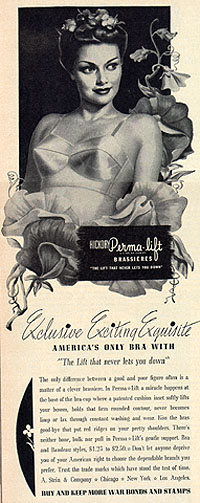
But private advertising is even more interesting than official advertising, which has carefully determined themes and methods. During peace, American advertising experts had enough time to investigate every mass instinct, and to learn how to reach it. The results provide a remarkably good picture of the American character. American ads may be confusing in their multiplicity, but they depend on a few principles of mass persuasion. They rely on sex appeal, the pious misuse of Christianity, a gangster type of heroism, or simple kitsch,but they are as successful in war as they were before. Now they have an added element, a national paroxysm using every method of mass influence. That is evident in the otherwise familiar concert of American advertising. One cannot really say that the average American advertisement gives much effort to join in the nationalist tune. A bra ad that we include here, for example, surely attracts the eye, but does not lose anything because of the war. It contributes to the general ideal of beauty, makes the device attractive, and gives the reader the pleasure of a pun (“The lift that never lets you down”). It thus meets the normal expectations of a product of this type. But because of the war, even a bra can be used to defend American freedom: “Let no one rob you of your American freedom...” At the bottom, there is the usual phrase: “Buy more war bonds.”
Most American ads do their duty in raising American war morale with this phrase. The firms using the phrase are usually those whose goods are not scarce. They have less to fear from the competition. America has plenty of room for whisky, suspenders, hair coloring products or pens. Things are different for the companies that have shifted to war production. They include the automobile industry, the photographic industry, the electrical industry, and other such areas. If they want to advertise to their publics today, they have to use entirely different methods. The earlier goal of advertising, fighting off the competition, makes no sense today. What good would it do General Motors to claim its cars were better than Ford’s when neither is producing civilian vehicles? The big advertisers now have new found freedom. They use it to reach deep into the feelings of the average American.
The new creative freedom has had remarkable results. The Nash Company,
which normally 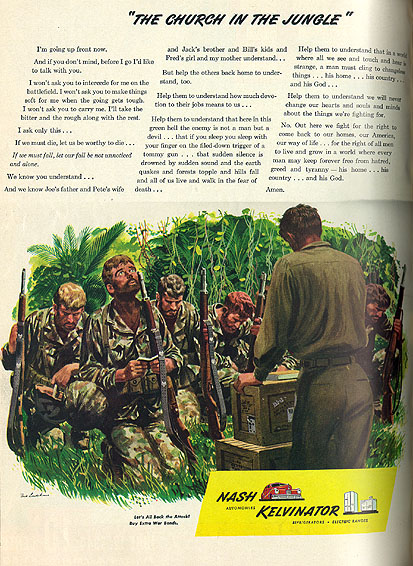 manufactures cars and cooling equipment, pays a lot of money
to pay writers for short stories that demonstrate living Americanism.
Formerly the talk was of streamlining and independent suspension. Now
they talk of worship services in the jungle. We reproduce the ad here,
since one seldom has the opportunity to see so concentrated a display
of the American mentality. This combination of sentimental hero worship,
religious prattle, kitschified family loyalty, and national vainglory is
aimed at every possible emotion. It may be aimed at the emotions, but
one has to grant that no real soldier would put such words on paper.
manufactures cars and cooling equipment, pays a lot of money
to pay writers for short stories that demonstrate living Americanism.
Formerly the talk was of streamlining and independent suspension. Now
they talk of worship services in the jungle. We reproduce the ad here,
since one seldom has the opportunity to see so concentrated a display
of the American mentality. This combination of sentimental hero worship,
religious prattle, kitschified family loyalty, and national vainglory is
aimed at every possible emotion. It may be aimed at the emotions, but
one has to grant that no real soldier would put such words on paper.
Everything that would show up in a war correspondent’s report ends up in these ads, though in a different form. It is certainly true that an American soldier has sought to carry his wounded comrade away from the front line, or that another has made a brave attack with a flame-thrower. Certainly many have done their duty here and there. But when their deeds are reported in so kitschified a manner, it is intolerable. “Hear, America! Open your hearts, women and daughters! Open your wallets, fathers! Give your blood, brothers and sisters ... give your work. Then you will have the freedom, the country and the future you want when you come back home.” And along with this supposed bombast of an American soldier we find business news: “Here at Nash Kelvinator we are building motors for naval aircraft, etc.”
The American press has never been too fussy when it came to choosing its methods of reaching the instincts of the masses. The less of the spirit of the daring pioneers of the early years of American history remained, the easier life became through technological progress. The more the spiritual and psychic nature of the people reached a comfortable average, the greater was the longing for the extraordinary, for heroes of every sort. They took these heroes wherever they found them. The American public liked Capone as much as Lindbergh, Joe Louis as much as a Hollywood star who had been divorced five times. Crime has become a central part of the American media. It is hard to imagine an American magazine without a “photo crime,” without a spouse murder, a child kidnapping, or a gangster attack. The attention paid to the most gruesome aspects of such cases would make no sense were there not a sadistic streak in the broad American public, which is shown by the reality of lynch justice as well as by pictures of every possible crime.
 The best
proof of the deep-rootedness of such instincts is proven by official
propaganda, which claims to be superior to other advertising,
but still is unable to dispense with the proper dose of horror.
One of a series of ads for war bonds shows the shattered and
half-decayed body of an American soldier on some battlefield.
The caption reads: “No one expects that he will join in
the Fifth War Bond Drive.” The American bond drive is not
going so poorly that the government was forced to use its heaviest
guns. No, this type of approach is only explicable if one understands
the mass psychology of the American public, which among other
things proves to us that more than an ocean lies between that
part of the world and Europe.
The best
proof of the deep-rootedness of such instincts is proven by official
propaganda, which claims to be superior to other advertising,
but still is unable to dispense with the proper dose of horror.
One of a series of ads for war bonds shows the shattered and
half-decayed body of an American soldier on some battlefield.
The caption reads: “No one expects that he will join in
the Fifth War Bond Drive.” The American bond drive is not
going so poorly that the government was forced to use its heaviest
guns. No, this type of approach is only explicable if one understands
the mass psychology of the American public, which among other
things proves to us that more than an ocean lies between that
part of the world and Europe.
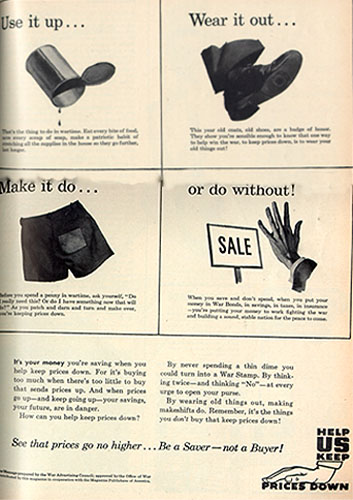
There is a picture of a pair of shorts with a patch. The caption says that during war, one should be sure one really needs something before buying it. Now, one can patch or darn or otherwise use a pair of shorts. These are perfectly reasonable suggestions. The viewer receives a simple argument about how such a pair of shorts looks. This pair of shorts is something of a modest sign in the midst of the bombastic flood of somewhat hysterical advertising to remind people that everything has two sides. Only a small minority is still able to think this way. That shows not only that there are a few individuals who have escaped the herd instinct of such frightening uniformity, but provides a counter-example to the sentiments that one writer expressed in one of the best examples of American advertising: “We are the greatest nation in the world. Our government is the best. We are the model of human religion, faith, and morality. We are the best soldiers the world has ever seen. We are the smartest and freest nation, and the best developed socially.” An old pair of shorts is easier to deal with than such a spirit: the shorts, at least, are still usable.
[Page copyright © 1999 by Randall Bytwerk. No unauthorized reproduction. My e-mail address is available on the FAQ page.
Go to the 1933-1945 Page.
Go to the German Propaganda Home Page.