


Background: The Nazis produced a large body of work glorifying the party’s history, particularly the Kampfzeit (1919-1933) when Nazism was fighting for power. Early Nazis were typically presented as brave and noble men who earlier than most recognized Adolf Hitler as Führer, and fought untiringly for him until their work was crowned with success on 30 January 1933. This book covers the origin and growth of the party in Starnberg County, a Bavarian resort and farming area to the south of Munich, from 1925 to the 14 September 1930 Reichstag election. It mentions the work of Fritz Reinhardt in some detail, who developed a correspondence course that trained thousands of Nazi speakers. It also is a good example of the enormous work that Nazi Party members did at the local level in Hitler’s cause.
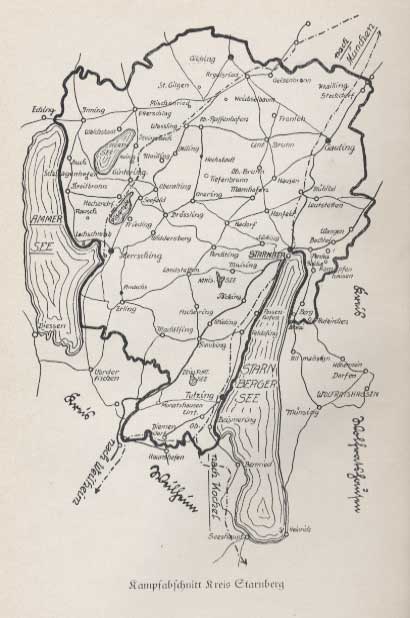
The book runs over 400 pages. I’ve translated the sections I think most interesting. I include page numbers in brackets occasionally as a help to those who might be interested in the material I omit. The map is of Starnberg County.
Given the length, this is in two parts, with a link to Part II at the bottom of this page.
Buchner was born in 1898 and served in the army in World War I. He was elected to the German Reichstag in 1933, and served until 1944. He was also mayor of Starnberg. He ran into some sort of difficulty with the party in 1944 and was disciplined, losing his Reichstag seat. He died in 1967. See the article on him in German on Wikipedia for more details.
The source: Franz Buchner, Kamerad! Halt aus! Aus der Geschichte des Kreises Starnberg der NSDAP. (Munich: Zentralverlag der NSDAP, 1938).
“Munich, 27 February 1925. Adolf Hitler, the Führer of the National Socialists, spoke yesterday at the Bürgerbräukeller in Munich for the first time since his release from Landsberg Prison on the occasion of the refoundation of the NSDAP.”
It was as if the flames burst forth. Finally!
Five lines of type in the corner of an insignificant newspaper, surrounded by trivial news items. That was all that a bourgeois “patriotic” newspaper had to say about the beginning of a new era in world history. — Naturally!
But the time had come.
 A
Crazy House
A
Crazy House In a tiny kitchen of the attic apartment on Zweigstr. 1/III in Starnberg, three hopeless dreamers gathered together. The minor civil servant, and Max the paperhanger with the wartime nickname Germansky, who was lively, heated, and impatient in the face of any other political opinion. The third was Gustl, the mason, always cheerful and joking. All three had served at the front; one had been in the Freikorps under Epp, the other two were former “Oberländer.” None was as yet 27 years old. All three were S.A. men, members of Company 8 of the former Munich S.A. regiment and each had been in the march of 9 November 1923 [Hitler’s Beer Hall Putsch].
These three dreamers fanaticized about founding a local group of the National Socialists!
“It has to be done!”
“You and you and me — that’s three men already!”
“Steingrübl from Schmalzhof and Honsberg from Buchhof have been SA men since 1922. They’ll join in. And there is Pöhlemann Max, too. And Professor Schmittt, and your brother...”
“It has to be done! By God and by Hitler, nothing is impossible!”
“...Well, don’t smoke so much if you want me to sew your flag ... my eyes are watering in this cloud of smoke.”
“Woman, wife, mother! There has to be a flag! Certainly!”
“The old battle flag vanished after 9 November 1923.”
“OK, cigarettes out! Open the window!”
It is warm outside, in March.
A warm wind blows over the mountains and across the lake. It rages and bellows against the shore, as if it wanted break through the granite banks. It wants to bring spring to Germany.
Spring!
“Money?... Others have it! Besides, it’s secondary. We need men! The comrades from 1923, the old gang...!”
“But we have to have posters and leaflets.”
“...They’re still in the back room, a thick stack of them from 9 November 1923. They are still up-to-date.”
9 November 1923. The day that keeps coming back, to always remember, an eternal admonition, the day of revenge. One starts to hum a melody. We must have sung it 400 times with the old SA Regiment Munich before 9 November:
“Comrade, give me your hand,
We will stand together loyally...
The spirit may not perish!
Swastika and Stahlhelm,
Black-white-red band,
We are Hitler’s Storm Troops.”
And then:
“Hitler will lead us out of our misery.”
Hitler! No one else on earth can do it... A moment of silence... Lord, thank you for giving him to the world... Adolf Hitler! No, we are not lost! We live!...
“Meeting posters?...” Max asks.
“We’ll have to write them ourselves and hang them.”
“No! Listen! National Socialist posters have to be blood red and neatly printed.”
“Yes, and we need a big newspaper ad!”
“Sure! And the money?”
“We’ll find it.”
“You think God will give it to us?”
“No, We’ll pull together a few marks ourselves and get the rest from the old gang. I know a few who will help us...!”
“If they want to...!”
“And a meeting place? I tell you, nobody will rent us a room after the fight with the ‘Völkischer Block’ during the period the party was banned.”
“The ‘Völkisher Block’ was really a parliamentary block.”
“Your Greater German People’s Community, the cause of the stink you had with the ‘Völkischer Block,’ has also entered its eternal rest,” teased Gustl.
“Remember the people who led it, old Nazis... Rosenberg, Schwarz, Streicher, Esser, and Rolf Eidhalt...”
“The great unknown... !”
Who knows who was behind that pseudonym? The letters could be changed to make “Adolf Hitler” out of “Rolf Eidhalt.” [“Rolf Eidhalt” was used as a pseudonym by the Nazi Party during Hitler’s incarceration.] One side gave its directives and rulings out, while the other side maintained that it alone was the true representative of the Hitler spirit. No one knew what was right, whom one should believe, who was really working on Hitler’s orders.
“Enough! Don’t start all that again! Stop the debate! Hitler is here again!”
“I’ll ask the owner of the Unterbräu about a room. Maybe he’ll let us in.”
“Promise him We’ll hold all our mass meetings there... That’s something!”
We were thinking of the period before 9 November 1923, when our meetings drew hundreds of people — and still had no idea how cowardly people were when the crowd was smaller, how cautious when the path looked long.
“We have to send out invitations ... printed ones ... through the mail...”
“You’re dreaming! In fact, you’re crazy. Meir in the district office will have to mimeograph meeting notices in the office after closing time. He’ll be able to get it done without being caught. He’s an old member of the Munich Regiment.”
“Leave it to me! I’ll get him to do it!”
“We’ll deliver them ourselves to every mailbox, every house, every shop. That way We’ll get everyone and save the postage.”
“We’ll invite the old gang personally. They’ll surely all come.”
“But it looks better if they get it in the mail. Maybe some bourgeois chap or another will come, and we can give him a good punch.” Maxl grinned.
The bourgeois to him was the embodiment of the worthless. And the thought was attractive. We knew those fine chaps who hung out the Swastika flags on the morning of 9 November 1923, but that evening, as the revolution was gunned down at the Feldherrnhalle by the treason of the traitor Kahr, did not know anything about it...
It would be fun to show these weather vanes that the wind was again blowing in the right direction, and to get back at the smirking Marxists, who believed we were dead, by waving our birth announcement in their faces. [p. 12]
[Several paragraphs of similar material omitted]
Good Lord! Adolf Hitler reestablished the party only eight days ago, and we are thinking of founding a local group of the NSDAP to promote Adolf Hitler’s ideas, to win people for his movement and its goals.
But we were not thinking of that. We wanted to fight against everything we hated: cowardice, subordination, surrender and all their consequences. We wanted to show that all to our fellow citizens. We wanted to rouse them from their ease, from their comfort, from their indifferent satisfaction. No one should be satisfied, at least as long as such conditions prevailed in Germany — least of all the Jew.
[A discussion of how long it might take for Hitler to win, then the discussion returns to the first meeting.]
“We need a speaker for our meeting!”
“Right! A speaker has to be there. Maybe...”
“Hitler...!” Gustl bursts out.
We quickly return to reason.
That was a dream.
“He will come!”
“He won’t come!”
“He will come!”
“First we have to prove we can do something on our own, then we might be able to...”
“Good Lord! We need a big meeting. We need a big gun!”
“Maybe Julius Streicher, or Adolf Wagner, or Hermann Esser?”
“I’ll write the party office in Munich. The office is Thierstraße 15. They must have a few big guns! And membership applications!”
The fine people of Starnberg will be astonished when those swastika chaps rise from the dead.
As we went our separate ways that evening, we certainly did not yet know that every reasonable citizen would think that our idea to found a local group of the National Socialist German Workers Party was complete insanity. Our wretched little group was that unreasonable...
[Eight days later they meet again. Hardly anyone was willing to help. Most of the old gang had given up hope. Together, they’ve come up with 18.30 marks, less that the cost of that first planned meeting. The party office in Munich promises a speaker for 9 May 1925.>
Hitler throws his support to General Ludendorff in the 29 March 1925 presidential election. Ludendorff gets only 1.1% of the vote nationwide, but does better in the Starnberg area. All of 349 votes. They conclude they have some supporters, if only they can find them.
A week before their first meeting, they gather together. The new flag is ready. The newspaper wanted 20 marks for an ad, their whole treasury. Getting official permission for the meeting is a challenge. Two days before the meeting, they hang red posters. The next day most are torn down. ]
[p. 30]. At 7 p.m., the three of us where there ... but no one else.
The pub keeper had shown backbone, despite covert and open boycott threats.
The new flag was hanging in the room. How small it looked. It had looked much larger back home in the kitchen...
The leaflets are here. “The membership applications?”
“Yup, 200 of them.”
“Think that’ll be enough?”
[37 people show up for the first meeting. After an effective speech, 13 join to form the local group of the Nazi Party]
[p. 35] Here they are:
If they had only known what was before them in the coming years... Constant bad weather and hailstorms broke over the little band. They reached dizzying heights and passed through dark valleys, through endless reaches, alone, deserted ... but they marched ... Five are still marching today. One moved away. A few stumbled and were left by the wayside. Three died...
[The first membership meeting is held on 15 May 1925. The treasury shows a 22 mark deficit as a result of the first meeting. Buchner’s boss, astonished at his foolishness in joining the Nazis, tries to talk him out of it. Buchner argues with other nationalists, who don’t think much of Hitler. On a Sunday afternoon, they head out to neighboring towns, recruiting seven new members.]
[p. 55] “Party comrade Matthias Mann, Rosenheim, stabbed by communists,” the Völkischer Beobachter reported on 29 June 1925.
Shortly thereafter, party comrade Hermann Esser, Gauleiter of Upper Bavaria, called a conference in Rosenheim. Perhaps...
In the afternoon, local group leaders meet. Party comrades Julius Streicher, who will speak at the following meeting, and party comrade Josef Rigauer, local group leader in Rosenheim, take part.
It’s a little room — a round table —and an even dozen men, just as many local group leaders as Gau Upper Bavaria has.
Suddenly Adolf Hitler appears.
He goes to each man, shaking his hand.
There are things one cannot explain, cannot describe.
But ever since that day, this is how it is:
The first thought every morning is about my new life. Throughout the day, I never stop thinking about him. In the evening, my last thoughts are of the Führer. Sometimes he meets us in our dreams. And when one awakens, all the dreamers say: Too bad....! It is that way for each Nazi — if not, he isn’t one!
The Führer spoke. For hours I sat across from him, eye to eye, only six feet away. I was never that near to him before.
You have given this man your life, sworn allegiance to him.
He has hard times in his past...
People call him a fool and a dreamer, and much more.
But what you say is true, Adolf Hitler:
“Struggle is the father of all things!”
“The war is behind us, the battle before us!”
“You must march alone, with only the flag before you!”
That is hard and difficult, but we are proud of it...
“This banner will one day be the flag of the new Reich.”
One day? ... It will come!
“Resistance is not there to capitulate to, but to break!”
Never forget that! Even if things seem hopeless, fight!
“We know that it will be decisive for the history of the nation for us to introduce our sixty-five million people spiritually and inwardly to the ideas of National Socialism.” Sixty-five million National Socialists ... wonderful, fantastic, this goal.
“The fall and rebirth of a people depends not on a good or a bad economic program, but on the strength or weakness of that people’s worldview.”
“Here, too, the majority cannot replace the man, for not only is it a representative of stupidity, but also cowardice. Just as a hundred idiots do not make one wise man, a hundred cowards can never make a courageous decision.”
“A movement that in the age of the majority holds to the principle of leadership and responsibility will one day with mathematical certainty overcome existing conditions and emerge victorious.”
With mathematical certainty ... emerge victorious ... When makes no difference! We believe in Adolf Hitler, and in his victory!
Therefore we follow you, and your struggle is our struggle and your fate shall be our fate.
Battling with foreign worlds.
The wife: “It’s 9 p.m. again! Every day you come in so late... You only come home to eat. Whom were you talking to today?”
The husband: “A guest, an old Marxist. Mind you, one without blinders, open, but without faith... We started at the corner, continued for a long walk, and ended up in his kitchen. I’ve got his attention. I want to fight for the soul of this German worker.”
The guest: “Soul? I don’t have a soul — nor any money.”
The husband: “You have more than that, my friend, you have yourself and your labor.”
The guest: “My labor? Capitalism exploits that. I’m only a serf.”
The husband: “Ah! —— What has become of the sixty-year battle against capitalism that you’ve fought with words? You, millions of German workers, and your leaders. Today, fate has given the power of the state to you who have proclaimed the battle against capitalism. But now that your leaders have political power, what have they done?
Have they done all they can to destroy capitalism?
The very opposite! They have given the nation’s economy a death blow and invited international capital in. The astonishing thing is that these same men who formerly wanted nothing to do with capitalism are the same people who travel to Geneva, to Genoa, to London, etc., to sit at a conference table and decide the fates of peoples, though not with ministers of state, but rather with bankers.
Look around! A pile of international bankers come together to discuss the fates of nations, this at a time when capitalism supposedly has been broken. They sit down to negotiate with Herr [a Russian politician], with the gentlemen from Moscow.
They are the real rulers of the world! That is the result of the battle you’ve fought for sixty years!
When we consider the fate of the German nation today, we don’t ask: What do the sovereign German people think, but rather what does the New York Stock Exchange say, what does London think, what do the big bankers think, what does the press of those big bankers think? That is what is important! An entire people has to do what they wish, what they want, all under the sign of a social republic, a social revolution. And you have fallen for their bluff!”
The guest: “I fight capitalism wherever I see it. I don’t care who it is.”
The husband: “don’t get excited. Light a cigarette and listen to me. There is a difference between national economic capital and international loan capital.
Your hands are a kind of capital. The needle and scissors that a tailor needs are capital. The machines in your factory, milling machines, lathes, drill presses, engines.
Factory capital! You also need company capital to buy raw materials, lights, transportation, and everything else. Just as the tailor must buy material to make your suit.
There is one thing you can do, one thing you can say: ‘I don’t want the plant, the factory, or the company to remain in the hands of Mr. So-and-So. But you cannot fight national economic capital, since that is what gives you work and food.
Destroy the machines?
That’s what they did in Soviet Russia! Then what? One has to replace what one has destroyed. One has to borrow for the “community” factory. The communist factory needs the same things: plant and operating capital, machines, and money.
Now let’s look at the second kind of capital: international loan capital. The first form of capital is dependent on the size and strength of a state. It rises or falls with the growth or collapse of that state. Loan capital depends only on a mathematical formula. Neither genius nor labor create loan capital. An example: Take two people. Each as a million in cash. One uses it for plant and operating capital. He puts his capital into a factory. He builds a restaurant. If the man is unable to lead it, the firm goes bankrupt despite his million. The other man with a million does not use it productively, but rather lends it out. He is freed of the need for personal intelligence, for personal effort. He can be an idiot, he can be lazy. Still, within one year, his million brings fifty thousand marks in interest, whether he is clever or not. In ten years, he gets a half a million, in twenty years he has doubled his capital. It grow and grows forever, no matter how dumb he is.
That is the difference. The state has power over the crooks and fools who control national capital, but not over the crooks and criminals of international capital, for international capital is controlled by a specific race, namely Jewry.”
The guest: “Well, that brings us back to your favorite topic, the Jews. There are decent Jews, though. I myself know... ”
The husband: “Stop! Comrade! By saying that, you grant that the majority of Jews are not decent, but ‘indecent.’”
The guest: “Well, are there not many Christian Jews among us?”
The husband: “My friend, this single sentence destroys your case! Why don’t you ask if there are not Jewish Christians?”
The guest: “There are Christians who are as bad as the Jews.”
The husband: “Then you admit that this spirit of decay has also infected us. If you say that there are also Christian Jews, you admit that we are gradually sinking down to their level.”
The guest: “The Jew is just as much a person as you or I.”
The husband: “Not exactly, dear friend. First, his nature is visible in his appearance. One can’t tell by looking whether one of us is Protestant, Catholic, or Baptist. But with the Chosen People, one can smell their religious beliefs. You find Jews only in very specific professions, not where you work. You have never seen one in a mine, or at a lathe, or behind a workbench.”
The guest: “Well, maybe he is smarter.”
The husband: “He is no smarter than you. There is an entirely different reason. The Jew has no sense of the meaning of “work.” Imagine this: What if we Germans one day got sick of the Jews and we all moved to Palestine, leaving the Jews here alone.
What would happen? The Jew would not suddenly have a desire to work, running to the workbenches, dashing into the mines to find and shovel coal. No, when the last German had left he would look around at what the Germans had left. The Chosen People would grow quiet and worried. They would ask if ’something could be done,’ not by working in the mines or factories, but whether one could sell things. Maybe someone or another needs something... The Jew once again becomes a warm-hearted soul, sneaking into the system, innocent and patient. Only when things have gotten better for us does he step in to plunder the people anew. It has been that way for centuries and millenia! Read what it says in Genesis 47:11 and after: [Genesis 47:11-27 is cited, the story of Joseph in Egypt]
That’s how it always is... “
The guest: “You call yourself a worker’s party, but you have members who are officers, barons, and the like. We workers do all the work. And work is humanity’s curse.”
The husband: “My dear friend, be happy that you can work. Without work, without something to do, life would not be worth living. Listen! By work, we mean something that benefits the individual without harming others; in a broader sense, we mean something that benefits the doer, as well as everyone else. If a person works without taking into consideration the good of his fellow human beings, we deny that he is working in the true sense... What do you think? Anyone who sweats is working, anyone else not?
We ask a different question: ‘Whom does his work benefit? The man who builds a safe sweats as he builds it, but the man who breaks into it during the night sweats just as much, maybe even more. However, we do not say that both have worked, that both are workers. Instead, we say that the one is a worker, the other is a thief, a criminal.
We distinguish between people who create to serve those around them, and those who work only for themselves, without any regard for their fellow human beings. For the Aryan, the concept of labor is inextricably tied to an ideal. We cannot imagine work that was not connected to an ideal.”
The guest: “Well, I don’t notice any ideals when I’m working.”
The husband: “My friend, you will never notice it. What millions do without noticing it is in reality something idealistic. You are a locksmith, someone else a backer or a tailor. He who stands at a workbench, at a carpenter’s bench, the switchman, the technician, or whoever it is, he who does his duty conscientiously, is an idealist. If instead of working, he were to rob, steal, swindle, or cheat, he would make more money. He who steals, cheats, swindles, however, is not the one who is smart enough, but the one who has too little idealism.”
The guest: “But the Jews are known for their industry and work.”
The husband: “That’s what you think? Look, there are thousands who slave and toil — and next to them sits one who also works and toils, but only with a scissors in his hands to cut the coupons. On the one side we see millions of people who work every day without ever being able to hope for material prosperity. On the other side, a person sits who has earned millions through a single speculation. Do you call him a worker?”
The guest: “Well, he probably also has his troubles.”
The husband: “Sure, he will say that it takes effort to find out how to get so much money... ‘I can’t rest for weeks until I succeed in such a financial coup... I think aboiut it day and night, I have to be figuring all the time in order to get my neighbor’s cash... I have no time for pleasure, no time to enjoy nature — try business yourself.’ Well, you can’t call that work. Work is a noble activity.”
The guest: “You plan to chase him away if you ever came to power?”
The husband: “We will enforce our laws on foreigners, since he is of a foreign race, because the Jew is a parasite who has always enriched himself from his host peoples. The Jew has never had his own state. The fw Rifkabylen have their own state, but not the Jew. Only the Jew is international. He roots himself in every people in order to rule them more easily.”
The guest: “Even if everything you say is true, what can the Jew do about the way he is?”
The husband: “No more than the tiger can do about the fact that he eats people. That doesn’t mean I’m obligated to let myself be eaten, however, just because he needs to eat. The eternal law of nature applies here: what succeeds lives, what is too cowardly does not. If one is lazy, one starves. Nature does not demand that you let yourself be enslaved. Nature builds not on the weak, but on strength. People who lack the strength to maintain themselve may step aside. Either someone else will come — or nothing will follow them.”
The guest: “One might almost believe you. If only your racial hatred were absent... People are all equal, after all. It doesn’t matter what they look like. Everything with a human face is human.”
The husband: “I’ll grant you that anything with a human face is human... But you have to grant that everything with a human face is not equally human. One person isn’t the same as the other.”
The guest: “No, a person is a person, a dog is a dog.”
The husband: “No doubt about that. Something with dog’s ears and snout is a dog. But in some circumstances, one dog is not the same as another dog.
For example, I can’t chase a rabbit with a dachshund, or set a greyhound after a badger, and a poodle is easier to train than a pug. There are differences between dogs.”
The guest: “But a human being is a human being.”
The husband: “Sure. But there is always a difference between individual humans. For example, some in New Zeeland still live in trees and climb around a lot, in contrast to a European who walks on two legs and doesn’t live in trees, but rather walks on streets.”
The guest: “That has to do with the climate.”
The husband: “If all the Europeans left and were replaced with New Zeelanders, you proably wouldn’t expect that the climate would make Europeans of them. And were you to move to New Zeeland, you would hardly claim that the climate made you climb trees and scurry around on all fours. If I place two people in identical circumstances, they will not use those resources in exactly the same way. If I put two people in the middle of the street and confront them with the same danger, one will save himself, the other will perish. They are not identical. There is a difference.
The fine differences we see between people of the same blood become far greater with we cross the boundaries of blood. History often teaches us that the climate of a land has stayed the same, but people have changed. We can see that in ancient Egypt... ”
So it went until deep into the night. And again the next day. For weeks, months, years, the struggle for the individual soul continued. [p. 68]
[More stories of attempts to win people over to Nazism.]
[p. 74] His propaganda methods too had a personal touch.
Franz Schmitt was his name. The terror of all relaxation-seeking people of the area, summer guests, and strollers.
He carried a bundle of newspapers, the Völkischer Beobachter and the Stürmer, in his coat pocket. He’d sit on the promenade. He’d grab hold of friends and strangers and accompany them for hours with stubborn determination. He didn’t let his victims escape without admitting that the Jew was our misfortune. Attempts to escape? Fruitless. He’d run ahead and get in the way of those who didn’t know him, or grab them by the collar.
He followed suspected Hitler supporters into the café. Over a cup of Hag [a brand of German decaffeinated coffee] — his heart couldn’t take any more, and his pension was very, very small — he would argue every objection into the ground with an angel’s patience.
He was stubborn in representing this idea, and impatient with all enemies of the movement, faithful and true to the Führer — one in a hundred thousand.
Those who still march will never forget you, Professor!
[Anti-Semitic activities, founding an S.S. unit in Starnberg, Nazis in the local chess and sports clubs.]
[p. 90] Work during the day, in the evening a battle for souls and hearts, man-to-man struggles. Leaflets distributed, propaganda marches with six, seven, eight S.S. men, advertising for the Völkischer Beobachter and the Stürmer, and again trips to Munich to protect meetings.
We were unable to hold as many meetings in the little town as we wanted.
But discussion evenings, we needed more and better ones, and before Christmas.
Each party comrade was obliged to bring at least one guest. The December discussion evening had an attendance twice that of the local membership. Everyone had brought along his girl or wife!
That wasn’t quite what we meant!
People had excuses.
“Well, Advent is a bad time...”
“Christmas...”
“Every club has its Christmas party...”
“The Veteran’s Association is putting on a patriotic play ... at the end field gray is transformed by red light and calls out to fate: ‘Lord, make us free!’ Yeah, he’ll end up in the dust if he doesn’t do something himself...”
“And then the choir sings: Silent Night, Holy Night, Everything sleeps...”
Yes, they are sleeping — but Jewry is awake!
We don’t sing that song. Our people is enslaved — we must shout into the silent night: Germany, awake!
[More excuses, new members, the year 1926 arrives]
[p. 102] Monday — Special delivery!
“SS Order! Urgent! 31 March 1926. Meeting hall guard duty! Large meeting at the Hackerkeller in Munich! Be there...
Leave the paper-hanging job site and the surveyor’s office at 6 p.m. At 8 p.m., SS men Ederer and Buchner join with SS Sturm Munich directly in front of the speaker’s platform.
The atmosphere is tense.
Two thousand people ... At least 500 communists at the back left of the hall. The atmosphere is explosive.
Julius Streicher leads the meeting.
A Russian German, Professor Gregor Schwarz-Bostinnitsch from Odessa, speaks on the topic “My Experiences in the Hell of the Soviet Union.” He was twice tortured by the Cheka, escaping the death chamber the third time, deaf in both ears.
...They slaughtered nuns, cut them apart, threw them in a pot and cooked them for soup and the remaining nuns were forced to eat it... The specialty of Rosa, the glove maker: she sliced the skin of the wrists of her victims and forced them to put their hands in boiling oil. One could peel the skin from their hands like a glove... They sawed the tops of the skulls of priests and monks, and forced their brothers to drink from them... They slit open the stomachs of farmers and women, pulled out a stretch of intestine and nailed it to a tree. Then they forced them to run around the tree until they pulled the rest out... They made decorations for former officers out of their own skin...
For about an hour everything was calm. Suddenly, from the center of the communist mob, a mocking laugh and an interruption.
Julius Streicher stood up, walked next to the speaker, who since he was deaf, kept talking. “One moment, please!” and stopped the speaker.
“Who laughed? The heckler should stand up! Who laughed? The dog has to leave!”
No one moves ... The pause before the storm ... Then the command: SS, step forward!”
A line heads toward the Bolshevist mob to throw out the troublemaker.
The battle begins.
A hailstorm descends on the death’s head caps. Chairs, mugs, glasses, bottles, jugs, ashtrays fill the air.
Blood flows...
But on we go into the red mob.
Without shouting, almost silently, the first rows of the enemy are beaten down.
The commune piles table on table seeking cover.
Instantly, chair legs break over criminal skulls.
At the second blow, the red horde begins to crumble. Some give up and run out the door. Whole clumps find themselves in the hands of the waiting SA The commune is beaten down without pity. Dozens are lying on the ground.
“Terror from the left can be broken only by still greater terror.”
The rest are seized and carried out by their arms and legs through the side doors. They are tossed onto the street and slide down the pavement.
By the time the cops show up with their truncheons, it’s all over. Within five minutes, peace prevails in the hall.
While the twenty or so injured and bleeding comrades are carried off, the Frankenführer [Streicher] returns the floor to the speaker... It is about 11 p.m.
We have to run to catch the last train to Starnberg. Take leave and off to the station. We don’t have any protection. The square outside is thick with people.
Squads of Moscow’s hirelings on every corner. In each side street. The commune is gathering! Hateful looks at our brown shirts.
At the Holzkirchner Station next to the tunnel to Arnulfstraße, a rolling commando group of the Muscovites. Probably thirty strong.
“Fascist dogs! Worker killers! Capitalist lackeys!”
Maxl is not very cautious. “What don’t you like? Speak up!”
He can’t keep his mouth shut.
I take a look back... the dark mob is in motion. Like a bloodthirsty animal, it is following us through the long, dark tunnel. They are coming!
“Hey, what do you have with you?”
“A handkerchief, that’s all.”
Max fingers his steel rod, curses the men following us, and that he doesn’t have anything else along. We don’t look back, but listen and go calmly forward.
Suddenly ... soft, quick steps ... a whistle. The attack! March, march!
Behind and to the side, two columns. Like lightning, they move forward across the tracks. They want to cut us off... If we run, we can still make it through. But after 30 feet, Maxl suddenly grabs his rod, spins, and yells “Police!”
Before I can stop, they are on him, two dozen, probably. They’ll smash him like a bug if you don’t help...
I raise my fist toward the mob and yell: “Stop or I’ll shoot!”
Surprised, they let their victim drop, and Maxl slips out between their legs and starts running.
The commune is after us ... down the streets ... through the empty train station ... up to the platform.
Only as we sit in the departing train, out of breath and dripping sweat, are we safe.
“Comrade, you’re bleeding!”
Blood streams down his temples. It sticks to his wet and disorderly hair ... a long, narrow and shallow wound ... a knife wound.
Good that we had a bandage along.
[The treasurer thinks they can risk a few small meetings. In May, 59 people show up. Some new faces, but no new members. They go to see Hitler at a party business meeting toward the end of May. A summary of events. In the local group. Starnberg Nazis attend the 1926 party rally in Weimar. Propaganda marches. A big meeting in Starnberg, with Hitler in attendance. Julius Streicher gives an anti-Semitic speech. Various other meetings. Legal difficulties. They hold a meeting in the neighboring town of Herrsching. The attendance is not impressive.]
[p. 140] Party comrade Bauer spoke about the Dawes Plan. At the end of his speech, he opened a discussion period. The younger of the two men at a nearby table, both unknown to us, stood up.
Some troublemaker was going to destroy the impression the speech had made.
The first sentence seemed to confirm that expectation.
The discussion speaker began:
“My dear racial comrades! I have nothing against what the speaker has said. I want to add only one thing. You, Mr. Bauer, presumably base your speech on ‘The Dawes Plan’ by Fritz Reinhardt?”
“Yes!”
It’s mine. My name is Reinhardt!”
This Fritz Reinhardt now spoke for more than an hour on the subject of the evening. With astonishment and enthusiasm we listened to the knowledge of a man who must have been one of us for a long time...
Just two years later, he was our Gauleiter. We know him, we who crisscrossed the area with him, preached with him, fought alongside him. None of the old guard of the Gau will forget him, for he was our comrade. As in war. And that was wonderful...
A curious event: The speaker thanked the discussion speaker for his remarks and concluded by asking him if he would be willing to found a local group.
Nearly all those present signed up. A local group with the first try! That happens at most once in a thousand meetings.
[The names of those who joined up and something on their backgrounds.]
Days later news that the meeting in Oberalting on the same day was a flop. Not a single new member! That is the rule...
[9 November 1926 ceremonies in Starnberg. The development of the local group in Herrsching. Christmas 1926. The second volume of Mein Kampf appears, but there is no money in the treasury to pay the 12 marks it costs. There is always need for money, and party members pay and pay and pay. Promoting the party press. They buy platform tickets at the train station to be able to sell newspapers, get 24 new subscribers to the Völkischer Beobachter after a lot of hard persuasive work, stand outside the church on Sunday morning, build display cases. Activities for spring 1927. Complaints about Jews in the area. A batch of members are expelled for missing party activities, not paying their dues, complaining. The general membership meeting of local group Starnberg in June 1927. The treasurer reports when he took over three months earlier, there was a deficit of 148 marks, which has to be reduced. The group now has 33 members. ]
[p. 162] August 1927! For the first time, the Reich Party Rally is in Nuremberg, the old German imperial city.
Julius did it — despite [Mayor] Luppe, Guggenheimer, and comrades!
A year ago when Julius Streicher spoke in Starnberg, the “Reichsjammer Black-Red-Gold” was marching about the noble city [The Reichsbanner was the socialist paramilitary group. The Nazi term “Reichsjammer” translates as something like “Reich misery.”]The “Reich Bananas” disfigured the Luitpoldhain [a large meeting field in Nuremberg], and these fine examples of Jewry’s protectors mutually blessed each other as defenders of democracy. The once “red” Nuremberg had been regained. To “reconquer” it had been the goal of the Reichbanner’s August 1926 national gathering in August 1926...
Today, Adolf Hitler is lord of the city!
Never before had the city seen the likes of it, even though much had happened within its walls ... How the old gables bent down and listened, awakened from centuries of sleep, the whisperings and cracklings, stretching, watching ... Germany was awakening! Bright flags against the blue sky ... columns marching .. trumpets blowing ... horns playing the old marches for hours ... the endless thunder of the marching brown battalions ... cheers rising above the rooftops ... Adolf Hitler and his comrades are covered in a hail of flowers. . .
As SS men, we had the good fortune to stand right next to Adolf Hitler’s car, to see how thirty thousand men in brown shirts greeted their Führer! Comrades from the Ruhr, mining lamps in their raised fists ... Real workers? ...
“Nonsense,” the Reds say.
“...only different caps,” the bourgeois say.
Berlin! The banned SA men from Berlin! “Despite the ban, not dead!”
Thirty thousand march ... five times as many as a year ago in Weimar.
Thirty thousand ... only a number .. but listen! Hear the rhythm of a hundred thousand footsteps? ... Battle! And battle! and battle! and battle! and...
Hear the drone of a million-fold will? ... Win! Win! Win! Win!
It is fascinating!
One’s throat catches ... Something unimaginably marvelous is happening: Germany is awakening! You poor devil who can’t experience Germany’s resurrection!
Soon! Soon a storm will break over Germany and the rotten gates of your state will give way ... We drove you out of Weimar last year and out of Nuremberg this year, and we will do the same everywhere in Germany!
At midnight, Adolf Hitler visits our quarters. The SS assembles in a square. Adolf Hitler goes down the rows and greets his men. He shakes each hand. We’ll let ourselves be torn to pieces for his sake ... and you don’t understand!
Eight Starnbergers are there: Buchner, Ederer, Urban, Grübl, Schmid, Steingrübl, Horner and Hofmann. Our hearts filled with pride and joy, we head back home ... We want to move the world!
[Despite a lack of money propaganda continues. The meeting efforts continue, often with poor attendance. They work for months or years to win a single convert. 9 November 1927. Hitler speaks in Munich. Activities in Herrsching. Christmas. They try a meeting in Gauting. No one comes but the four SS men from Starnberg and four party members from Gauting. They finally find a meeting place in Tutzing. No one comes to the meeting.]
[p. 182] The members of local group Starnberg were invited to a special discussion evening on 22 February 1928. The invitation announced “drills.” For our opponents, that meant hand grenades, blood and bombs.
Our plan, however, was the party program.
No one knew it by heart, (I fear that they still do not today.)
“What do we mean by the concept of ‘race’?”
Answer: “Jews, Negroes, and Chinese!”
“What by capitalism?” ... “Those are the ones who have the most money!”
“Freemasonry?” ... “Dreaming members of secret societies and Christians gone crazy!”
“Marxism?” ... “The socialists!”
“Democracy?” ... “The majority.”
“Pacifism?” ... “Draft dodgers and washouts!”
The concepts of labor — nationalism and socialism — blood against money — personality and the masses — sacrifice as opposed to self interest...?
Some slogans have stuck in their minds. Another question: “What does Adolf Hitler want?” ... Most probably know what he doesn’t want! But we do not want to be negative for its own sake. Adolf Hitler wants to build. The destruction of the present system is only the first precondition for the building of a new Reich.
In the battle between worlds, the shadow fencer does not win, rather the believing, knowing fighter.
[Preparations for the Reichstag elections of 20 May 1928. Fritz Reinhardt is named Gauleiter of Upper Bavaria. Not enough speakers for the election. And party members generally have to go from place to place to place on foot or on a bicycle. ]
[p. 189] The Gauleiter divides his area into sections. Each local group leader is assigned an area ten or twenty times as big as he had before.
We’re amazed ... The man is good!
The System [the Nazi term for the Weimar Republic] must be fought! The guerrilla operation must be replaced by a systematic campaign ... True! He has the plan worked out already!
The goals are announced.
The tactics? Attack. Always attack! Defense is unnecessary!
And: Every local group leader must become a speaker, a preacher, a proclaimer of Adolf Hitler’s ideas! He who still cannot “speak” must systematically be trained to be a “speaker” for the party. The Gauleiter will take care of that. He will conduct a speaker training course. How to pay for it? There isn’t any money. Neither from the Gau or party headquarters. Each man will have to find the means himself ... Good Lord! We hardly earn enough to feed our families! The Gauleiter will also provide munitions: leaflets, posters, newspapers, his own brochures, up-to-the-minute, with great explosive effect. Sparks will fly! ... And they did!
[More on the election campaign. 200 people show up for a meeting in Herrsching, a record. The Nazis get the fifth highest number of votes in Starnberg. In Herrsching, they are #1. Suddenly, they have credibility. Nationwide, the Nazis get 12 seats in the Reichstag. There are 31 party members in Starnberg — two less than the year before — but they are all active. They try another meeting in Gauting. No success — but one old man donates 20 marks. ]
[p. 221] The order of our Gauleiter is exciting, both in word and tone.
“Order! Each district leader must speak at least once, and preferably twice, weekly in public meetings in his district, unless he is temporarily hampered by illness.
He who cannot speak must learn! Participation in the next training course for National Socialist speakers is obligatory for all district leaders. Written and oral tests in eight weeks!”
A little later, the “material” arrives.
“My dear party comrades! ... Beginning today, I shall train you to become National Socialist speakers and orators. The course is not designed to teach you how to move your mouth or body while speaking, or how to use your arms and hands, or which expressions to use, or when to speak loudly or softly, etc.
You are not learning to become actors, rather National Socialist speakers and then National Socialist orators. That requires that you be thoroughly familiar with all the questions that you will hammer into the minds of our fellow racial comrades, that you are yourself filled with the idealism you will instill in the hearts of our fellow racial comrades, and that the concepts of Volk and Fatherland are rooted in your heart. This goal will be reached when you:
... In speaking, that which does not come from complete conviction and the deepest depths of the heart is only artificial, cold and lifeless. But if conviction, heart and a consciousness of duty are the speaker’s resources, he will be guided in the way that is necessary for his words to be crowned with success . . .
You are participating in this course not to make a sacrifice for National Socialism or our German people, rather because duty forces you do ... Not to please yourself, not to sacrifice, but because you are aware of your duty. A respect for the basic principles of nature moves you to participate in the course. Our success is therefore certain! With this foundation, let’s get to work! ... Heil! Fritz Reinhardt.”
The assignment for Day 1 follows: “... Consider issue Nr. 9 of the Magazine for Economics and Taxation. Read the article titled ‘The State’ twice, slowly, carefully and carefully, being sure that you are clear about the meaning of every word you read. Reading it slowly and carefully twice will give you a general idea of the whole argument. Now read paragraphs 1-3 slowly and carefully. don’t read quickly, read carefully. Reading carefully means making the dead letters come alive in your mind...
Day 2: Once again, read paragraphs 1-3 of ‘The State’ slowly and carefully. Now express out loud the line of thinking: the individual — the many — a community of blood — the state. don’t learn it by heart and recite it. No, you should work to express the line of thinking you have just read.
Day 3: Express the line of thinking ‘people — state’ slowly twice. Think of nothing but what you are saying. You must experience each word you say. Speak loudly and clearly! Not quickly, but slowly and thoughtfully! Better too slow than too fast! A speaker can never speak too slowly, but easily too quickly...
Day 4: Read paragraph 4 of ‘The State’ thoroughly. Express the concept of the state apparatus thoroughly. I ask you to do this out loud, slowly and carefully...
Day 5: Read paragraph 5 of ‘The State’ thoroughly. Experience the tasks of the state, or more properly, the state apparatus. Every single word you say must reach the minds of the hearers. You must feel so close to your hearers that the idea you express in one moment is in the thinking of every single person in the audience the next moment. If each thought you express becomes an experience that reaches inside, you will have a surprisingly powerful impact on the whole audience. You live in the audience, and they must live in you. If that is the case, the goal of the speech is achieved...
Day 6: Read paragraph 6 of ‘The State’ carefully. Paragraph 7 also belongs to the section on ‘Tasks of the State.’ Please read paragraph 7 as well and express its content.
Now please deliver the first section of our speech three times, slowly and thoroughly...
Day 7: Please begin by delivering section 1 of our speech slowly and thoroughly...
Day 8: Read paragraph 8 of ‘The State’ thoroughly. Express its thoughts twice, slowly and thoroughly...
Day 9: Express the whole line of thinking ‘The Task of the State’ slowly and thoroughly. This includes paragraphs 5-8 of ‘The State’...
Day 10: Please deliver the contents of paragraphs 1-8 of ‘The State’ as often today as you have free time at work. The concepts of the state and the characteristics of the present state must be firmly fixed in your mind. The concept and the characteristics must become impossible for you to forget...
Day 11: Deliver ‘The State’ loudly and clearly. Begin with: ‘My dear racial comrades!’...
Day 12: Read the essays ‘The Economic Party’ and ‘The Struggle for or against Marxism’ twice, slowly and thoroughly. Reflect on everything in these two essays...
Day 13: Deliver the speech ‘The State’ twice.
Day 14: Please read the essay ‘The Dawes Policy’ three times, slowly and thoroughly, and reflect on its content!...
Day 15: Once again, deliver ‘The State’...
Day 16: Read slowly paragraphs 1-11 of ‘The Dawes Policy’...
Day 17: Thoroughly absorb paragraphs 12-10 of ‘The Dawes Policy’...
Day 18: Speak the thoughts of paragraphs 1-2 of ‘The Dawes Policy’ in your own words... “
Please ... read ... deliver ... slowly, loudly, clearly...
Thus it went day after way, for weeks and months. At lunch, after dinner, three or four hours a day... slowly, loudly, clearly...
After three days, I was expelled from the kitchen.
After eight days, the speaking ban was extended to the front room, and finally to the whole house.
After ten days, the fellow inhabitants of the building complained about the noise, and the neighbors asked about my health.
After fourteen days my wife complained because she could never talk with her husband any more, and the children gave reproachful looks as their father wandered through the apartment talking to himself.
Even comrades began shaking their heads.
“Hey, Maxl, what is the difference between ‘people’ and ‘state’?”
“Huh?”
“Gustl, what is a ‘natural’ and what is an ‘artificial’ state?”
“What?”
“Hansl, what are ‘reparations creditors’?”
“No idea!”
“Sepp, what you know about ‘international high finance’?”
“The Jews in America.”
“Maxl, a farmer says to you: ‘How can I join your party, since you’re a workers’ party?’ What will you say to him?”
“That he’s an idiot because he doesn’t understand!”
“What is territorial sovereignty?”
“What is financial sovereignty?”
“What is military sovereignty?”
“What is transportation sovereignty?”
“What is legal sovereignty?”
“The bourgeois and the Stahlhelm always say: What are you really trying to do? We are defenseless. We have to pay the reparations or they will occupy and probably divide Germany!... What would you say during the discussion in response?”
“Shut up, you stupid fool!”
“And if he didn’t shut up?”
“...then I’d give him a good punch!”
Finally we agreed on both methods in this order: First words, then if needed the fist.
Our weapons: ... For years our local arsenal lacked the heaviest weapon of political combat: the spoken word! For years we had to borrow this absolutely necessary instrument, and were at the mercy of the Gau or the national office. The party had too few speakers, a handful perhaps with reputations and a few dozen unknown preachers in the wilderness.
We could secure the weapons for man-to-man combat: leaflets, brochures, posters, and a flamethrower, the Stürmer. And an artillery piece: the Völkischer Beobachter...
Our fighting songs and propaganda marches gave the opponent little rest.
But we lacked rhetorical cannons of medium to heavy caliber that could fire into enemy areas, that could make the sparks fly. Such big guns were rare — and they cost money. They were needed to attack the millions of political opponents in the political wilderness.
And now a member of local group Starnberg was ready to serve as a “speaker” in political meetings. At least, he thought so.
“We’ll see how good the machine gun is,” Preiß said.
Our inexhaustible reserve was our faith in Adolf Hitler. In critical situations, when we were laughed at, mocked and terrorized in the meetings of our much stronger enemies, in wearying little battles, as we hung posters in night and fog, dripping sweat and rain, when we staggered home dead tired, hungry and worn out, when the end of our struggle seemed hopelessly far off, it was then we thought of Adolf Hitler. For his sake, we accepted it all. If this people, our people, was ever to be free and great once again, it could only become free and great through Adolf Hitler. But it didn’t want to be, at least not yet...
Our means of transportation... Train, bicycle, foot. We could cover the twenty kilometers Gauting — Leutstetten — Pöcking — Feldafing — Tützing by train. The use of the other means of transport might be pleasant enough during the summer, but they were not needed, because the farmers were working every day and none would go to a Nazi meeting.
But in winter, with a half meter of snow and more, a bicycle is more trouble than it is worth for a twenty kilometer trip. In fall and winter, the pathways are more bottomless swamps with treacherous bogs and pools. That means hours-long tramps...
Our financial resources: ... We couldn’t depend on having money. In Directive 17 of 1928, our Gauleiter gave us some good advice on money... “Each district leader is responsible to ensure that the income for a meeting is not less that its costs. (I laughed about that!) No meeting may have less than a 20 pfenning admission charge. And ask for contributions whenever possible at the end!” (We are happy enough if someone even listens to us...)
But the Gauleiteris always an optimist... “The receipts, if sufficient, should cover the transportation costs and a glass of beer for the five SA men who provide protection, as well as for the meeting leader and the speaker. The remaining money should be passed on to the Gauleitung.
On the day following the meeting, the district leader or an assigned party member is to submit a report to the Gauleitung,an example of which follows:
[A model report follows that includes a 4.40 mark profit for the Gau. There are constant requests for money from the Gau and national offices. ]
[Page copyright © 2003 by Randall Bytwerk. No unauthorized reproduction My e-mail address is available on the FAQ page.]
Go to the German Propaganda Archive Home Page.