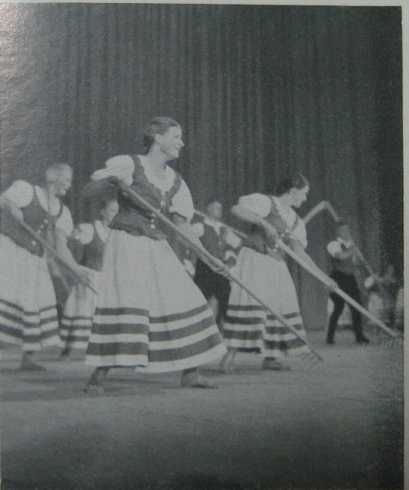

Background: This is a summary of the Fourth Reich Farmers’ Rally, held in Goslar in 1936. It was something of a Nuremberg Rally for farmers. It included professional meetings, but also mass meetings of the kind the Nazis favored. Top leaders including Rudolf Heß and Hermann Göring spoke. There was also a grand theatrical evening. The Nazis were out to transform all of German life — agriculture was not to be an exception. What follows will give an indication of the event.
The source: Der 4. Reichsbauerntag in Goslar vom 22. - 29. November 1936 (Berlin: Reichsnährstand Verlag, 1937).
The Fourth Reich Farmers’ Rally 1936, held in Goslar, has shown that the Reich Farmers’ Rallies are among the major events in National Socialist Germany. The first three Reich Farmers’ Rallies were held as the Reichsnährstand was being built up. The Fourth Reich Farmers’ Rally was held at the after the initial organizational efforts were concluded. By receiving the designation Reich Farmers’ City, the old imperial city of Goslar became the center of agriculture and agricultural self-administration. The Fourth Reich Farmers’ Rally showed that, even in outwardly appearance, the Reich Farmers’ City had established a good tradition, which came to expression in the strong participation of the population in the work of the Reichsnährstand. For the first time, the concept of Reich Farmers’ City Goslar as the center of Nordic-German farming, of the state idea of blood and soil, reached far beyond the Reich borders, drawing the attention of many states and peoples throughout the world. The Fourth Reich Farmers’ Rally was thus not only a German gathering in a narrow sense, but rather its form and spiritual aims were an event of international significance.
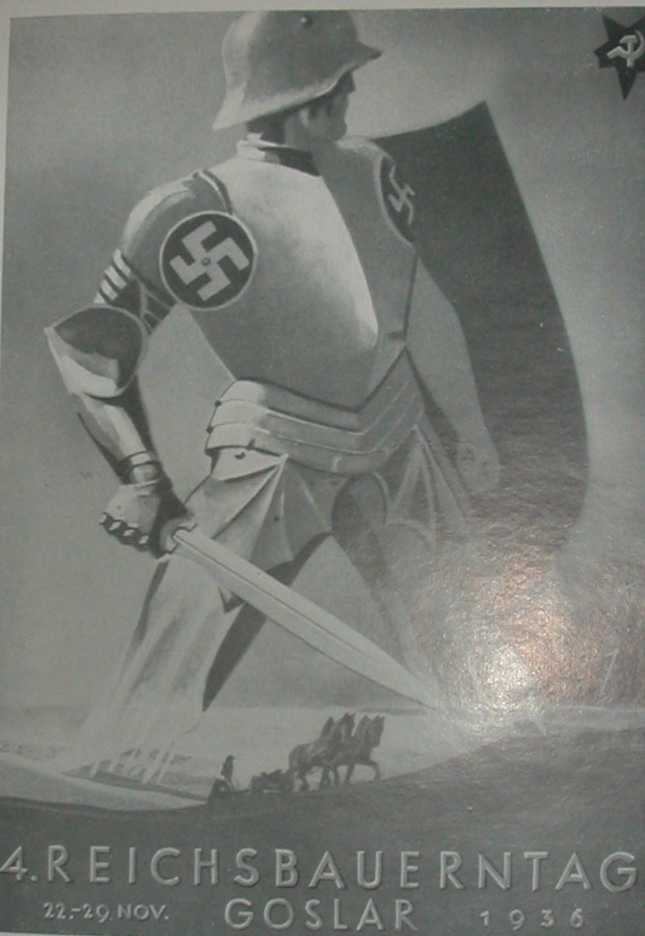 Two primary themes marked the Reich Farmers’ Rally in 1936:
An uncompromising declaration of war against Jewish world Bolshevism and
an indomitable will to self-assertion and national independence within
the framework of the Four Year Plan. Two years earlier, the Reich Farmers’
Leader had called on the whole agricultural community to fight to bring
in the harvest. At the Fourth Reich Farmers’ Rally, the battle for an independent
food supply entered its decisive phase, in accordance with the Four Year
Plan. In his opening remarks at the Goslar City Hall, the Reich Farmers’
Leader gave the assembled leadership corps the inspiring command: Agriculture
to the front.
Two primary themes marked the Reich Farmers’ Rally in 1936:
An uncompromising declaration of war against Jewish world Bolshevism and
an indomitable will to self-assertion and national independence within
the framework of the Four Year Plan. Two years earlier, the Reich Farmers’
Leader had called on the whole agricultural community to fight to bring
in the harvest. At the Fourth Reich Farmers’ Rally, the battle for an independent
food supply entered its decisive phase, in accordance with the Four Year
Plan. In his opening remarks at the Goslar City Hall, the Reich Farmers’
Leader gave the assembled leadership corps the inspiring command: Agriculture
to the front.
Obviously, there was no comparison between this Fourth Reich Farmers’ Rally and the annual gatherings of previous agricultural organizations. This was not a gathering of the lobbyists of an occupational group, presenting their demands to the government. Instead, here were gathered men responsible for agricultural self-administration. They came together to discuss the Reich’s agricultural system and how to guarantee the nation’s food supply, and to discuss the peasantry as the blood source of the nation. Everything that happened in the meetings and events of the Reich Farmers’ Rally followed a plan, proving unity of will and the loyalty of the leadership. Thus, the outward appearance demonstrated the inner determination of the Reichsnährstand, whose accomplishments have proven it to be a critical part of the National Socialist Reich.
The Reich Farmers’ Rally again had two main parts: the professional meetings and the main meetings. The professional meetings were held on 23, 24, and 25 November. They were concerned with internal matters of the various departments and organizations of the Reichsnährstand. The main meetings of 26-29 November had a more public character, as they involved important speeches by leading men of the state, the party, and the Reichsnährstand itself. They provided the spirit and content for farming leaders, and therefore for the entire agricultural community. This Fourth Reich Farmers’ Rally showed that traditions have been established. As was true of past Reich Farmer’ Rallies, Reich Farmers’ Leader Darré officially opened the Fourth Reich Farmers’ Rally on the afternoon of 25 November in city hall. There was a major Wehrmacht concert for the benefit of the Winter Relief, conducted by buglers and the music corps of the Goslar Rifle Battalion, Inf. Reg. 17, along with a choice of 200 members of the battalion. The Goslar City Hall presented a festive appearance, and was filled to the last seat. The Reich Farmers Leader was recovering from a sporting injury. As he entered the Goslar City Hall, supported by a cane, strong applause came from the assembled farming leaders and guests of honor. The speaker of the Reich Farmer’s Rally, Minister President a. D. Granzow, welcomed the Reich Farmers’ Leader. Major Broste welcomed the Reich Farmers’ Leader and the leadership corps of the Reichsnährstand in the name of the Reich Farmers’ City Goslar. Assistant Gauleiter Schmalz, as the representative of Gau Lower Saxony, gave personal greetings to Reich Farmers’ Leader R. Walther Darré, who had not been able to attend the Thanksgiving ceremonies on the Bückeberg.
Reich Farmers’ Leader Darré thanked them for their warm reception, and made the following remarks:
“I was deeply moved by the friendly remarks of Assistant Gauleiter Schmalz. I was unable to attend that gathering. Let me say that I would have done everything possible to attend the Reich Farmers Rally in Goslar, and to once again stand before my farming leaders. We belong together, as farmers who are used to few words. But we are also used to depending on each other. Just as a farmer cannot rest until he is sure that everything is in order with his farm, so it is with me as Reich Farmers’ Leader.
I therefore begin my remarks today by thanking you. I know that many things have been accomplished only because I could depend on two things: First, on the unshakable trust of my leaders, and second, because we have so many hardworking and capable comrades. I build on these two pillars, which are the foundation on which the efforts of today and tomorrow stand.
This brings me to my intended introduction. I wish to begin by reading what I said a year ago in this hall at the conclusion of the rally. A year ago I said:
‘A year ago I laid out our thinking at the Second Reich Farmers’ Rally, calling for a battle of production. Our goals and our statements caused some head-shaking among all those economic experts who stood outside our ranks. People said that our all of our speeches and plans took no heed of well-known laws of economics, and that our efforts were doomed to failure. Such thinking would have been justified if one depended on liberal presuppositions. But why should a National Socialist, sworn to the Führer’s banner and filled with the conviction that the laws of a people are more important than all the material laws of economics, pay heed to them?
We have been successful! Our success was only possible because we behaved in a way exactly opposite of how a liberal economic leader would have behaved in our situation. We had the example of our Führer before us, who had won the freedom of his people, despite the fact that all the politicians of whatever stripe had declared his methods crazy and insane. But the Führer was right. He was right because he believed in his people and in his mission, considering the spiritual strength of his people to be more important than the material laws of economics. One may call such faith ‘optimistic.’ But it is also true that optimists make history and pessimists are condemned to suffer the blows of history.”
Why do I begin with these words? Because I want to show clearly and forthrightly in Goslar have followed a law that has been justified by our success. We go into the battle of production today not was young recruits, rather that we enter the third battle of production as experienced soldiers. In our first year, our new organization might have been overwhelmed by the tasks. The second year of the battle of production was already successful. We may not yet have achieved all of our goals, but step-by-step we have gained the ground that is necessary to secure the agricultural freedom of our people. We thus enter the third battle of production armed with the experience of two previous battles, and are determined to win it because we know that it must be won to enable our Führer to carry out his wishes for the German people.
I am pleased to be able to say something else on the occasion. The Führer has charged Hermann Göring with the leadership of the Second Four Year Plan. Let me remind you of something. In 1918, a famous fighter squadron, which had been reduced to but a few men, had the good fortune to receive Hermann Göring as its commander, and we know what that meant for those men. As Reich Farmers’ Leader, I today, along with I am sure the whole Reichsnährstand am happy to have Hermann Göring as the commander of the Führer’s new Four Year Plan. We know that he will display the same drive, the same directness, and the same assurance with which he once led his squadron, and that he will lead the German economy to victory. I am happy to give this order to the Reichsnährstand: Under the command of Herman Göring, and as part of the Führer’s Second Four Year Plan, there is for us but a single command: Reichsnährstand to the front!
In past years, we have proven our commitment to the people’s community through our deeds and through out work. The German rural population has not made promises to the people’s community that it did not keep, but rather it has proven its commitment to the people’s community through its deeds. It has striven to earn the esteem of those in the cities, of the workers, and I believe that I can say that the Führer himself has recognized our efforts to be a valuable part of the people’s community by the respect he has given to us and our Reich Farmers’ City Goslar, which he has given the official name of Reich Farmers’ City. I am pleased by this recognition, and am happy that the warm relations between the Reichsnährstand and the city of Goslar have been made even stronger through this new bond. The phrase Reich Farmers’ City is today a powerful concept. Every member of the German people is familiar with it. It is also known throughout the world . We have become a unity that can no longer be broken, and I am happy that the Führer gave this recognition to the city from which he has always given his directives to the rural population. I am furthermore happy that the people’s community today is expressed in the fact that there was always been a strong connection between the free farmer and the soldier. The farmer and the people’s army are never to be separated; both are impossible outside the community of their people. Thus it is a wonderful symbol of the New Germany that the Fourth Farmers’ Rally of the Third Reich is opened with a concert of local riflemen for Winter Relief. This concert, and the opening of the full Reich Farmers’ Rally, is for us an expression of the New Germany. One cannot imagine a more beautiful, clearer, or better opening. We are delighted with it, and I express my particular thanks.
Let me note, however, that we are so happy to come together in this hour to speak of this, that we are so full of pride to hear of our alliance with a strong and powerful people in the Far East, only because of our Führer to whom we owe it all: Adolf Hitler! What we are, we are because of him. He gave us the idea of the people’s community, and hammered it into us. He lived out the idea of the people’s community. He also realized the people’s community, and through this people’s community made us again a free people in the world. I thus call upon all those present to open the Fourth Reich Farmers’ Rally be together saying: Our beloved Führer Adolf Hitler Sieg Heil!”
The speaker of the Reich Farmers’ Rally then read a telegram that the Reich Farmers Leader had sent to the Führer and Reich Chancellor:
“The leadership corps of the Reichsnährstand had gathered in the Reich Farmers’ City of Goslar for the Fourth Reich Farmers’ Rally. It will give account to the German people of the second year of the agricultural battle of production, and lay out guidelines for increased contributions by farmers to the Four Year Plan.
My Führer, the German rural population stands behind in order behind its farming leaders, your old loyal comrades, ready to carry out any command you give.
We greet you, my Führer, with faithful trust in you and your great work.
Signed: R. Walter Darré, Reich Farmers’ Leader”
The Führer sent the following telegram in response:
I express my genuine thanks for the loyalty and support that you have given me in the name of German farming leaders gathered at the Fourth Reich Farmers’ Rally. I greet the entire German rural population, whose knowledge and abilities are being used to the utmost in the battle of the goal of German agricultural freedom. For centuries, German farmers have guided the plow in times of peace, and taken up the sword in times of need and danger to defend German blood, to protect German soil. Party Comrade Darré, I am confident that under your leadership the German rural population will overcome the hardest challenges.
Yours, Adolf Hitler”
After the opening festivities of the Fourth Reich Farmers’ Rally, all of Goslar reflected this major and impressive event. It could not be compared to a mass meeting, but rather its outward and inward form and style were that of an agricultural leadership meeting in the best sense of the word. As always, the buildings on every street of the Reich Farmers’ City Goslar were decked with banners and the green branches of Harz firs. The importance of the Fourth Reich Farmers Rally was clear from the numerous guests of honor, above all close associates of the Führer, who participated in the events over the course of the Reich Farmers’ Rally. Rudolf Heß, Deputy Führer, and Minister President General Göring spoke personally at the Reich Farmers’Rally. Also present were Reichsleiters Bormann, Rosenberg, Buch, Grimm, Reichsleiter and Reich Labor Leader Hierl, and the Gauleiters Kaufmann, Meyer of Westfalen-Süd, Simon, Wagner of Breslau, and Wagner of Munich, the head of the S.A. Lutze, Assistant Gauleiter Schmalz, a number of SS Gruppenführer under the leadership of SS Obergruppenführer Heißmeyer, Lieutenant General Reitel and Lieutenant General Fischer, Minister President Klagges and State Secretary Körner. One thousand agricultural laborers were also invited to the Reich Farmers’ Rally along with the conference participants. There were also large farming delegations from abroad, including representatives from Argentina, Belgium, Bulgaria, Denmark, Danzig, England, Estonia, France, Holland, Iceland, Italy, Japan, Yugoslavia, Lithuania, Norway, Austria, Poland, South Africa, Sweden, Switzerland, Czechoslovakia, and Hungary. The representatives from Austria and Japan received particular applause as they were introduced. They all followed the speeches and events at the Reich Farmers’ Rally with extraordinary interest.
There were no sessions on Friday, 27 November. Instead, there were receptions and sight-seeing excursions in the area of the Reich Farmers’ City. The Reich Farmers’ Leader also took the opportunity to receive about 150 guests of honor from abroad. The Reich Farmers’ Leader said the following to foreign guests, which received considerable interest from the world press:
“It is my pleasure once again to greet the representatives of foreign farmers here in Goslar, who have appeared in large numbers. There presence is proof to me that they are greatly interested in National Socialist agricultural policy and in the work of the Reichsnährstand. More than that, I believe that it shows great understanding for our work. Conditions are different in each country, of course, such that one can never say that what is necessary and right for one country can simply be transferred to another country. However, the fundamental principle that “the peasantry is the life source of the people and must therefore be maintained and strengthened” applies to all countries. Woe to the country that wants to transform its peasantry into a mass of industrial agricultural laborers, as Bolshevism is doing with the most horrible methods! Bolshevism drives the farmer from his farm. It forces the farmer to labor in large operations and to waste his life in the city. Bolshevism destroys the farming family and thereby stops up the life source of the people. Bolshevism ruins a once flourishing agriculture. Despair and ruin fill its villages and fields. Its rich lands that once provided bounteous harvests no longer feed its own population. Bolshevism has transformed its land into a desert. Wherever one destroys the peasantry, the inevitable result is the ruination of the land, the stopping up of the life source of a people, and, therefore, the decline of the entire nation.
No healthy people and no honest statesman wants that! From the perspective of the nation, the destruction of the peasantry means the destruction of a critical element that supports the state. From the international perspective, it means the destruction of that element that most strongly supports peace. The farmer has no desire for conquest. He does not want to go beyond the boundaries of his fields. He demands that the state protect the land that his holy to him, and is therefore the friend of the soldier who protects him, Farmer and soldier go together. The people that protects its peasantry serves the cause of peace.
It is also untrue that the farmer wants to close his country off from foreign countries so that he can sell his products for as much as he can. In the past, of course, when the German farmer was robbed through speculation of the just reward for his labor, one can understand that he blamed his desperate situation on foreign imports. By that he meant, mostly without realizing it, the artificial prices resulting from international speculation. He forgot that those prices were as hard on foreign farmers as they were on him. One farmer will always understand another farmer, because they share a holy love for Mother Earth, but a farmer will never understand a speculator. These two can never understand each other, for they are by nature enemies: speculative commerce over against loyal administration of the farm for the good of the people. As long as the German farmer was the victim of international speculation, he distrusted and opposed imports.
Former German governments tried to help by restricting or banning imports, if they had any sympathy at all for agriculture. Other countries behaved in a similar manner. The result was here and there a collapse of agricultural markets, and as a result lower demand for industrial products from agricultural lands. The world fell into a general crisis.
National Socialist agricultural policy recognized this situation from the beginning. It saw that it was the result of false conclusions. Imports as such are not the danger, but rather the accompanying unscrupulous speculation that exploits the farmer through both imports and exports. Thus, we first made the German peasantry healthy once more, and free from all types of speculation. The law on hereditary farms, the law on the Reichsnährstand, market reform, and a sound policy of reserves are the milestones of our policy. The continuing improvement of the German peasantry gave us the opportunity to allow increased imports of agricultural products. Our goal is not to make us totally self-sufficient in every regard, but rather to meet basic needs and guarantee our people’s food supply under any circumstances. We know that this cannot be achieved overnight. We also know that to fully meet our needs, imports of some foodstuffs will remain necessary, all the more so as the great army of the unemployed is again incorporated into the labor system. We are therefore prepared to allow increased imports of agricultural products, and have proved that in recent years. However, two conditions must be met:
- We must be able to pay for increased imports through increased exports
- Farmers on both sides of the border must come to an understanding of where, when, and with what products German markets are to be supplied.
The commercial treaties Germany has signed point significantly in this direction. However, I believe that this must be carried even further if the goal of growing and lasting cooperation between farmers on both sides of the border is to be realized. In this sense, I give you my warmest greetings once again, and hope that everything you see and hear in Goslar will persuade you of our earnest and genuine desire for cooperation.”
The leader of the large Italian delegation, President Amenise of the Fascist agricultural provincial federation of Rome, passed on a letter from the president of the association to the Reich Farmers’ Leader, which expressed the warm good wishes of the Italian peasantry. The letter said:
“The honor of the earth, defended by Fascism in Italy and National Socialism in Germany, binds together the peoples of the two great nations that are defending culture from the subversion and attacks of anarchy.” Senator Fudakowski from Poland expressed the thanks of the foreign delegations, and concluded that foreigners could follow the wonderful work from year to year, and expressed their hope that Germany would prosper and that its agriculture would thrive. President von Meesée of the Hungarian Chamber of Agriculture said: “I would like to assure the Reich Farmers’ Leader that the hearts of all the guests here present are marching together.”
A large number of telegrams also arrived, including ones from the leader of the German Labor Front, Reichsleiter Dr. Ley, and General Daluege. The Reich Minister for People’s Enlightenment and Propaganda Dr. Goebbels send the following telegram:
“Dear Party Comrade Darré! I send my warmest greetings to you and to the leadership of the Reichsnährstand assembled in Goslar. In the coming year, Germany’s peasantry will once again have critical tasks to fulfill within the Four Year Plan. The German farmer will prove that he is one of the contributors to National Socialist construction. I wish you and German peasantry strength, courage, and determination.
Yours with Heil Hitler, Dr. Goebbels”
That same evening, the German Reich Farmers’ Council met in the old imperial palace. The great hall of the imperial palace was decorated in a dignified manner, which contributed to the elevated atmosphere of this ceremony. Business leader Richard Arauner, who died in an accident while on a business trip, and who was one of the Reich Farmers’ Leader’s closest colleagues, and his friend, was remembered. The Reich Farmers’ Leader administered the oath to those who had joined since the previous Reich Farmers’ Rally. First, the gathering sang: “If all become untrue, we remain true.” Then the oath was solemnly repeated:
“We swear to you, Adolf Hitler, loyalty and courage. We promise you, and the representatives that you have appointed, obedience unto death, so help us God.”
The national anthem and the Horst Wessel Song concluded the dignified ceremony. Afterward, the Reich Farmer’s Leader and the members of the Reich Farmers’ Council attended a reception by Mayor Droste of the Reich Farmers’ City, where both the Reich Farmers’ Leader and the major made remarks.
Numerous representatives of the domestic and foreign press had the opportunity to tour the Goslar vicinity, including Gandersheim, the Hunting Lodge on the Hainberg, and the romantic Hubertus Chapel. In the evening, there was a reception for the domestic and foreign press. After Reichshauptabteilungsleiter Roland Schulze greeted them, the Reichsobmann of the Reichsnährstand, farmer Wilhelm Meinberg spoke about the camaraderie that exists in Germany today between farmer and worker, city and countryside. Two foreign journalists expressed thanks for their warm reception, and for the opportunity to learn more about the National Socialist peasantry.
As the second day of meetings began on Saturday, 28 November, the speaker of the Reich Farmers’ Rally read the following remarks from foreign farming leaders in attendance:
“Honored Reich Farmers’ Leader! The undersigned representatives of farming and agricultural organizations was to express our warmest thanks for the fine and educational days that we have had here in Goslar. In these days when the battle between good and evil, between construction and destruction, is intensifying, it is particularly important for Europe’s farmers to proclaim clearly and forthrightly the ideals of farming: of honor, of fatherland, of family, of belief in God, of the face of one’s own people. The venerable and ancient city of Goslar offers a proper place to do that, and we thank you once again for making that possible for us to do. Be assured of our thanks and continued camaraderie.”
The day concluded with “An Evening of the German Peasantry” in city hall.
As at past Reich Farmers’ Rallies, there was again “An Evening of German Peasantry.” However, while past gatherings of this sort had focused on presentations of old customs and farming dances, this year there was a new approach to farming ceremonies. For the first time, the attempt was to express farming cultural matters in a way appropriate for today. In his speech, the Reich Farmers’ Leader (see his speech on p. 219) said that this new ceremony at the Reich Farmers’ Rally was an experiment. It was to provide a starting point for future development, not a fixed model for the future.
The evening was a complete success. This was clear not only from the applause, but above all from the critical response in the German press.
A newspaper in the Reich capital wrote:
“One could not miss the fact that this rally did more than give a new face to the agricultural market system. The cultural life of Germany’s peasantry also displayed progress that will be important for our entire cultural life. Never before has there been so clear a turning from mere peasant traditionalism, from the “knitting room romance.” Never before was the nature of the new farmer so clearly displayed, going beyond peasant costumes and outdated conservatism. The young peasantry displayed gymnastic ability that freed them from the former farmer’s stiffness. The boys and girls from the countryside affirmed their bodies. There was more than old customs and colorful historical costumes. In the second part of the “Evening of German Peasantry,” 400 young farming boys and girls from the entire Reich, mostly blond Nordic types, preformed sports, rhythmic movement, and dance. They displayed something entirely new — for villages — something that, to put it bluntly, one “did not think farmers could do.” Given what we have seen in Goslar, the field festivals and evening games, after the influence of Bode, the head of the agricultural college for physical fitness spreads, will have an unforgettable impact on the youth and young adults in the villages. There can be no other result... In Goslar it seemed a bit “schoolmasterish” and “artificial,” but in the atmosphere of the countryside, it will awaken the melodies of the countryside, as well as the youth, which is necessary if things are to advance beyond the narrowness of the rural environment. The market order is demanding increased ties, and the peasantry is demanding more physical and spiritual freedom. Both are equally as important. Both have to be understood. The new economic ties will not stand in the way of the growing freedom and pleasure of the individual farmer. It will not do to give lip service to free personal development consistent with the farmer’s nature. Something has to be done. The rhythm of life and the march of life go together — the resulting tensions, we hope, are fruitful. To follow their struggles would be an educational experience. Even the ‘educated,’ after all, ultimately spring from rural roots.”
The “Evening of the German Peasantry” had two parts. The first part was a kind of theatre, which used every available method of the art to illuminate the peasantry before 1933. It was directed by Alfred Mühr, the artistic director of the Berlin State Theatre, and had three acts: The financial conspiracy — the legal challenge — the attack on the German peasantry. Alfred Mühr succeeded in a brilliant way in presenting something entirely new and unique in terms of action and direction, despite the simple stage of the Goslar city hall. The set builders as well as performance were designed to suggest woodcut images, and succeeded completely. The individual character types presented by professional actors, without exception, corresponded exactly to the period.
The action of the first act made clear immediately how farmers, in the period before the National Socialist seizure of power, suffered from the dirty business of politicians, Jewish finance capital, and certain “rural circles,” in political, spiritual, and economic ways. The second act showed how Jewish attorneys, in the service of these gravediggers of German peasantry, used government power to rob farmers of their political, legal, and economic rights. The third act portrayed the suffering of the farmers themselves. A pub scene showed conditions in the countryside. We see the desperation of farmers searching for something new, something to free them, as well as the appearance of false prophets in the form of liberal agricultural theorists. This was no theatrical play in the usual sense, but rather a political confrontation in direct form. It was a battle of ideas, of unmasking old ideas and establishing a new political idea. It showed the German farmer at his worst state, but already marching down the path under a new banner.
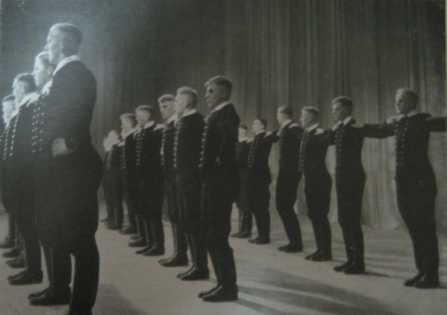 The second part of the evening was of an entirely different
nature, and took a quite different direction from the first part. It consisted
of exercises from the Reich School for Physical Fitness of the Reichsnährstand.
It was an example of what the Reich Farmers Leader said at the beginning
of the evening: an attempt to establish new rural customs. It began with
free gymnastics, then gymnastics with equipment (poles, medicine balls).
This was followed by applied gymnastics (Bode exercises). The exercises
demonstrated that only systematic physical exercises can relieve the bodily
strain resulting from repetitive agricultural labor. The audience was
most impressed, however, by the dances, for they were of an entirely new
type. These dances rejected everything artificial, working only with the
most simple movements. But it was just those movements that allowed the
dances to express the peasantry’s life and strength. There were male dances,
dances with agricultural implements, and a dance of male and female youth.
The Hanover State Orchestra provided the music. There was regular enthusiastic
applause for the performances.
The second part of the evening was of an entirely different
nature, and took a quite different direction from the first part. It consisted
of exercises from the Reich School for Physical Fitness of the Reichsnährstand.
It was an example of what the Reich Farmers Leader said at the beginning
of the evening: an attempt to establish new rural customs. It began with
free gymnastics, then gymnastics with equipment (poles, medicine balls).
This was followed by applied gymnastics (Bode exercises). The exercises
demonstrated that only systematic physical exercises can relieve the bodily
strain resulting from repetitive agricultural labor. The audience was
most impressed, however, by the dances, for they were of an entirely new
type. These dances rejected everything artificial, working only with the
most simple movements. But it was just those movements that allowed the
dances to express the peasantry’s life and strength. There were male dances,
dances with agricultural implements, and a dance of male and female youth.
The Hanover State Orchestra provided the music. There was regular enthusiastic
applause for the performances.
The conference reached its highpoint on its concluding Sunday, 29 November. Reich Minister Rudolf Hess, the Deputy Führer, was the first to speak. His speech appears later in this volume. Then, Reichsobmann and farmer Wilhelm Meinberg and the Reich Farmers’ Leader spoke. Minister President General Hermann Göring received enthusiastic applause even before he began to speak. As the Führer’s Plenipotentiary for the Second Four Year Plan, he expressed to farming leaders his best wishes for their common efforts. The Reich Farmers’ Leader thanked everyone in conclusion. The gathering concluded by singing the national anthem and the “Horst Wessel Song.” There was probably no one among the many farming leaders who did not leave with a thankful heart filled with new courage and hope to face the coming year, and with the firm will to work for the building of Germany
[The rest of the book has over 400 pages of speeches and reports, and sixteen pages of photographs.]
[Page copyright © 2007 by Randall Bytwerk. No unauthorized reproduction. My e-mail address is available on the FAQ page.]
Go to the 1933-1945 Page.
Go to the German Propaganda Home Page.